Quick answer:
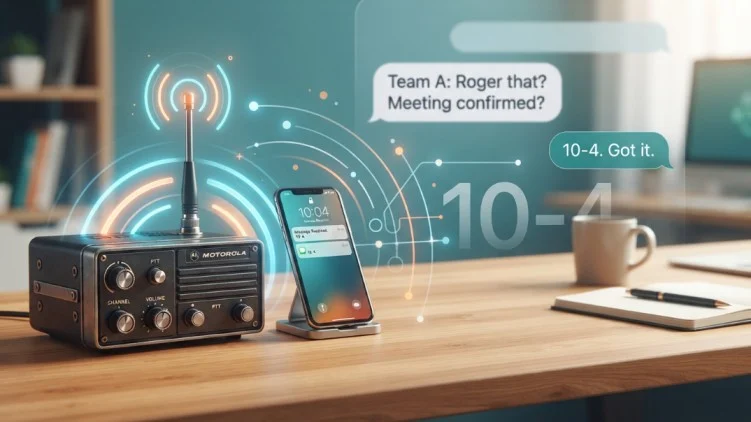
10-4 means “message received,” “understood,” or “okay.” It comes from radio communication and is now also used casually in texts and online chats.
Example: “Meet me at 7.” “10-4!” means “Got it!”
A short message can sometimes say more than a full sentence. 10-4 meaning is a great example. You may see “10-4” in a text, social media comment, gaming chat, movie, or conversation and wonder why someone is using numbers to say “okay.”
If you are a student, writer, gamer, texter, social media user, or someone learning modern English, knowing this expression can make conversations much easier to understand. It is short, friendly, and often has a cool radio-style feel.
The phrase originally became popular through radio communication, especially among workers who needed quick and clear messages. Today, people often use it in a playful or casual way. You might receive “10-4” after giving someone instructions, sharing a plan, or asking them to remember something. Understanding the context helps you know exactly what the speaker means.
Definition & Meaning
The basic 10-4 meaning is “message received,” “understood,” “okay,” or “I understand.”
It is an expression of acknowledgment. When someone says 10-4, they are usually telling you that they heard or understood what you said.
Simple definition
10-4 = I got your message and understand it.
For example:
Alex: “Please bring the documents tomorrow.”
Sam: “10-4.”
Alex: “Thanks.”
Here, Sam is not giving a long answer. They are simply saying, “Got it.”
What does the “10” mean?
The number 10 comes from a group of radio communication codes known as ten-codes or 10-codes.
The number 4 identifies a specific message in that code system.
So, 10-4 became associated with acknowledgment and understanding.
Over time, the expression moved beyond professional radio communication. People began hearing it in movies, television shows, trucker conversations, police scenes, and other forms of popular culture.
10-4 does not always mean “yes”
This is an important difference.
If someone asks:
“Do you want pizza?”
Saying “10-4” would usually sound unusual.
But if someone says:
“I’ll pick you up at 8.”
Then:
“10-4!”
sounds natural in a playful or informal setting.
The expression is closer to “understood” or “message received” than simply “yes.”
Everyday examples
Friend: “Remember to lock the door.”
You: “10-4.”
Boss: “Send me the file before lunch.”
Worker: “10-4.”
Gamer: “Meet at the east gate.”
Player: “10-4!”
The meaning stays almost the same in each example: I understand what you said.
Background & History
The history of 10-4 is connected to the development of radio communication in the United States. During the early growth of two-way radio, workers needed a quick way to communicate important information.
Long spoken messages were not always practical. Radio signals could be unclear, communication time could be limited, and different users needed short expressions that could be understood quickly.
This led to the development and use of ten-codes, often called ten signals.
The codes became especially familiar in areas such as:
- Police communication
- Emergency services
- Trucking
- Dispatch work
- CB radio
- Public safety communication
- Other radio-based jobs
Why use numbers?
Radio communication can sometimes be noisy or difficult to hear. Short standardized expressions helped reduce the need for long explanations.
Instead of saying:
“Yes, I received your message and understand what you are asking me to do.”
A person could say:
“10-4.”
That was much faster.
How 10-4 became popular
The phrase gained widespread public recognition through CB radio culture and American popular entertainment.
Truck drivers and radio users helped make the expression familiar to the general public. Movies, television programs, songs, and comedy also helped spread radio-style language.
As more people heard characters saying “10-4,” the phrase became recognizable even to people who had never used a radio.
From radio to everyday speech
The expression eventually moved from professional communication into casual language.
People began using it outside radio settings as a humorous way to say:
- Got it.
- Okay.
- Understood.
- Sounds good.
- I hear you.
- Message received.
Today, 10-4 is much less likely to be a serious communication code in an ordinary conversation. Instead, it often carries a playful, old-school, or radio-inspired tone.
Usage in Various Contexts
The meaning of 10-4 stays fairly consistent, but its tone can change depending on the situation.
10-4 in texting
In texting, 10-4 usually means:
“Okay, I understand.”
For example:
Maya: “I’ll call you after work.”
Liam: “10-4 👍”
Here, Liam simply acknowledges the plan.
Another example:
Maya: “Can you bring my charger?”
Liam: “10-4.”
It means:
“Sure, I got it.”
10-4 on social media
People sometimes use 10-4 in comments or direct messages when they want to sound playful.
User 1: “New post goes live at noon.”
User 2: “10-4!”
It can make a simple acknowledgment sound more energetic or humorous.
10-4 in gaming
Gamers may use 10-4 when responding to instructions.
Leader: “Everyone move to the left side.”
Player: “10-4.”
The player means:
“Understood. I’ll do that.”
It can be especially fitting in games involving military, police, truck driving, survival, or tactical themes.
10-4 in casual conversations
Friends may use it as a fun alternative to “okay.”
Friend 1: “Pick me up at 6.”
Friend 2: “10-4, captain.”
The addition of “captain” makes the exchange humorous.
10-4 in work conversations
It can be understood at work, but the tone may be informal.
Manager: “Please send the report by 4.”
Employee: “10-4.”
The meaning is clear, but “Understood” or “Sure” may sound more natural in a formal workplace.
Common Misconceptions & Clarifications
Because 10-4 is an old expression, people sometimes misunderstand its meaning.
Misconception 1: 10-4 means only “yes”
Not exactly.
The phrase primarily communicates acknowledgment or understanding.
For example:
“The meeting starts at 9.”
“10-4” means:
“I understand.”
It does not necessarily mean:
“I agree with everything.”
Misconception 2: 10-4 is always a serious radio code
No.
It has a historical connection to radio communication, but modern speakers often use it casually.
A friend might text:
“10-4 😂”
simply because the phrase sounds funny or old-fashioned.
Misconception 3: Everyone uses 10-4 today
No.
Some people use it often. Others rarely use it.
Its popularity depends on age, culture, media exposure, profession, and personal style.
You may hear it more often in American media or conversations influenced by American radio culture.
Misconception 4: 10-4 means “goodbye”
Usually, no.
It means acknowledgment.
If someone wants to end a radio-style conversation, they may use a different phrase.
For example:
“10-4. Talk later.”
Here, “10-4” means the person understood the message, while “talk later” ends the conversation.
Misconception 5: The hyphen changes the meaning
You may see:
- 10-4
- 10 4
- ten-four
- ten four
The standard written form is generally 10-4, but informal texting can vary.
Similar Terms & Alternatives
Many expressions can replace 10-4, depending on the situation.
| Term | Meaning | Tone |
|---|---|---|
| 10-4 | Message received / understood | Casual, radio-style |
| Got it | I understand | Casual |
| Understood | I understand | Professional |
| Okay | Acknowledgment or agreement | Neutral |
| Copy | I received your message | Radio-style |
| Roger | Message received / understood | Radio-style |
| Sounds good | I agree with the plan | Friendly |
| Noted | I have recorded or understood it | Professional |
| Sure | Yes / okay | Casual |
| Affirmative | Yes | Formal or radio-style |
10-4 vs. “got it”
These are very close in casual conversation.
Person A: “Bring your ID tomorrow.”
Person B: “Got it.”
You could also say:
“10-4.”
The difference is mainly tone.
“Got it” sounds normal and modern.
“10-4” sounds more playful, old-school, or radio-inspired.
10-4 vs. “roger”
These expressions are also related.
“Roger” has a long history in radio communication and generally means that a message was received.
“10-4” also communicates acknowledgment or understanding.
In everyday texting, however, both can sound intentionally radio-like.
How to Respond to This Term
If someone sends you 10-4, you usually do not need a complicated response.
The best reply depends on the conversation.
Casual response
Friend: “Meet me outside at 7.”
You: “Got it!”
You can also reply:
“Sounds good!”
Funny response
If someone uses 10-4 dramatically, you can play along.
Friend: “Mission starts at 8.”
You: “10-4, commander!”
Or:
“Roger that!”
This keeps the radio theme going.
Professional response
If someone says 10-4 at work, a simple response is enough.
Coworker: “Please update the spreadsheet.”
You: “Understood. I’ll take care of it.”
You do not need to copy the slang if your workplace communication is formal.
If you want clarification
Sometimes 10-4 may not tell you exactly what the other person intends to do.
You can ask:
“Just to confirm, will you send it today?”
This is useful when an important task is involved.
Privacy-conscious response
If the conversation involves private information, do not assume “10-4” means you should share more information.
For example:
Person: “Send me your private login details. 10-4?”
You: “I’m not comfortable sharing login information.”
Understanding a phrase does not mean you have to follow every instruction.
Regional or Cultural Differences
The expression 10-4 is strongly associated with American English and American radio culture.
It is widely recognizable in many English-speaking places because American films, television, music, and internet culture have spread the phrase internationally.
However, people in different regions may prefer different expressions.
United States
10-4 is well known and can sound natural in casual speech, especially when someone wants a radio-style tone.
Canada
Canadian speakers may understand the expression because of shared North American media and communication culture. Still, everyday alternatives such as “okay” and “got it” are more common.
United Kingdom
British English speakers generally understand 10-4, but it may sound more like an American expression or something borrowed from movies and popular culture.
For workplace communication, British speakers may prefer:
- Understood
- Okay
- Noted
- Got it
Australia and other regions
The phrase may also be recognized, but frequency varies. Many people know it without using it regularly.
Across languages
Other languages have their own ways of saying:
- understood
- okay
- received
- got it
- message received
So, 10-4 is not a universal expression. It is best understood as an English-language radio expression with strong American cultural roots.
Comparison with Similar Terms
Several radio-style expressions can look similar to 10-4.
| Expression | Basic meaning | Main difference |
|---|---|---|
| 10-4 | Understood / message received | Numeric radio code |
| Roger | Message received | Traditional radio phrase |
| Copy | I received your message | Focuses on receiving information |
| Affirmative | Yes | Direct confirmation |
| Negative | No | Direct rejection |
| Over | I have finished speaking | Signals the other person may respond |
| Out | Conversation finished | Indicates the exchange is ending |
| Got it | I understand | Normal everyday English |
| Understood | I understand | More professional |
10-4 vs. “copy”
These are close, but they can have slightly different emphasis.
10-4 often means:
“Understood.”
Copy often means:
“I received what you said.”
In casual conversation, people may use them almost interchangeably.
10-4 vs. “affirmative”
“Affirmative” is closer to yes.
“10-4” is closer to I received and understood your message.
Consider this:
Question: “Are you coming?”
“Affirmative” makes sense.
“10-4” could sound unusual unless the conversation has a radio theme.
But:
“Meet at the north entrance.”
“10-4” fits naturally in a radio-style exchange.
Usage in Online Communities & Dating Apps
Today, 10-4 can appear in online communities, social media conversations, gaming chats, and dating messages.
On platforms such as Tinder, it may appear when someone wants to give a playful response.
For example:
Match: “I’ll text you when I get home.”
You: “10-4 😊”
This can sound light and humorous.
However, it may also make you sound older or intentionally old-fashioned, depending on your audience.
On social media
Users may write:
“10-4, boss.”
This usually does not mean the person is actually communicating through a radio.
It is simply playful slang.
In gaming communities
10-4 can fit naturally into tactical or team-based games.
Team leader: “Hold your position.”
Player: “10-4.”
The phrase makes the conversation feel more like a dispatch or military communication scene.
Dating app tips
If someone uses 10-4 with you, you can match their tone.
If they write:
“10-4, see you Friday.”
You could respond:
“Roger that 😄”
Or keep it simple:
“Sounds good!”
If you do not know what they mean, you can simply ask:
“Does 10-4 mean you got it?”
There is no need to pretend you understand slang you have never seen before.
Hidden or Offensive Meanings
There is no widely recognized offensive or sexual hidden meaning attached to 10-4 in standard English.
Its normal meaning is related to:
- acknowledgment
- understanding
- confirmation
- radio communication
Still, context can affect how the phrase feels.
Can 10-4 sound rude?
It can, depending on tone.
For example:
“10-4.”
as a very short reply may feel cold if the other person expected a warmer response.
Compare:
“10-4!”
This feels more energetic.
Or:
“Got it, thanks!”
This feels friendlier.
Can it be sarcastic?
Yes.
Someone might say:
“10-4, genius.”
That is not a special meaning of 10-4. The sarcasm comes from the surrounding words and tone.
Can it be insulting?
The expression itself is not normally insulting.
But people can use almost any neutral phrase sarcastically.
The best way to understand the intended meaning is to consider the conversation, relationship, punctuation, emojis, and tone.
Suitability for Professional Communication
You can use 10-4 in professional communication, but it is usually better suited to informal workplaces or casual team conversations.
For a formal email, business report, academic message, or official communication, choose a clearer expression.
Instead of:
“10-4, I’ll send the document.”
Use:
“Understood. I’ll send the document.”
Or:
“Certainly. I’ll send the document today.”
Better professional alternatives
Use:
- Understood
- Noted
- Confirmed
- I understand
- Certainly
- Acknowledged
- I’ll take care of it
- Thanks, I’ve received this
Example
Casual:
“10-4, I’ll handle it.”
Professional:
“Understood. I’ll handle it and provide an update once it is complete.”
The second version sounds more appropriate for formal communication.
When 10-4 can work professionally
It may be fine in a workplace where the team already uses informal language.
For example:
Team member: “The delivery arrives at 3.”
Coworker: “10-4.”
In a relaxed environment, nobody may find this unusual.
The important thing is to match the communication style of your workplace.
FAQs
1. What does 10-4 mean?
10-4 means “message received,” “understood,” or “okay.” It is traditionally associated with radio communication.
2. Is 10-4 slang?
Yes. It is a radio-style expression that has also become informal slang in everyday English.
3. Does 10-4 mean yes?
Not exactly. It usually means “I understand” or “I received your message.” It can sometimes function like “okay” in casual conversation.
4. Why do people say 10-4?
The phrase comes from ten-codes used in radio communication. It allowed people to acknowledge messages quickly.
5. Can I use 10-4 in texting?
Yes. You can use it in casual texts when you want to say “got it” or “understood.”
6. Is 10-4 appropriate in a professional email?
It can be understood, but it may sound too informal. “Understood,” “Noted,” or “Confirmed” are usually better choices.
7. What is another way to say 10-4?
You can say “Got it,” “Understood,” “Okay,” “Copy,” “Sounds good,” or “Roger that,” depending on the context.
Conclusion
The 10-4 meaning is simple: “I received your message and understand it.” The phrase began in radio communication and became widely known through American radio culture, entertainment, and popular media.
Today, you can find 10-4 in texts, social media, gaming chats, casual conversations, and even some workplace discussions. It often adds a playful, old-school, or radio-inspired tone. However, it is not exactly the same as “yes.” Its main purpose is to acknowledge or confirm that a message has been received and understood.
Remember the key idea: 10-4 = got it, understood, message received.
For formal emails and professional writing, phrases such as “Understood,” “Noted,” and “Confirmed” are usually better. In casual chats, however, 10-4 can be a fun and recognizable way to respond. Context and tone always matter.
Read More Related Articles:
Cougar Meaning | Definition, Slang, Dating Context, Examples …
What Does “Curated” Mean in Simple English in 2026
What Does “Mhm” Mean in Texting and Chat in 2026