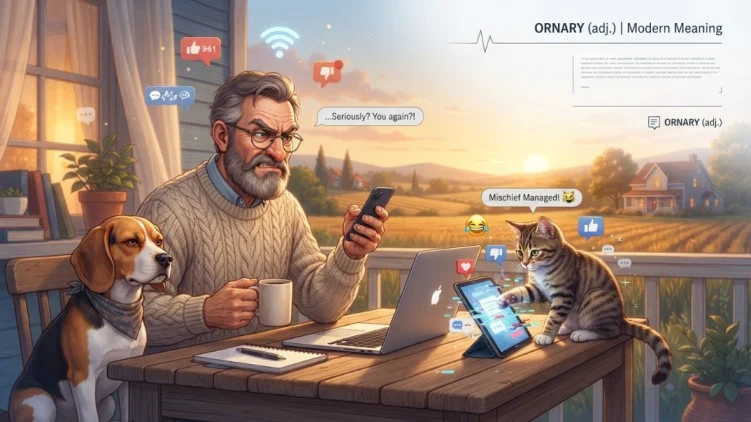
Quick answer:
Ornery usually means bad-tempered, stubborn, difficult, or easily annoyed.
It can also describe someone who behaves in a troublesome or mischievous way.
Some English words sound funny even before you know what they mean. Ornery is one of them. You may see this word in a book, hear it in a family conversation, or come across it in a social media comment. At first, it can seem confusing because its meaning depends a little on tone and context.
If you are a student, writer, teacher, social media user, gamer, professional, or everyday texter, learning the ornery meaning can help you understand people more clearly. The word often describes someone who is hard to deal with, stubborn, grumpy, or in a bad mood.
It is also an interesting word because it can sound insulting in one situation but playful in another. Understanding the context helps you know what the speaker really means. Let’s explore its meaning, history, examples, common uses, and the best ways to respond.
Definition & Meaning
The word ornery is an adjective used to describe a person, animal, or sometimes behavior that is difficult, stubborn, bad-tempered, or troublesome.
In simple English:
Ornery = difficult, grumpy, stubborn, or unpleasant to deal with.
For example:
Mom: “Why is Grandpa so quiet today?”
Dad: “He is feeling a little ornery this morning.”
Here, ornery suggests that Grandpa is in a bad mood or acting difficult.
Ornery can have different shades
The word does not always mean someone is seriously angry. It can describe mild irritation, stubbornness, or playful troublemaking.
For example:
“That old dog gets ornery when someone touches his food.”
The dog may growl or become difficult to control.
Another example is:
“My little brother was being ornery all afternoon.”
This could mean the child was being annoying, stubborn, or mischievous.
Ornery meaning in a sentence
Here are some simple examples:
- “The ornery customer refused to listen.”
- “My horse can be ornery sometimes.”
- “He was in an ornery mood today.”
- “That ornery child kept hiding my shoes.”
- “The old man had an ornery sense of humor.”
The exact meaning depends on context.
Is ornery always negative?
Not always.
Someone might call a friend ornery in a joking or affectionate way.
Friend A: “You changed my phone wallpaper again!”
Friend B: “What can I say? I’m feeling ornery today.”
Here, the speaker is probably being playful rather than truly unpleasant.
Background & History
The history of ornery is closely connected to American English. The word is generally understood as a pronunciation and spelling variation of ordinary.
Over time, ordinary developed a regional pronunciation that sounded different. In American speech, especially in some Southern and rural communities, this form eventually became written as ornery.
The meaning also changed.
While ordinary originally meant something common or usual, ornery developed a different sense. It came to describe someone who was mean-spirited, stubborn, troublesome, or difficult.
American English roots
The word became strongly associated with informal American speech. It is especially familiar in Southern and rural American culture.
You may hear phrases such as:
“That old mule is ornery.”
This means the mule is stubborn or difficult to control.
People also use the word for humans:
“He has always been a little ornery.”
This might suggest that the person is stubborn, cranky, or enjoys causing minor trouble.
How the meaning evolved
The word gradually gained several related meanings, including:
- bad-tempered
- stubborn
- difficult
- cantankerous
- mischievous
- troublesome
Its informal nature has remained important.
Today, ornery is still used in American English, especially in casual speech, literature, storytelling, humor, and descriptions of colorful personalities.
It is less common in formal business writing. In professional settings, clearer words such as difficult, uncooperative, or irritable are usually better choices.
Usage in Various Contexts
The word ornery can appear in many everyday situations.
In texting
People may use ornery jokingly when someone is being difficult or playful.
Alex: “Why did you delete my playlist?”
Sam: “Because I felt ornery 😂.”
The word makes the message sound playful.
On social media
Someone might describe a person’s behavior as ornery in a humorous post.
“My cat woke me up at 5 a.m. and then stole my pillow. Such an ornery little creature.”
Here, the speaker probably loves the cat despite its behavior.
In gaming
Gamers can use the word to describe a difficult opponent or teammate.
Player A: “Why is that boss so hard?”
Player B: “Because it’s an ornery little monster!”
In this case, ornery adds humor rather than serious criticism.
In casual conversations
The word often appears when talking about someone’s mood.
Sarah: “You seem quiet today.”
Mike: “I’m just a little ornery. Give me some coffee.”
This means Mike is feeling grumpy or difficult.
For animals
One of the most natural uses is describing stubborn animals.
“That horse is too ornery to ride today.”
It can mean the animal is refusing to cooperate or behaving badly.
In storytelling
Writers often use ornery because it creates a strong personality.
“The old farmer had an ornery smile and a sharp sense of humor.”
This suggests someone who may be grumpy, stubborn, mischievous, or teasing.
Common Misconceptions & Clarifications
The word ornery is easy to misunderstand because it can have several shades of meaning.
Misconception 1: Ornery always means angry
Not necessarily.
An ornery person may be angry, but they can also simply be stubborn, cranky, difficult, or mischievous.
For example:
“The ornery child refused to put on his shoes.”
The child may not be angry. He may simply be refusing to cooperate.
Misconception 2: Ornery means ordinary
This is a common confusion because of the word’s history.
Although ornery is believed to have developed from a pronunciation of ordinary, modern ornery does not mean ordinary.
Ordinary means normal or common.
Ornery means difficult, stubborn, bad-tempered, or troublesome.
Misconception 3: Ornery is a very formal word
It is not.
The word is mainly informal and is especially associated with conversational American English.
In a formal report, uncooperative or irritable may be more appropriate.
Misconception 4: Ornery is always an insult
Not always.
Family members and friends may use it affectionately.
“You ornery old thing!”
Depending on the relationship and tone, this could be playful rather than offensive.
Misconception 5: Ornery only describes people
It can also describe animals, behavior, moods, and personalities.
A horse, dog, child, or even a difficult situation may be called ornery in informal speech.
Similar Terms & Alternatives
Many English words have meanings close to ornery, but each one has a slightly different feeling.
| Term | Meaning | Example |
|---|---|---|
| Grumpy | Easily annoyed or in a bad mood | “Dad is grumpy today.” |
| Cranky | Irritable or bad-tempered | “The baby is cranky.” |
| Stubborn | Unwilling to change your mind | “He is very stubborn.” |
| Difficult | Hard to deal with | “She can be difficult.” |
| Mischievous | Enjoying playful trouble | “The child is mischievous.” |
| Cantankerous | Bad-tempered and argumentative | “The old man was cantankerous.” |
| Uncooperative | Refusing to help or work with others | “The employee was uncooperative.” |
| Irritable | Easily annoyed | “He becomes irritable when tired.” |
Ornery vs. grumpy
Grumpy mainly describes a bad mood.
Ornery can describe a bad mood, but it can also suggest stubbornness or troublesome behavior.
Ornery vs. stubborn
Stubborn means refusing to change your position or behavior.
Ornery is broader. It can include stubbornness, bad temper, or mischief.
Ornery vs. mischievous
Mischievous often suggests playful trouble.
Ornery can sound more negative, but it can also be playful depending on tone.
How to Respond to This Term
If someone calls you ornery, your response should match the situation.
Casual response
“Maybe a little. I’m just having a rough day.”
This works if you really are feeling grumpy.
Funny response
“Ornery? I prefer ‘professionally difficult.’”
This turns the comment into a joke.
Playful response
“Only on weekdays!”
This works well between friends.
Professional response
If someone uses the word at work, you can ask for clarification.
“Could you explain what behavior you mean?”
This avoids guessing what they intended.
If you disagree
“I don’t think I was trying to be difficult. I just had a different opinion.”
This keeps the conversation calm.
If someone says it affectionately
You can simply laugh or respond playfully.
Friend: “You’re such an ornery person.”
You: “And yet you keep coming back!”
Tone and relationship matter a lot with this word.
Regional or Cultural Differences
Ornery is most strongly associated with American English, especially informal speech in the Southern United States and some rural communities.
It may be less familiar to people who primarily use British English.
American English
In the United States, people may naturally use ornery in everyday storytelling.
“That old truck has an ornery engine.”
Or:
“My grandfather was a real ornery character.”
British English
A British speaker may understand the word from American movies, books, or online content, but might choose another word in normal conversation.
Common alternatives include:
- grumpy
- awkward
- difficult
- bad-tempered
- cantankerous
- troublesome
Cultural tone
In some American communities, ornery can have a warm, humorous feeling.
Calling an older relative “ornery” may suggest that they are stubborn and full of personality rather than genuinely unpleasant.
That cultural tone is important when interpreting the word.
Comparison with Similar Terms
The following comparison can help you choose the right word.
| Word | Main meaning | Tone | Common use |
|---|---|---|---|
| Ornery | Difficult, stubborn, bad-tempered | Informal, sometimes playful | American conversation |
| Grumpy | Bad mood | Mild | Everyday speech |
| Cranky | Irritable | Mild to negative | People, children |
| Stubborn | Refusing to change | Neutral to negative | People, animals |
| Cantankerous | Argumentative and bad-tempered | Strong | Formal or literary descriptions |
| Mischievous | Playfully troublesome | Often positive | Children, pets |
| Irritable | Easily annoyed | Neutral to negative | Professional and everyday use |
| Uncooperative | Refusing to work with others | Professional | Workplace situations |
Which word is closest?
The closest word depends on the context.
- If someone is in a bad mood, grumpy may be better.
- If someone refuses to change their mind, stubborn may fit.
- If someone is playful and troublesome, mischievous may be better.
- If someone is generally difficult and bad-tempered, ornery may be the perfect informal choice.
Usage in Online Communities & Dating Apps
The word ornery can appear online when people describe personalities, pets, relationships, or funny situations.
On dating apps such as Tinder, someone might use the word in a playful profile.
For example:
“Coffee lover, dog owner, and occasionally ornery.”
Here, the person is probably trying to show personality and humor.
A match might respond:
Match: “How ornery are we talking?”
You: “Only before my first coffee.”
This turns the word into a conversation starter.
On social media
People may use ornery to describe funny behavior.
“My dog is being ornery again. He stole my socks.”
In gaming communities
Players might call a difficult boss “ornery” as a humorous way to describe its behavior.
Tips for online use
Before using the word with someone you do not know well, remember that they may interpret it differently.
If you want to sound neutral, use:
- difficult
- stubborn
- irritable
- uncooperative
If you are joking with a close friend, ornery can sound much more playful.
Hidden or Offensive Meanings
There is no standard hidden sexual or offensive meaning attached to ornery.
It is an ordinary English adjective.
Still, the word can become insulting depending on how it is used.
For example:
“You are being ornery.”
This may simply mean:
“You are being difficult.”
But:
“You are an ornery person.”
can sound more personal.
Tone changes the meaning
Compare:
“That ornery puppy is adorable.”
This sounds affectionate.
With:
“That ornery employee is impossible.”
This sounds negative.
The relationship between the speakers also matters.
Friends may use the word jokingly. A stranger, manager, or teacher may make it sound more critical.
If you are unsure, consider the speaker’s tone, facial expression, relationship, and surrounding words.
Suitability for Professional Communication
The word ornery is understandable in professional settings, but it is usually not the best choice for formal communication.
It has a casual and somewhat regional flavor.
For example, instead of writing:
“The client is ornery.”
A professional email could say:
“The client has been difficult to work with.”
Or:
“The client has expressed frustration with the process.”
These alternatives are clearer and less personal.
Better professional alternatives
Use:
- uncooperative for someone who refuses to work with others
- irritable for someone who becomes easily annoyed
- difficult for a challenging interaction
- resistant for someone who does not accept a change
- confrontational for someone who frequently argues
- frustrated when the person’s behavior comes from dissatisfaction
When can you use ornery at work?
It may be fine in casual workplace conversation, especially among colleagues who know each other well.
“The old printer is being ornery again.”
Here, the word sounds humorous and harmless.
For reports, emails, evaluations, and official documents, choose a more precise professional term.
FAQs
1. What does ornery mean in simple English?
Ornery means difficult, stubborn, bad-tempered, or troublesome. It can sometimes describe playful mischief.
2. Is ornery a bad word?
No. Ornery is not a swear word or offensive term. However, it can sound negative when used seriously to describe someone.
3. Is ornery the same as ordinary?
No. Ordinary means normal or common. Ornery means difficult, stubborn, grumpy, or troublesome.
4. Is ornery an American word?
It is strongly associated with American English, especially informal Southern and rural speech.
5. Can ornery describe an animal?
Yes. People often use it for stubborn or difficult animals such as horses, dogs, and cats.
6. What is a synonym for ornery?
Depending on the context, synonyms include grumpy, cranky, stubborn, difficult, cantankerous, troublesome, and mischievous.
7. Can I use ornery in professional writing?
You can, but it is usually better to use a more precise word such as difficult, irritable, uncooperative, or resistant.
Conclusion
Understanding the ornery meaning is easier when you remember its main idea: someone or something that is difficult, stubborn, bad-tempered, or troublesome. The word is informal and has a strong connection to American English, especially Southern and rural speech.
It can describe people, animals, moods, and behavior. It can also be playful. Calling a mischievous dog “ornery” may sound affectionate, while calling a difficult coworker “ornery” may sound critical. That is why tone and context matter.
Also remember that ornery does not mean ordinary. Although the two words are historically connected, their modern meanings are very different. In formal writing, clearer alternatives such as difficult, irritable, or uncooperative may work better.
Once you understand these differences, you can recognize and use ornery naturally in conversations, texts, social media, stories, and everyday American English.
Read More Related Articles:
Cougar Meaning | Definition, Slang, Dating Context, Examples …
What Does “Curated” Mean in Simple English in 2026
What Does “Mhm” Mean in Texting and Chat in 2026