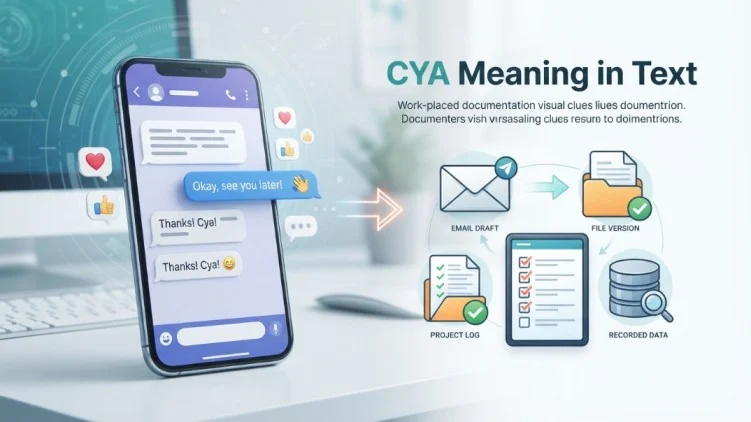
Quick answer:
CYA usually means “see ya” or “see you” in casual texting.
In work or serious conversations, it can also mean “cover your ass,” so context matters.
A tiny three-letter message can sometimes leave you wondering, “What did they actually mean?” If you have seen cya meaning in a text, DM, game chat, or social media comment, you are not alone. CYA is usually a quick and friendly way to say “see ya” or “see you.” But it has another meaning that can sound very different.
If you are a student, parent, writer, gamer, social media user, dater, or professional, knowing this slang can help you avoid awkward replies. It is common in fast digital conversations because short forms save time and feel natural.
The key is context. A friend saying “cya later” is probably saying goodbye. A coworker saying “save that email for CYA” means something else. Let’s break down both meanings, their history, examples, tone, and the safest ways to respond.
Definition & Meaning
The most common CYA meaning in texting is “see ya.” It is an informal shortened form of “see you” and is normally used when someone is ending a conversation. It can mean goodbye, see you later, talk soon, or catch you later.
For example:
Mia: “I have to finish my homework.”
Liam: “Okay, cya later!”
Here, cya simply means see you later.
You may also see it written as:
- cya
- CYA
- C ya
- see ya
- cya later
- cya soon
The lowercase form often feels more relaxed.
The second meaning of CYA
CYA can also stand for “cover your ass.” This is a slang phrase about protecting yourself from blame, trouble, criticism, or responsibility. It often appears in workplace discussions or situations where someone wants to keep proof that they followed instructions.
For example:
Sam: “I sent the approval email to everyone.”
Jake: “Good. That gives you some CYA.”
Here, CYA does not mean goodbye. It means taking steps to protect yourself if a problem happens later.
Which meaning is more common?
In ordinary texting, “see ya” is usually the expected meaning, especially when the message appears at the end of a friendly conversation. The second meaning is more likely when the conversation involves work, documentation, blame, proof, or risk.
So, always look at the surrounding words before deciding what CYA means.
Background & History
The story behind CYA has two parts because the abbreviation developed around two different expressions.
The first comes from the casual phrase “see ya.” People have used “see ya” as an informal goodbye for many years. It is simply a relaxed pronunciation of “see you.” As online chat, instant messaging, and SMS became popular, people began shortening familiar phrases to type faster.
This created many short forms, such as:
- BRB = be right back
- TTYL = talk to you later
- LOL = laugh out loud
- CU = see you
- CYA = see ya
The rise of online communication helped make these abbreviations easy to recognize. CYA became especially natural in quick chats, gaming rooms, and instant messages.
The workplace meaning
The second meaning comes from the phrase “cover your ass.” This expression developed as informal workplace and organizational slang. It describes actions taken to protect yourself if something goes wrong.
For example, a worker may keep an email, save a receipt, or get written approval. The goal is to show that they acted properly.
Employee: “I asked for approval in writing.”
Coworker: “Smart. That is good CYA.”
The expression became associated with office politics, responsibility, documentation, and risk.
How CYA evolved online
Digital communication brought both meanings into the same three letters. That created an interesting problem: the exact same abbreviation can be friendly in one conversation and serious in another.
Today, CYA is still recognized in casual digital communication, while the second meaning remains part of informal workplace slang.
Usage in Various Contexts
CYA can appear in many digital spaces. Its meaning usually becomes clear from the situation.
CYA in texting
This is where the “see ya” meaning is most common.
Alex: “Dinner was fun!”
Noah: “Yeah, I gotta go. CYA!”
Meaning: See you later.
Another example:
Emma: “See you at school tomorrow.”
Sofia: “CYA!”
Here, the abbreviation makes the goodbye quick and friendly.
CYA on social media
People may use CYA in comments, direct messages, or casual replies.
User 1: “I’m logging off for the night.”
User 2: “CYA tomorrow!”
It has a relaxed and conversational feel.
CYA in gaming
Gamers often use short phrases because chats can move quickly.
Player 1: “I need to leave the match.”
Player 2: “No problem, cya!”
Here, CYA means see you.
You might also see:
“CYA next round!”
This means see you in the next round.
CYA in workplace conversations
The meaning can change completely.
Employee 1: “Should I keep the client’s approval email?”
Employee 2: “Definitely. CYA.”
Here, CYA means cover your ass, or protect yourself by keeping a record.
Because the second meaning contains a vulgar word when expanded, it is usually better suited to informal workplace conversations between people who are comfortable with that language.
Common Misconceptions & Clarifications
CYA can cause confusion because people sometimes assume there is only one meaning.
Misconception 1: CYA always means “see ya”
Not always.
In casual texts, that is normally the right interpretation. But in workplace or defensive situations, it can mean cover your ass.
Consider these examples:
“Gotta go, CYA!”
This clearly means see ya.
But:
“Keep the receipt for CYA.”
This means protect yourself by keeping evidence.
Misconception 2: CYA is always friendly
The goodbye version is usually friendly. The other meaning can sound serious, cynical, or defensive.
If someone says:
“I copied the manager for CYA.”
They may be saying they created a record to protect themselves from future blame.
Misconception 3: CYA is formal English
It is not a good choice for formal writing when you mean “see you.”
A client email should normally say:
“See you at the meeting.”
rather than:
“CYA at the meeting.”
Misconception 4: The second meaning is always offensive
The phrase “cover your ass” contains vulgar language, but CYA is often used as an abbreviation that people understand without saying the full phrase.
Still, it can sound too informal in professional or sensitive settings.
Misconception 5: CYA is rude
Not by itself.
“Cya later!” is usually harmless. But a short “CYA” without context can sometimes feel abrupt. Tone, punctuation, emojis, and the relationship between the speakers all matter.
Similar Terms & Alternatives
If you want to say goodbye, CYA has many alternatives.
| Term | Meaning | Tone |
|---|---|---|
| CYA | See ya | Very casual |
| See ya | Goodbye | Casual |
| See you | Goodbye | Neutral |
| Later | Goodbye for now | Casual |
| TTYL | Talk to you later | Casual |
| CU | See you | Casual |
| CUL8R | See you later | Playful |
| Bye | Goodbye | Neutral |
| Talk soon | Speak again soon | Friendly |
If you want to express the “cover your ass” idea professionally, you can choose clearer phrases such as:
- Keep a record.
- Document everything.
- Get written approval.
- Keep the email.
- Save the receipt.
- Make sure you have confirmation.
- Protect yourself with proper documentation.
These alternatives are safer in formal communication.
How to Respond to This Term
Your response should match the meaning and tone.
Casual response
If someone texts:
Friend: “Okay, cya!”
You can say:
“Cya!”
Or:
“See you!”
Friendly response
“Cya tomorrow! 😊”
This works well with friends or classmates.
Funny response
If your friend says:
“CYA!”
You could reply:
“Don’t disappear for too long!”
This keeps the conversation playful.
Professional response
If someone uses CYA in a work discussion and clearly means documentation, you can reply:
“Understood. I’ll keep a copy of the approval.”
This sounds clear and professional.
If you are unsure
Ask:
“Do you mean see ya?”
This is better than guessing when the context is unclear.
Regional or Cultural Differences
CYA is mainly an English-language abbreviation, so its meaning depends heavily on the language and culture of the conversation.
The “see ya” version is easiest to understand in English-speaking digital spaces. It reflects a casual English goodbye that became shorter through online communication.
In other languages, people may use completely different abbreviations for goodbye. They may also prefer local slang instead of English internet shorthand.
British and American English
Both British and American English speakers can understand “see ya.” However, the phrase “cover your ass” is more informal and may be replaced by softer wording depending on the workplace.
In American English, you may hear:
“I’m doing this for CYA.”
In a more formal environment, someone might instead say:
“I want to make sure we have proper documentation.”
Why culture matters
Some people see texting abbreviations as friendly and efficient. Others may view them as too casual.
That is why audience matters.
A close friend may appreciate:
“CYA!”
A client may prefer:
“See you tomorrow.”
The safest choice is always to match the communication style of the other person.
Comparison with Similar Terms
- CYA is often confused with other goodbye abbreviations.
| Abbreviation | Full meaning | Main use |
|---|---|---|
| CYA | See ya | Casual goodbye |
| CU | See you | Casual goodbye |
| TTYL | Talk to you later | Ending a chat |
| CUL8R | See you later | Playful texting |
| BRB | Be right back | Temporary absence |
| GTG | Got to go | Leaving |
| L8R | Later | Casual goodbye |
| B4N | Bye for now | Casual goodbye |
CYA vs TTYL
CYA suggests seeing or meeting the person again.
TTYL focuses on talking again later.
“CYA tomorrow.”
means you expect to see them.
“TTYL tonight.”
means you expect to talk later.
CYA vs BRB
These are very different.
BRB means the person is leaving temporarily and plans to return.
CYA usually signals the end of the current interaction.
“BRB, getting water.”
The person will return.
“Okay, CYA tomorrow.”
The conversation is ending.
Usage in Online Communities & Dating Apps
CYA can appear in gaming communities, social media DMs, and dating conversations.
On dating apps such as Tinder, a person may use CYA casually after arranging another meeting.
Match: “I had fun tonight!”
You: “Same! CYA Friday 😊”
Here, CYA means see you Friday and can sound warm.
However, if someone simply writes:
“CYA.”
after an argument, the tone may feel colder. The abbreviation itself has not changed, but the context has.
In online gaming
Gamers may use CYA when leaving a lobby.
Player: “Dinner time. CYA guys!”
This is a normal casual goodbye.
On social media
A creator or follower may use CYA in a quick comment:
“Gotta go. CYA in the next stream!”
Again, it means see you.
Tips for dating conversations
If you want to sound warm, consider:
- “See you soon 😊”
- “See you Friday!”
- “Talk soon!”
- “Can’t wait to see you!”
CYA is short and casual. It may feel less personal than a full sentence, especially early in a relationship.
Hidden or Offensive Meanings
The most important alternative meaning of CYA is “cover your ass.” This is not a secret code. It is a recognized slang use, especially in situations involving workplace protection, blame, or documentation.
The phrase can sound offensive because “ass” is informal and mildly vulgar in many settings.
For example:
“Save the message for CYA.”
A close coworker may understand it immediately.
But in a formal meeting, you could say:
“Please save the message for documentation.”
That version is much more professional.
Can CYA sound rude?
Yes, depending on context.
A friend saying:
“CYA later!”
usually sounds friendly.
Someone saying:
“I did that for CYA.”
may sound defensive or distrustful.
Context is the key
Look for clues around the abbreviation.
Goodbye clues:
- later
- tomorrow
- tonight
- going
- leaving
- see you
- talk
Workplace protection clues:
- proof
- approval
- record
- document
- blame
- receipt
- screenshot
These clues can help you identify the intended meaning.
Suitability for Professional Communication
CYA is not the best choice for formal professional communication when you mean “see you.”
Instead of:
“CYA at the meeting.”
Use:
“See you at the meeting.”
Or:
“I’ll see you tomorrow.”
These sound polished and clear.
What about the workplace slang meaning?
You may hear CYA among coworkers, especially in informal chats.
For example:
“I saved the client’s approval for CYA.”
People familiar with workplace slang may understand this immediately.
Still, the phrase can sound too casual because the full expression contains profanity.
Better professional alternatives
Use:
“For documentation.”
“I am keeping the email for documentation.”
“To keep a record.”
“Let’s keep a record of the approval.”
“For accountability.”
“Please confirm the decision in writing for accountability.”
“To protect against misunderstandings.”
“I would like written confirmation to avoid misunderstandings.”
These phrases communicate the same general idea without slang.
A useful rule
Use CYA casually with people who understand the slang. For clients, managers, formal emails, academic writing, or official documents, choose clearer language.
FAQs
1. What does CYA mean in texting?
In most casual texts, CYA means “see ya” or “see you.” It is a short and friendly way to say goodbye.
2. What does CYA mean in a work chat?
In a work or serious context, CYA can mean “cover your ass,” referring to protecting yourself from blame by keeping records or proof.
3. Is CYA rude?
Usually not when it means “see ya.” However, the “cover your ass” meaning can sound informal or vulgar.
4. Is CYA appropriate for a professional email?
If you mean “see you,” it is better to write “see you” or “talk soon.” Avoid CYA in formal emails.
5. Does CYA mean goodbye?
Yes. In casual texting, it commonly means “see ya”, which is a casual goodbye.
6. How do I know which meaning CYA has?
Check the context. If someone is leaving a conversation, it probably means see ya. If the discussion involves documentation, proof, blame, or risk, it may mean cover your ass.
7. Can I use CYA with friends?
Yes. CYA is perfectly natural in casual texting with friends, especially when you are saying goodbye.
Conclusion
The CYA meaning is easy to understand once you look at the context. In most casual texts, chats, gaming conversations, and social media messages, CYA means “see ya” or “see you.” It is quick, friendly, and informal.
But CYA has another important meaning: “cover your ass.” This version is connected to protecting yourself from blame or trouble, often by keeping documentation or proof. Because the full phrase contains informal language, it should be used carefully.
The best rule is simple: look at the conversation before you reply. If someone is saying goodbye, CYA is probably friendly. If they are talking about emails, records, approval, or responsibility, the meaning may be very different.
For formal communication, spelling out “see you,” “talk soon,” “keep a record,” or “for documentation” is usually clearer. Once you understand both meanings, CYA becomes much easier to recognize and use correctly.
Read More Related Articles:
Cougar Meaning | Definition, Slang, Dating Context, Examples …
What Does “Curated” Mean in Simple English in 2026
What Does “Mhm” Mean in Texting and Chat in 2026