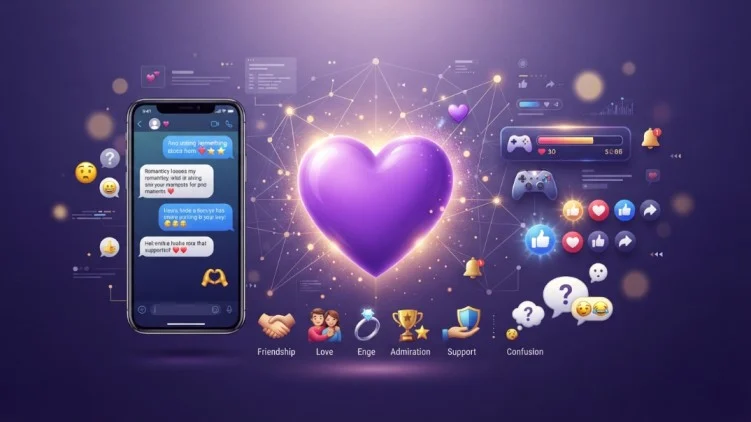
Quick answer:
The purple heart meaning is usually love, care, compassion, support, or admiration. 💜
Its exact meaning depends on the relationship, message, and context.
One tiny emoji can say a lot without using a single word. The 💜 purple heart is a perfect example. You may see it in a text from a friend, a comment on social media, a message from someone you like, or even a gaming chat. But what does it really mean?
If you are a student, texter, social media user, gamer, content creator, or someone trying to understand a message from a crush, knowing the purple heart meaning can help you read the tone correctly. The emoji can show love, kindness, emotional support, admiration, friendship, or a special connection.
Unlike the classic ❤️ red heart, the purple heart often feels softer, more unique, or more expressive. Its meaning can also change based on the person using it. Let’s explore what 💜 means, where it came from, and how people use it in real conversations.
Definition & Meaning
The purple heart emoji 💜 is a colored heart symbol commonly used to express love, affection, care, support, compassion, admiration, and emotional connection.
It is similar to other heart emojis, but its purple color gives it a different emotional tone.
Simple meaning of 💜
In many conversations, 💜 can mean:
- I love you
- I care about you
- I support you
- You are special to me
- I appreciate you
- I am proud of you
- I am here for you
- You mean a lot to me
For example:
Friend: “Thanks for staying with me when I was having a hard day.”
You: “Always 💜”
Here, the purple heart shows care and emotional support.
Purple heart from a friend
A friend may send 💜 simply to show affection.
Friend: “You did such a great job today! 💜”
This does not automatically mean romantic love. It may simply communicate warmth and appreciation.
Purple heart from a romantic partner
When a partner sends 💜, it can express love or affection.
Partner: “Goodnight, beautiful 💜”
The meaning here is likely romantic, especially if the rest of the conversation has a romantic tone.
Purple heart from a crush
This is where things can become confusing.
You: “I had such a nice time with you today.”
Crush: “Me too 💜”
The emoji may suggest affection or emotional warmth. However, one emoji alone cannot prove romantic interest.
Always consider the full conversation.
Why purple?
Purple has long been associated with ideas such as creativity, luxury, mystery, compassion, and individuality. Because of this, 💜 can feel different from the traditional red heart.
It can communicate affection while feeling less direct or intense than ❤️ in some situations.
Background & History
The purple heart emoji developed as part of the wider growth of digital communication and emoji culture.
Before emojis became common, people used text symbols such as <3 to represent a heart. As phones and social platforms introduced larger emoji libraries, users gained the ability to choose hearts in different colors.
The purple heart became one of several colored heart emojis, including:
- ❤️ Red Heart
- 🧡 Orange Heart
- 💛 Yellow Heart
- 💚 Green Heart
- 💙 Blue Heart
- 💜 Purple Heart
- 🖤 Black Heart
- 🤍 White Heart
- 🤎 Brown Heart
Each color can create a slightly different emotional impression.
Purple heart and emotional expression
The purple heart became popular because people wanted more ways to express feelings without using the same red heart every time.
For example:
“Thank you ❤️”
and
“Thank you 💜”
can feel slightly different.
The red heart often feels more traditional and strongly romantic. The purple heart may feel gentler, more personal, playful, or supportive, depending on the relationship.
Purple heart in online culture
Online communities have also given 💜 special meanings.
Some fandoms use purple as part of their identity. A well-known example is the connection between the purple heart and BTS fans, often called ARMY, because purple has become strongly associated with BTS and its fan culture.
However, this does not mean every person who sends 💜 is referring to BTS.
The emoji’s meaning continues to evolve as social media users create their own meanings and communication styles.
Usage in Various Contexts
The purple heart meaning changes based on the situation. The same emoji can communicate friendship in one conversation and romance in another.
In texting
Friends often use 💜 to show appreciation or emotional support.
You: “Thanks for listening to me.”
Friend: “Anytime 💜”
Here, the emoji means care and friendship.
On social media
People use 💜 in comments, captions, and replies.
“This photo is beautiful 💜”
The commenter may simply be showing admiration.
It can also be used after supportive messages.
“Sending you love and strength 💜”
Here, it clearly communicates compassion.
In gaming
Gamers may use 💜 to support teammates or friends.
Player A: “We finally won!”
Player B: “That was a great match 💜”
The emoji adds friendliness and excitement.
In romantic conversations
A romantic partner may use it as a softer form of affection.
Partner: “Miss you already 💜”
Here, it likely means love and emotional closeness.
In family conversations
Parents, siblings, or relatives may also use 💜.
Mom: “Good luck with your exam! 💜”
This usually means love, encouragement, and support.
In comments
A person may reply:
“So proud of you 💜”
This usually shows admiration or encouragement rather than romantic interest.
Common Misconceptions & Clarifications
The purple heart is easy to misunderstand because emojis do not have one fixed meaning.
Misconception 1: 💜 always means romantic love
Not true.
A friend, sibling, parent, fan, or stranger can use 💜.
The relationship matters more than the emoji itself.
Misconception 2: Purple heart means someone has a crush on you
Not necessarily.
If your crush sends:
“Thank you 💜”
it may show warmth, but it does not automatically confirm romantic feelings.
Look at the person’s overall behavior and communication, not one emoji.
Misconception 3: Purple heart is less meaningful than red heart
Not always.
People choose emojis based on personality and preference. Someone may use 💜 with everyone because they simply like the color.
Misconception 4: 💜 has one universal definition
There is no single meaning that fits every conversation.
It can mean:
- affection
- friendship
- support
- admiration
- compassion
- pride
- romance
- fandom
Misconception 5: Purple heart is always positive
Most uses are positive, but tone can change meaning.
For example:
“Wow, great job 💜”
could be sincere, playful, or sarcastic depending on the conversation.
That is why context matters.
Similar Terms & Alternatives
Several emojis can express feelings similar to 💜, but each has its own common tone.
| Emoji | Common meaning | Typical feeling |
|---|---|---|
| ❤️ | Love, romance, deep affection | Strong and direct |
| 🧡 | Care, warmth, friendship | Friendly and warm |
| 💛 | Happiness, friendship, positivity | Cheerful |
| 💚 | Care, nature, support | Fresh or supportive |
| 💙 | Trust, loyalty, calm support | Stable and caring |
| 💜 | Love, care, admiration, support | Unique and affectionate |
| 🖤 | Dark humor, grief, style, affection | Edgy or emotional |
| 🤍 | Peace, purity, sympathy | Soft and gentle |
| 🤎 | Warmth, comfort, appreciation | Cozy and grounded |
💜 vs ❤️
The red heart often feels more direct.
“I love you ❤️”
can sound strongly romantic.
“I love you 💜”
can still be romantic, but may feel softer or more distinctive.
💜 vs 💙
Blue often communicates trust, loyalty, friendship, or calm support.
Purple can feel more emotional, affectionate, or expressive.
Still, personal habits can change these meanings.
How to Respond to This Term
If someone sends you 💜, your response should match the tone of the conversation.
Casual response
If a friend sends it:
“Aww, thanks! 💜”
This keeps the exchange warm and natural.
Romantic response
If your partner sends it:
“Love you too 💜”
This clearly returns the affection.
Funny response
If someone sends a purple heart unexpectedly:
“Okayyy, purple heart! I see you 💜😂”
This can create a playful tone.
If you are unsure
You do not need to immediately assume anything.
You can simply continue the conversation naturally.
Them: “Good luck today 💜”
You: “Thank you! I really appreciate it.”
This avoids overthinking the emoji.
If you want clarification
If the context genuinely feels confusing:
“Haha, what does the purple heart mean here? 😂”
This can work with someone you know well.
Regional or Cultural Differences
The purple heart is widely recognized across online communication because emojis are used globally. However, the emotional meaning can differ between people and cultures.
In some communities, purple is strongly connected with creativity, individuality, spirituality, royalty, or compassion.
In other online communities, purple may have a specific fandom meaning.
Fandom culture
Purple has a strong association with BTS and its global fan community. Fans may use 💜 as a sign of connection and support.
A message such as:
“BTS forever 💜”
has a more specific cultural meaning than simply:
“Thank you 💜”
Personal emoji habits
Cultural differences are not the only factor.
Some people use ❤️ for everyone. Others rarely use red hearts and prefer 💜, 💙, or 🩷.
Therefore, learning someone’s normal texting style can be more useful than relying on a fixed emoji dictionary.
Language differences
The emoji itself remains visually recognizable across languages. A purple heart can communicate emotion even when two people do not share the same first language.
Still, the social meaning behind it can vary.
Comparison with Similar Terms
It is useful to compare 💜 with common heart expressions because people often interpret them differently.
| Expression | Common interpretation | Romantic level |
|---|---|---|
| ❤️ | Love, romance, strong affection | High |
| 💜 | Care, affection, support, admiration | Medium to high |
| 🩷 | Sweet love, affection, tenderness | Medium |
| 💙 | Trust, friendship, loyalty | Low to medium |
| 💛 | Friendship, happiness, positivity | Low |
| 🖤 | Deep emotion, style, dark humor, grief | Depends on context |
| 🤍 | Sympathy, peace, gentle affection | Low to medium |
| “Love you” | Direct affection | High |
| “Take care” | Concern or kindness | Low |
| “Proud of you” | Encouragement and admiration | Usually non-romantic |
The most important point is that emoji meanings overlap.
A purple heart does not exist in isolation. The words around it help determine the real message.
Usage in Online Communities & Dating Apps
Purple hearts are common in online spaces where people use short messages to show emotion.
On dating apps such as Tinder, 💜 may appear in a message to make it feel warmer.
For example:
Match: “That sounds like a fun date idea 💜”
This could be friendly or flirtatious.
Another example:
Match: “You look amazing 💜”
This is more likely to carry romantic or flirtatious energy.
However, the emoji alone does not tell you how serious the person’s interest is.
On X
On X, users may add 💜 to supportive posts, fandom conversations, announcements, or personal messages.
“Sending everyone love today 💜”
This is generally a broad message of support.
In gaming communities
Gaming groups may use 💜 to celebrate teammates, friendships, or community events.
“GG everyone! 💜”
The emoji makes the message feel friendly and positive.
Tips for responding online
If you are unsure about someone’s intention:
- Read the whole message.
- Consider your relationship with the person.
- Look at their usual emoji habits.
- Notice whether the conversation is romantic or friendly.
- Avoid making major assumptions from one emoji.
Hidden or Offensive Meanings
The 💜 emoji does not have a standard hidden offensive meaning.
Its most common uses are positive.
However, like almost any emoji, it can be used sarcastically.
For example:
“Thanks for completely ignoring my message 💜”
The purple heart here may make the sentence sound passive-aggressive.
The words create the negative meaning, not the emoji itself.
Could 💜 be flirty?
Yes.
If someone sends:
“Wish you were here 💜”
the emoji may strengthen the romantic tone.
But if the same person sends 💜 to everyone, it may have little romantic meaning.
Could 💜 be sarcastic?
Yes.
“Great job deleting the file 💜”
If the person is clearly upset, the heart may be sarcastic.
This is why tone, relationship, and context matter more than the emoji alone.
Suitability for Professional Communication
The purple heart can appear in professional communication, but its suitability depends on the workplace and relationship.
In a formal email, it is usually better to avoid heart emojis unless the workplace culture clearly welcomes them.
Instead of:
“Thanks for your help 💜”
a formal message could say:
“Thank you for your help. I really appreciate it.”
When 💜 may be acceptable
It can work in:
- friendly team chats
- creative workplaces
- social media management
- community groups
- informal internal messages
For example:
“Great work on the campaign team! 💜”
may be perfectly acceptable in a casual company chat.
When to avoid it
Use caution in:
- job applications
- formal business emails
- legal communication
- client complaints
- official documents
- serious workplace matters
Professional communication should make your meaning clear without relying on emoji interpretation.
FAQs
1. What does 💜 mean from a girl?
It can mean love, friendship, care, support, admiration, or affection. It does not automatically mean she likes you romantically.
2. What does 💜 mean from a guy?
A guy may use 💜 to show friendship, affection, support, admiration, or romantic interest. The surrounding conversation matters.
3. Is 💜 a romantic heart?
It can be romantic, but it is not exclusively romantic. Friends and family use it too.
4. What does 💜 mean from a crush?
It may suggest warmth, affection, or flirtation. However, one emoji cannot confirm a crush.
5. What is the difference between ❤️ and 💜?
❤️ often feels more direct and traditionally romantic. 💜 can feel softer, more unique, supportive, or affectionate.
6. Does 💜 mean friendship?
Yes. Many people use the purple heart to express friendship, appreciation, and emotional support.
7. Why do people use purple hearts?
People use 💜 because they want to show affection, support, admiration, kindness, or connection while choosing a color that feels different from the traditional red heart.
Conclusion
The purple heart meaning is flexible, which is exactly why the emoji is so popular. 💜 can express love, friendship, support, admiration, compassion, pride, or simple appreciation. Its meaning depends heavily on the person using it and the conversation around it.
A purple heart from your best friend may simply mean “I care about you.” The same emoji from a romantic partner may express love. From a crush, it could suggest affection or flirtation, but it is not enough to prove romantic interest.
The safest way to understand 💜 is to read the entire message and consider the relationship. Do not judge someone’s feelings from one emoji alone. Once you understand that context matters, the purple heart becomes much easier to interpret in texts, social media posts, gaming chats, dating apps, and everyday conversations.
Read More Related Articles:
Cougar Meaning | Definition, Slang, Dating Context, Examples …
What Does “Curated” Mean in Simple English in 2026
What Does “Mhm” Mean in Texting and Chat in 2026