Have you ever received a message saying “IDT” and paused for a second because you were not sure what it meant? You are not alone. If you enjoy texting, chatting on social media, gaming with friends, or simply want to understand modern internet slang, this guide is for you.
The IDT meaning in text is simple, but its meaning can change slightly depending on the conversation. Knowing how and when people use it can help you avoid confusion and reply with confidence.
In this guide, you will learn what IDT stands for, where it came from, how people use it on apps like Snapchat, Instagram, TikTok, Discord, and X, plus the best ways to respond in different situations. By the end, you will understand this popular abbreviation like a native internet user.
What Does IDT Mean in Text?
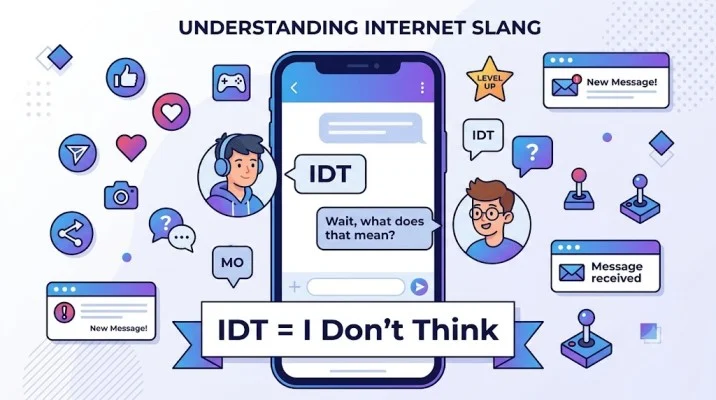
The IDT meaning in text is “I Don’t Think.”
People use this abbreviation to quickly express doubt, uncertainty, disagreement, or a personal opinion without typing the full sentence.
Instead of writing:
“I don’t think that’s true.”
They simply write:
“IDT that’s true.”
It saves time while keeping conversations casual and natural.
Common Examples
Friend 1: Are they coming tonight?
Friend 2: IDT so.
Alex: Do you think we’ll finish today?
Jordan: IDT we’ll have enough time.
Emma: Is this the right answer?
Jake: IDT, maybe check again.
What Does IDT Express?
People use IDT to show:
- Doubt
- Uncertainty
- Disagreement
- A personal opinion
- A polite way to say no
Unlike saying “No,” IDT sounds softer and less direct.
For example:
No: That’s wrong.
Better: IDT that’s correct.
Background & History of IDT
Like many internet abbreviations, IDT became popular during the rise of online chatting in the late 1990s and early 2000s.
Early messaging platforms had strict character limits and slow typing speeds. Users started shortening common phrases.
Examples include:
- LOL
- BRB
- IMO
- IDK
- IDC
- IDT
As smartphones became popular, abbreviations remained because they made texting faster.
Today, IDT appears on:
- SMS
- Messenger
- Snapchat
- TikTok comments
- Discord
- X (formerly Twitter)
- Gaming chats
Although newer users often type complete sentences thanks to voice typing, IDT remains widely understood.
How IDT Is Used in Different Situations
IDT in Text Messages
Friends often use IDT when they are unsure.
Sarah: Are you free tonight?
Mike: IDT. I have homework.
IDT on Social Media
People use it when replying to posts.
Post: This is the best movie ever.
Comment: IDT. I liked the first one more.
IDT in Gaming
Gamers use IDT during quick conversations.
Player 1: Can we beat this boss?
Player 2: IDT without better gear.
IDT in Group Chats
Emma: Everyone coming tomorrow?
Lucas: IDT Ben can make it.
IDT in Everyday Conversation
Sometimes people even say “IDT” while speaking online with friends who understand internet slang.
Common Misconceptions About IDT
Many people confuse IDT with similar abbreviations.
Misconception 1: IDT Means “I Don’t Know”
It does not.
“I Don’t Know” is:
IDK
Misconception 2: IDT Always Means No
Not exactly.
It usually means the person is unsure.
Example:
“I don’t think so.”
This leaves room for uncertainty.
Misconception 3: IDT Is Rude
No.
It is actually a polite way to disagree.
Compare:
“No.”
vs.
“IDT that’s right.”
The second sounds friendlier.
Similar Terms & Alternatives
Here are similar abbreviations people often use.
| Term | Meaning | When Used |
|---|---|---|
| IDT | I Don’t Think | Expressing doubt |
| IDK | I Don’t Know | Lack of knowledge |
| IMO | In My Opinion | Sharing opinions |
| IMHO | In My Humble Opinion | Soft opinions |
| IDC | I Don’t Care | Showing indifference |
| TBH | To Be Honest | Honest statements |
| NGL | Not Gonna Lie | Honest reactions |
Alternatives Without Abbreviations
Instead of IDT, people may say:
- I don’t think so.
- Probably not.
- Maybe not.
- I’m not sure.
- It doesn’t seem likely.
How to Respond to IDT
Casual Reply
Friend: IDT I’ll come.
You: No worries. Maybe next time.
Funny Reply
Friend: IDT that’s happening.
You: Never underestimate my luck.
Professional Reply
Coworker: IDT this deadline is realistic.
You: Thanks for your feedback. Let’s discuss another timeline.
Privacy-Conscious Reply
Friend: IDT you should post that.
You: Good point. I’ll think about it first.
Regional and Cultural Differences
IDT is most common in English-speaking countries.
These include:
- United States
- Canada
- United Kingdom
- Australia
- New Zealand
In countries where English is a second language, younger users often understand IDT through social media.
Some people may instead type the full phrase because abbreviations are less common in their native language.
Different cultures also have their own texting shortcuts with similar meanings.
IDT vs Similar Expressions
| Expression | Meaning | Difference |
|---|---|---|
| IDT | I Don’t Think | Shows doubt |
| IDK | I Don’t Know | No information |
| IDC | I Don’t Care | No interest |
| IMO | In My Opinion | Gives opinion |
| TBH | To Be Honest | Introduces honesty |
| NGL | Not Gonna Lie | Honest confession |
The biggest difference is that IDT expresses uncertainty, while IDK expresses lack of knowledge.
IDT on Dating Apps and Online Communities
People often use IDT on:
- Tinder
- Bumble
- Discord
- X
- Snapchat
Example on Tinder
Person A: Want to meet this weekend?
Person B: IDT I’ll be free.
Example on Discord
Player: Think the update comes today?
Friend: IDT. Probably tomorrow.
Tips for Responding
- Respect the person’s opinion.
- Don’t assume they are rejecting you completely.
- Ask politely if you need clarification.
- Keep the conversation friendly.
Can IDT Have Hidden or Offensive Meanings?
Most of the time, no.
IDT simply means “I Don’t Think.”
However, context matters.
For example:
“IDT you’re telling the truth.”
This could sound accusatory.
Likewise:
“IDT you understand.”
Depending on tone, it may seem dismissive.
The abbreviation itself is not offensive.
The surrounding message determines whether it feels polite or rude.
Is IDT Appropriate for Professional Communication?
Generally, no.
Professional emails and business messages should avoid internet abbreviations unless your workplace commonly uses them.
Instead of writing:
IDT this proposal works.
Write:
I don’t think this proposal meets our requirements.
Better alternatives include:
- I don’t believe…
- It may not be…
- I have concerns about…
- Based on my review…
- I suggest…
Using complete sentences appears more professional and respectful.
Frequently Asked Questions
What does IDT stand for in texting?
It stands for “I Don’t Think.”
Is IDT the same as IDK?
No. IDT means “I Don’t Think,” while IDK means “I Don’t Know.”
Is IDT rude?
No. It is usually a polite way to express doubt.
Where is IDT commonly used?
It is common in texting, social media, gaming, and online chats.
Can I use IDT in work emails?
It is better to avoid it and write the full sentence instead.
Does IDT have another meaning?
In most online conversations, it means “I Don’t Think.” In some technical or business fields, the same letters may stand for something entirely different, so always consider the context.
Conclusion
The IDT meaning in text is “I Don’t Think,” and it is one of the simplest internet abbreviations you’ll come across. People use it every day to express doubt, disagreement, or uncertainty in a quick and friendly way. You will see it in text messages, social media comments, gaming chats, and group conversations across many online platforms.
The key to understanding IDT is paying attention to the surrounding conversation. While the abbreviation itself is harmless, the tone of the message can make it sound supportive, humorous, or critical. In casual chats, IDT helps keep conversations short and natural. In professional settings, however, writing the complete phrase is usually the better choice. Once you recognize how IDT is used, you can respond naturally and communicate with greater confidence online.
Discover More Post:
What It Really Means in Chats, Snapchat, and Social Media
SB Meaning in Text | What It Means and How to Use It
IMK Meaning in Text | What It Really Means in Chats and …