Quick Answer:
Imminent means something is about to happen very soon. It is often used when an event is expected or likely to happen in the near future.
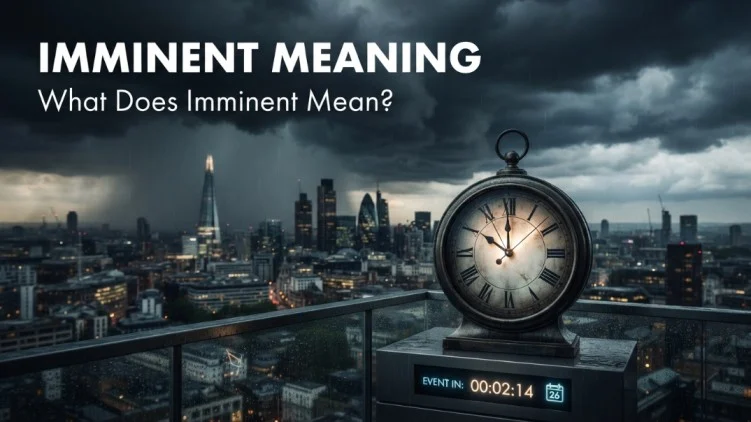
Imagine dark clouds gathering above you, thunder getting louder, and rain starting to fall. You might say, “A storm is imminent.” The word sounds formal, but its meaning is quite simple: something is about to happen soon.
If you are a student, English learner, writer, professional, or someone who often sees unfamiliar words online, understanding imminent meaning can make reading and conversations much easier. You may find this word in news reports, books, emails, school assignments, weather updates, movies, social media posts, and everyday discussions.
Unlike words such as “possible” or “eventual,” imminent suggests that something is expected to happen very soon. It can describe both exciting events and serious situations. A celebration can be imminent, but so can a storm or major change.
Knowing the difference helps you understand the urgency behind a sentence.
Definition & Meaning
The word imminent is an adjective that means likely to happen very soon or about to happen.
When someone says an event is imminent, they usually mean there is a strong reason to believe it will happen in the near future. The exact amount of time is not fixed. It could mean minutes, hours, days, or sometimes a short period of time depending on the situation.
For example:
“The storm is imminent.”
This means the storm is expected to arrive soon.
Another example is:
“Her graduation is imminent.”
This means her graduation is coming soon.
The word often creates a feeling of nearness or urgency. It is stronger than simply saying something will happen someday.
Simple Meaning
You can remember imminent like this:
Imminent = about to happen soon.
Here are some examples:
- The deadline is imminent.
The deadline is very close. - A major announcement is imminent.
The announcement is expected very soon. - The baby’s arrival is imminent.
The baby is expected to arrive soon. - Rain appears imminent.
Rain seems likely to begin soon. - Change is imminent.
Change is expected to happen soon.
The word does not automatically mean something bad. This is an important point.
People sometimes connect imminent with danger because phrases such as “imminent threat” and “imminent danger” are common. However, the word itself is neutral.
You can describe a positive event as imminent:
“The wedding is imminent.”
You can also describe something negative:
“The company faces an imminent crisis.”
The surrounding words tell you whether the event is positive, negative, or neutral.
Background & History
The word imminent has a long history in the English language. It comes from the Latin word imminere, which carried the idea of overhanging, projecting, or being near.
That original idea helps explain the modern meaning. Imagine something hanging above you and very close. It feels as if it could happen at any moment. Over time, this idea became associated with an event that is very near or about to occur.
The word entered English through French and Latin influences and eventually developed its modern spelling and meaning.
Today, imminent is more common in written or formal English than in casual speech. You may see it in newspapers, official statements, academic writing, legal documents, business reports, and serious discussions.
For example, a news report might say:
“Officials warned that flooding was imminent.”
A business report could say:
“The company expects an imminent change in leadership.”
In everyday conversation, people often use simpler phrases instead:
“It’s about to happen.”
“It’s coming soon.”
“It’s right around the corner.”
This does not mean imminent is outdated. It remains a useful word when you want to communicate that something is very close to happening.
It is especially useful when the writer wants to create a sense of urgency without using a long explanation.
Usage in Various Contexts
The word imminent appears in many different situations.
1. Everyday Conversations
Although it sounds somewhat formal, you can use it in normal conversation.
Tom: “When is the move happening?”
Sara: “Next week. It’s imminent.”
Here, Sara means the move is very close.
2. Weather
Weather reports often use imminent when dangerous conditions are expected soon.
“Severe weather is imminent.”
This tells people that they should prepare because the weather event may happen shortly.
3. News
News writers frequently use the word when discussing upcoming events.
“A decision from the court is imminent.”
The sentence suggests that the decision is expected soon.
4. School
A student might say:
“The exam is imminent, and I still have three chapters to study.”
The exam is approaching quickly.
5. Work
An employee could say:
“The project deadline is imminent.”
This means there is little time left.
6. Texting
In casual texting, people usually prefer simpler wording:
“The party is imminent 😂.”
This can sound playful because the word is more formal than typical texting language.
7. Social Media
Someone might post:
“Summer vacation is imminent! ☀️”
Here, the word creates excitement about something coming soon.
8. Gaming
A gamer might joke:
“Boss fight imminent. Wish me luck! 🎮”
This means the boss fight is about to happen.
The word can therefore sound serious, humorous, dramatic, or excited depending on context.
Common Misconceptions & Clarifications
One common misunderstanding is that imminent means “certain.” That is not always true.
The word usually suggests that something is expected to happen very soon, but it does not guarantee that it will happen.
For example:
“A storm is imminent.”
This means the storm is expected soon. It does not mean the speaker has absolute certainty about every detail.
Imminent vs. Immediate
These words are related but not identical.
Imminent means something is likely to happen very soon.
Immediate can mean happening now, requiring instant action, or having no delay.
Compare:
“The danger is imminent.”
The danger is about to happen.
“Take immediate action.”
Act right now.
Imminent Does Not Mean “Important”
Something can be imminent without being important.
“The bus arrival is imminent.”
The bus is coming soon, but that does not make the event especially serious.
Imminent Does Not Mean “Impossible to Avoid”
Another misconception is that an imminent event cannot be stopped.
That is not necessarily true.
For example:
“The launch is imminent.”
Plans could still change.
Is Imminent Always Negative?
No.
You can use it for positive events:
“The holiday is imminent.”
“The wedding is imminent.”
“The product launch is imminent.”
The word simply describes timing.
Similar Terms & Alternatives
Several English words and phrases have meanings close to imminent.
About to
This is one of the simplest alternatives.
“The train is about to leave.”
Approaching
This means something is getting closer.
“The deadline is approaching.”
Forthcoming
This means something is coming or expected, often in a more formal style.
“A forthcoming announcement will explain the changes.”
Near
This can describe something that is close in time or distance.
“The deadline is near.”
Upcoming
This is common for planned events.
“The upcoming meeting starts at noon.”
Pending
This means something is waiting to happen or be decided. It does not always suggest that it will happen very soon.
| Word/Phrase | Main Meaning | Sense of Urgency |
|---|---|---|
| Imminent | About to happen soon | High |
| About to | Will happen very soon | High |
| Approaching | Getting closer | Medium |
| Upcoming | Coming in the future | Low to medium |
| Forthcoming | Expected or coming | Medium |
| Near | Close in time | Medium |
| Pending | Waiting for an action or decision | Varies |
How to Respond to This Term
If someone uses imminent in conversation, your response depends on what they are describing.
Casual Response
“So it’s happening soon?”
This is a natural way to confirm the meaning.
Excited Response
“That’s exciting! How soon?”
Use this when the imminent event is positive.
Concerned Response
“Should we prepare for it?”
This works when someone is discussing danger, bad weather, or another serious event.
Funny Response
“Imminent? That sounds serious. Should I panic now?” 😂
This can work among friends when the situation is not genuinely dangerous.
Professional Response
“Understood. What action should we take before it occurs?”
This works well in workplace discussions.
If You Are Unsure
You can ask:
“When you say imminent, do you mean today or sometime this week?”
This is useful because imminent does not give an exact time.
Regional or Cultural Differences
The basic meaning of imminent stays the same across English-speaking countries.
You can encounter the word in American English, British English, Canadian English, Australian English, and other forms of English.
However, the frequency of use can vary by situation.
In formal British and American writing, imminent is common in news reports, government announcements, legal writing, and serious discussions.
In casual conversations, speakers often choose simpler expressions such as:
- “Coming soon”
- “About to happen”
- “Right around the corner”
- “Happening soon”
For example, an American speaker might say:
“The deadline is right around the corner.”
A formal report might say:
“The deadline is imminent.”
Both communicate a similar idea, but the tone is different.
The word also translates differently into other languages. A direct translation may not always carry exactly the same level of urgency, so learners should pay attention to context.
Comparison with Similar Terms
Understanding the difference between similar words can help you use imminent correctly.
Imminent vs. Upcoming
Imminent suggests something is very close.
Upcoming simply means something is scheduled or expected in the future.
Compare:
“The exam is upcoming.”
This tells us the exam is coming.
“The exam is imminent.”
This suggests the exam is very close.
Imminent vs. Eventual
Eventual refers to something that will happen at some point, often after time has passed.
Imminent means it is coming soon.
Imminent vs. Immediate
Immediate often means now or without delay.
Imminent means very soon.
| Term | Meaning | Example |
|---|---|---|
| Imminent | About to happen soon | “The storm is imminent.” |
| Upcoming | Coming in the future | “The event is upcoming.” |
| Eventual | Happening at some later point | “Her eventual decision surprised us.” |
| Immediate | Happening now or requiring no delay | “We need immediate help.” |
| Approaching | Getting closer | “The deadline is approaching.” |
A useful memory trick is:
Imminent = very near in time.
Usage in Online Communities & Dating Apps
The word imminent can appear online, especially when people want to sound dramatic, humorous, or expressive.
On social media, someone might post:
“The weekend is imminent. 🎉”
This simply means the weekend is almost here.
On X, Instagram, Reddit, Discord, or gaming communities, people may use the word dramatically:
“Exam failure is imminent. 💀”
The person may be joking about being unprepared.
In gaming:
“Victory is imminent!”
This means the player believes they are very close to winning.
Dating Apps
On Tinder or other dating platforms, imminent is less common in normal casual messages, but someone may use it humorously.
“Our first coffee date is imminent ☕.”
This means the date is coming soon.
If someone uses the word with you, do not assume it has a hidden romantic meaning. Look at the rest of the conversation.
If you are unsure, you can respond:
“Haha, imminent? How soon are we talking?”
That keeps the conversation light while clarifying the meaning.
Hidden or Offensive Meanings
Imminent does not have a standard hidden or offensive meaning.
It is a normal English adjective.
However, context can make a sentence sound threatening.
For example:
“An attack is imminent.”
The word itself is not offensive. The sentence describes a serious situation.
Someone could also use it sarcastically:
“My productivity is imminent.” 😂
This might mean the person keeps saying they will become productive but has not started yet.
Online, people sometimes use formal words like imminent for comic effect because they sound dramatic compared with casual language.
The key point is simple:
The word itself is neutral. The context creates the emotional tone.
If someone says “danger is imminent,” the tone is serious.
If someone says “pizza is imminent,” the tone is probably playful.
Suitability for Professional Communication
Imminent is suitable for professional communication.
In fact, it can be useful when you need to communicate urgency clearly and formally.
Examples include:
“A system update is imminent.”
“The deadline is imminent.”
“Severe weather is imminent.”
“An important announcement is imminent.”
The word is especially useful in reports, emails, presentations, news writing, academic work, and official notices.
However, in simple workplace communication, you may sometimes prefer clearer wording.
Instead of:
“The deadline is imminent.”
You could write:
“The deadline is very close.”
The second version is easier for readers with basic English skills.
Professional Alternatives
Depending on your message, you can use:
- Expected soon
- Coming shortly
- Approaching
- Due soon
- About to occur
- Expected in the near future
Choose the simplest phrase when clarity matters more than formal style.
FAQs
What does imminent mean?
Imminent means something is about to happen or expected to happen very soon.
Does imminent mean today?
Not necessarily. It means very soon, but the exact time depends on the context. It could mean within minutes, hours, or days.
Is imminent a positive or negative word?
It is neutral. It can describe positive, negative, or neutral events.
What is an easy synonym for imminent?
Easy synonyms include “about to happen,” “coming soon,” “near,” and “approaching.”
What is the difference between imminent and immediate?
Imminent means something is expected very soon. Immediate usually means happening now or requiring action without delay.
Is imminent a formal word?
Yes. It is common in formal writing, news reports, professional communication, and serious discussions.
Can I use imminent in texting?
Yes, but it sounds more formal than everyday texting. You can also use it humorously, such as “Pizza is imminent 😂.”
Conclusion
The word imminent means something is about to happen very soon. It does not automatically mean something bad, nor does it guarantee that an event will happen. Context determines the exact meaning and tone.
You may see imminent in news stories, workplace emails, school assignments, weather warnings, social media posts, gaming chats, and everyday conversations. It is more formal than simple phrases like “coming soon” or “about to happen,” but it can make a message sound clear and urgent.
Remember the easiest definition: imminent = very close to happening. Once you understand that idea, it becomes much easier to recognize and use the word correctly.
Read More Related Articles:
WTM Meaning in Texting | Definition, Examples & How to Use …
What Does Soursop Mean and What Is This Fruit – Similixy.com
IG Meaning in Text Messages | Definition, Uses, and Real …