Quick answer:
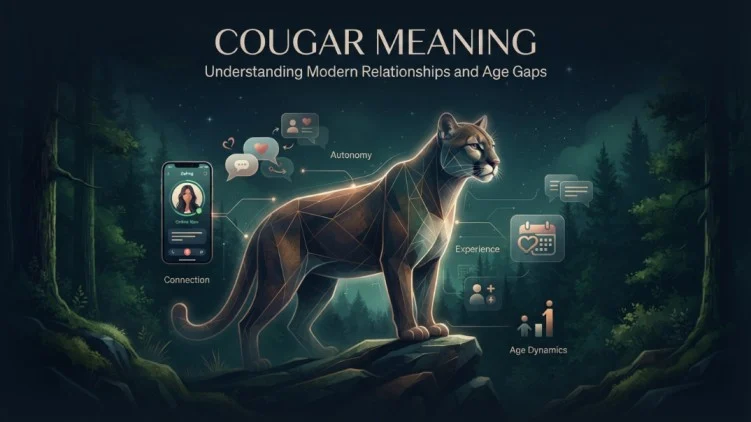
Cougar can mean a large wild cat, but in slang, it usually refers to an older woman who is romantically or sexually interested in younger men.
The meaning depends strongly on the context, tone, and conversation.
One word can have two very different meanings, and cougar meaning is a perfect example. You might see “cougar” in a wildlife documentary, a text message, a dating profile, a social media comment, or a casual conversation. In one situation, it means a powerful wild cat. In another, it is slang for an older woman who dates or is attracted to younger men.
If you are a student, writer, social media user, gamer, texter, or someone navigating online dating, knowing both meanings can help you avoid confusion. The slang meaning is common, but it can also sound playful, judgmental, or offensive depending on who says it and how it is used.
Understanding the context is the key. Below, you will learn the simple definition, history, examples, dating meaning, cultural differences, and polite ways to respond when someone uses this word.
Definition & Meaning
The word cougar has a literal meaning and a slang meaning.
Literal meaning of cougar
A cougar is a large wild cat native to the Americas. It is also known by names such as:
- mountain lion
- puma
- panther
For example:
“We saw a cougar while hiking in the mountains.”
Here, the speaker is talking about an animal.
Slang meaning of cougar
In modern informal English, cougar can describe an older woman who is romantically or sexually interested in younger men, especially when the age difference is noticeable.
For example:
Alex: “Who is she?”
Jordan: “She is an older woman who dates younger guys.”
Alex: “Oh, people might call her a cougar.”
The word does not have one universally agreed age requirement. It is usually based on a noticeable age gap, not a specific number.
Is cougar an insult?
Not always.
Some people use the word positively or playfully to describe an older woman who is confident, attractive, independent, or comfortable dating younger men.
Others dislike the label because it can reduce a woman to her age and dating preferences.
For this reason, tone and context matter.
Cougar meaning in dating
On dating platforms and social media, the word may appear in profiles or conversations.
“I’m interested in older women.”
This is a neutral statement.
“I’m looking for a cougar.”
This specifically signals interest in an older woman who dates younger men.
The word is therefore much more specific than simply saying older woman.
Background & History
The animal meaning of cougar is much older than the slang meaning.
The word has been used in English for the large wild cat found across parts of North and South America. The animal has many regional names, including puma and mountain lion.
Over time, the word developed a separate informal meaning connected with relationships between older women and younger men.
How did the slang develop?
The exact history of the slang use is not completely simple. Its popularity grew through North American popular culture, entertainment, magazines, television, and later the internet.
The metaphor comes from the idea of an older woman being a confident or predatory figure pursuing younger men. That comparison is why some people find the term playful while others find it uncomfortable.
By the 2000s, the slang meaning had become much more visible in mainstream media and online conversations.
Reality television and celebrity culture also helped spread the term.
Modern use
Today, people may encounter cougar in:
- dating apps
- social media
- entertainment
- online forums
- jokes and memes
- casual conversations
- relationship discussions
The meaning can change based on the speaker.
Someone may use it proudly:
“I’m comfortable dating younger men, but I don’t really use the word cougar.”
Another person may use it as a joke.
Because the word carries cultural assumptions about age, gender, and attraction, it is best to understand the context before using it.
Usage in Various Contexts
The meaning of cougar depends heavily on where you see it.
In texting
Someone may use the term while discussing dating.
Sam: “She’s 45 and her boyfriend is 28.”
Chris: “That’s a pretty big age gap.”
Sam: “Yeah, some people would call her a cougar.”
The word is usually informal.
On social media
People may use cougar in captions, comments, jokes, or relationship discussions.
“She looks amazing at 50!”
Someone might reply:
“Total cougar energy.”
This can be intended as a compliment, but it can also feel objectifying.
In dating conversations
A younger man might say:
“I’m attracted to older women.”
That is broader than:
“I’m looking for a cougar.”
The second phrase specifically uses the slang label.
In gaming
The slang meaning is less common in gaming than in dating conversations, but the word may appear in jokes, usernames, memes, or off-topic chats.
The literal animal meaning may also appear in games involving wildlife.
Player A: “There’s a cougar near the campsite!”
Player B: “Wait, you mean the animal?”
Here, context immediately clarifies the meaning.
In casual conversation
A speaker may use cougar humorously.
Maya: “My friend is dating a man 15 years younger.”
Nina: “She’s entering her cougar era!”
This is informal and playful, but not everyone will appreciate the label.
Common Misconceptions & Clarifications
The slang term cougar is often misunderstood.
Misconception 1: Every older woman who dates a younger man is a cougar
Not necessarily.
There is no universal age difference that automatically makes someone a cougar. The term is subjective and informal.
A 35-year-old woman dating a 30-year-old man might not normally be described this way.
A larger age gap may make people more likely to use the label.
Misconception 2: Cougar always means an aggressive woman
No.
The slang term does not literally mean the woman is aggressive, predatory, or dangerous.
Those associations come from the metaphor behind the slang.
Misconception 3: Cougar is always a compliment
Not necessarily.
Some people use it positively.
Others consider it ageist, sexist, or objectifying.
The same word can sound flattering in one conversation and insulting in another.
Misconception 4: It has a fixed age requirement
There is no official age cutoff.
The word generally focuses on a noticeable age difference between an older woman and a younger male partner.
Misconception 5: Cougar only refers to casual relationships
No.
An older woman and younger man can have a serious, committed relationship.
The slang term itself does not tell you whether the relationship is casual or serious.
Similar Terms & Alternatives
Several expressions can describe similar situations, but they do not all carry the same tone.
| Term | Meaning | Tone |
|---|---|---|
| Cougar | Older woman attracted to younger men | Informal, sometimes playful |
| Older woman | Woman who is older than the partner | Neutral |
| Age-gap relationship | Relationship with a noticeable age difference | Neutral |
| Older partner | Partner who is older | Neutral |
| MILF | Sexual slang for an attractive mother | Explicit/informal |
| Sugar mama | Older or wealthier woman who financially supports a younger partner | Informal |
| Puma | Sometimes used as a softer variation of cougar | Informal |
| May-December relationship | Relationship involving a significant age difference | Literary/informal |
Which term is safest?
If you do not know how someone feels about the label, older woman or age-gap relationship is usually more respectful.
For example:
“She is dating a younger man.”
This describes the situation without putting a label on the person.
How to Respond to This Term
Your response should depend on how the word is being used.
Casual response
“Yeah, I’ve heard that term before.”
This works when you do not want to make the conversation deeper.
Funny response
“Careful, that word comes with a whole dictionary of assumptions!”
This keeps the mood light while acknowledging the stereotype.
If someone calls you a cougar
You can respond confidently:
“If that’s your word for an older woman who dates younger men, I suppose that’s one way to describe it.”
If you dislike the term
“I’d rather you just say I’m dating a younger man.”
This clearly sets a boundary.
Professional response
If the word appears in a workplace conversation, a neutral response is better.
“I think ‘age-gap relationship’ would be a more neutral description.”
Privacy-conscious response
If someone asks about your dating life:
“I’d rather keep my relationships private.”
You never have to discuss your age, partner, or dating preferences simply because someone uses the word.
Regional or Cultural Differences
The slang meaning of cougar is especially recognizable in North American English and has spread through global entertainment and internet culture.
United States and Canada
The term is widely understood and often appears in dating discussions, entertainment, social media, and popular culture.
It may be used jokingly or descriptively.
United Kingdom
British English speakers may understand the term, especially because American media has helped spread it. However, everyday usage varies from person to person.
Australia
The term is also recognizable in Australian English, particularly in popular culture and online dating discussions.
Other countries
People who speak English as a second language may recognize cougar from movies, television, social media, and dating apps.
However, the slang may not have an exact equivalent in every language.
Some cultures may also have different attitudes toward relationships involving older women and younger men.
This means the label can feel more acceptable in one social group and more offensive in another.
Comparison with Similar Terms
The differences between related expressions can be important.
| Expression | Main Meaning | Focus |
|---|---|---|
| Cougar | Older woman attracted to younger men | Age + attraction |
| Age-gap relationship | Partners have a noticeable age difference | Relationship |
| Older woman | Woman older than another person | Age |
| Sugar mama | Woman who financially supports a younger partner | Money + relationship |
| MILF | Sexual slang for an attractive mother | Sexual attraction |
| May-December relationship | Relationship with a large age difference | Age difference |
| Older partner | Partner who is older | Relationship age |
Cougar vs. sugar mama
These terms are often confused.
A cougar refers mainly to age and attraction.
A sugar mama usually suggests a financial arrangement or financial support.
One does not automatically mean the other.
Cougar vs. MILF
These are also different.
Cougar focuses on an older woman and younger men.
MILF is sexual slang focused on attractiveness and motherhood.
Because MILF is more explicitly sexual, it is not a professional or polite substitute for cougar.
Usage in Online Communities & Dating Apps
The slang meaning of cougar is especially visible online.
On dating platforms such as Tinder, people may use the word to describe their preferences.
For example:
“I’m a younger guy interested in older women.”
This is usually clearer and less stereotypical than:
“I’m looking for a cougar.”
On platforms such as X, the term may appear in memes, jokes, celebrity discussions, or debates about relationships.
Why context matters online
Online communication removes facial expressions and voice tone. A word intended as a joke can easily sound insulting.
Before using cougar, consider:
- Is the person comfortable with the label?
- Are you discussing a private relationship?
- Is the conversation sexual?
- Is the word being used as a joke?
- Could the person feel objectified?
Dating profile advice
If you are creating a dating profile, direct language is often better.
Instead of:
“Looking for a cougar.”
You could write:
“I’m attracted to confident, mature women.”
This communicates your preference without relying on a stereotype.
Hidden or Offensive Meanings
The word cougar does not have a secret offensive meaning in standard English, but the slang version can carry negative associations.
Some people connect the term with ideas of:
- predatory behavior
- desperation
- excessive sexuality
- age stereotypes
- objectification
These assumptions are not facts about the person being described.
The word can therefore become offensive when it is used to reduce someone to their age and sexual preferences.
Tone makes a difference
Compare:
“She calls herself a cougar.”
This suggests the person accepts the label.
Now compare:
“That old cougar is chasing young men.”
The second sentence sounds much more insulting because it combines the label with a negative stereotype.
When to avoid it
Avoid using cougar about a stranger if you do not know how they feel about the term.
A neutral description is usually safer:
“She is dating a younger man.”
This communicates the same basic fact without the stereotype.
Suitability for Professional Communication
The slang meaning of cougar is generally not suitable for professional communication.
You should avoid it in:
- workplace emails
- business meetings
- academic writing
- job interviews
- professional reports
- formal presentations
- workplace chats
For example, saying:
“She is a cougar.”
in a workplace discussion about a colleague’s relationship could be inappropriate and disrespectful.
Better professional alternatives
Use neutral terms such as:
- older woman
- younger partner
- age-gap relationship
- older partner
- relationship with an age difference
For example:
Informal:
“He is dating a cougar.”
Professional and neutral:
“He is in a relationship with an older partner.”
The second sentence focuses on the relationship rather than using a potentially loaded label.
If you are discussing workplace restructuring, remember that redundant and cougar have completely different meanings. Context is essential when interpreting slang.
FAQs
1. What does cougar mean in slang?
In slang, cougar usually refers to an older woman who is romantically or sexually interested in younger men.
2. Is cougar an offensive word?
It can be. Some people use it playfully or positively, while others consider it sexist, ageist, or objectifying. Context and personal preference matter.
3. What is the literal meaning of cougar?
A cougar is a large wild cat, also called a mountain lion or puma.
4. Is there a specific age for being called a cougar?
No. There is no official age requirement. The term generally refers to an older woman with a noticeably younger male partner or dating preference.
5. Is cougar the same as sugar mama?
No. Cougar mainly refers to an age difference and attraction. Sugar mama usually suggests financial support or a financially based relationship.
6. Can a cougar have a serious relationship?
Yes. The term does not indicate whether a relationship is casual or serious. An older woman and younger man can have a committed long-term relationship.
7. What is a polite alternative to cougar?
Older woman, older partner, or age-gap relationship are more neutral alternatives.
Conclusion
Understanding cougar meaning requires looking at the context. Literally, a cougar is a powerful wild cat, also known as a mountain lion or puma. In slang, however, it usually describes an older woman who is romantically or sexually interested in younger men.
The slang term is widely recognized, especially in online dating, social media, entertainment, and casual conversations. Still, it does not have a fixed age requirement, and not everyone likes being described this way. Some people see it as playful or empowering, while others see it as an unfair stereotype.
The safest approach is simple: pay attention to tone and personal preference. When you need neutral language, say “older woman,” “younger partner,” or “age-gap relationship.” Understanding these differences helps you communicate clearly and avoid using a casual label where a respectful description would work better.
Discover More Post:
What Does “Petite” Mean? Simple Definition & Examples in …
What Does “Cringe” Mean in Text, Slang & Social Media in 2026
The Simple Meaning Behind This Popular Word in 2026