Quick answer:
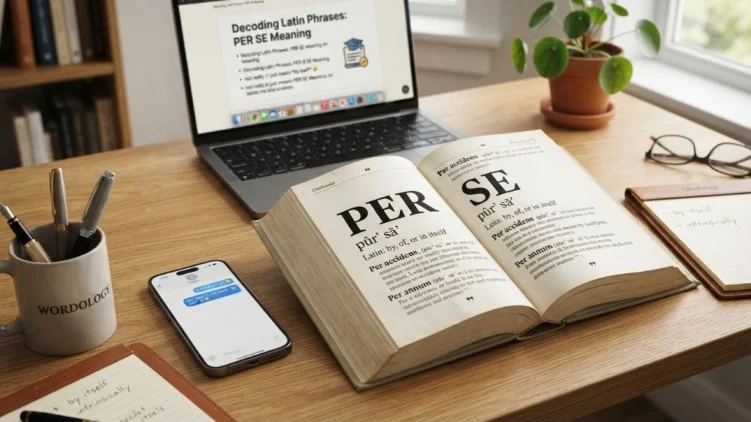
“Per se” is a Latin phrase that means “by itself,” “in itself,” or “as such.” It is used when you want to talk about something on its own, without considering other factors
Some phrases sound more complicated than they really are. Per se is a good example. You may have seen it in a text, social media post, school assignment, news story, or even a work email and wondered what it actually means. The good news is that the meaning is simple: per se means “by itself” or “in itself.”
If you are a student, writer, social media user, gamer, professional, or simply someone who wants to understand everyday English better, knowing this phrase can help. It often appears when someone wants to make a small but important distinction.
For example, someone might say, “I don’t dislike the movie per se. I just didn’t enjoy the ending.” Here, the person is saying they do not dislike the movie itself. Their problem is with one part of it. Once you understand this idea, per se becomes much easier to recognize and use.
Definition & Meaning
Per se is a Latin phrase that means “by itself,” “in itself,” “of itself,” or “as such.” It is commonly used in English when someone wants to describe something on its own, without adding outside factors to the discussion.
The phrase is usually pronounced something like “per say.” The spelling can look unusual because it comes directly from Latin.
Imagine someone says:
“There is nothing wrong with coffee per se.”
This does not mean the person loves coffee. It means coffee itself is not the problem. Perhaps they dislike drinking it late at night because it keeps them awake.
Another example is:
“Being quiet isn’t rude per se.”
This means being quiet in itself is not rude. The situation, tone, or reason for being quiet may change how people see it.
The phrase is useful when you want to separate an object, action, idea, or person from the circumstances around it.
Simple meaning of per se
You can usually understand per se as:
- By itself
- In itself
- In and of itself
- As such
- Considered alone
- Taken on its own
For example:
“I don’t hate online shopping per se. I just prefer shopping in stores.”
The speaker is not saying online shopping is bad. They are simply explaining that their personal preference is different.
Per se in a sentence
Here are a few simple examples:
“The job isn’t difficult per se, but it takes a lot of time.”
- Meaning: The job is not difficult by itself, but it has another problem.
“Money isn’t the goal per se. Freedom is.”
- Meaning: Money itself is not the main goal.
“I’m not angry at you per se. I’m upset about what happened.”
- Meaning: The person is not angry at the other person as a person. They are upset about a specific event.
Why people use per se
People use per se when they want to make their meaning more precise. It can help show that they are not completely rejecting or criticizing something.
Compare these two statements:
“I don’t like your idea.”
and
“I don’t dislike your idea per se, but I think it needs some changes.”
The second statement is softer and more specific. It tells the listener that the idea itself is not necessarily bad.
Background & History
Per se comes from Latin. The Latin expression can be understood as meaning “by itself” or “in itself.” English adopted many Latin words and phrases over the centuries, especially through education, law, philosophy, science, religion, and formal writing.
Unlike some modern slang terms, per se was not created as an internet abbreviation or texting expression. It has a much older history.
The Latin word per can mean “through,” “by,” or “by means of,” depending on context. Se refers to “itself” or “himself/herself” in this construction. Together, the phrase expresses the idea of something considered on its own.
Over time, English speakers began using per se as a borrowed phrase. It became especially common in educated and formal forms of English.
You can still see its older influence in areas such as:
- Law
- Philosophy
- Academic writing
- Business
- Journalism
- Formal discussions
- Everyday speech
However, per se is not limited to formal writing anymore. Many English speakers use it in casual conversations.
For example:
“It’s not expensive per se, but I don’t really need it.”
That sounds natural in everyday speech.
How per se became common in English
English has a long history of borrowing words from other languages. Latin had a major influence on English vocabulary, particularly in areas involving education and formal thought.
Words and phrases connected with concepts such as “in itself,” “by itself,” and “of its own nature” were useful in logical and philosophical discussions.
As English developed, per se remained useful because it expresses a very specific idea in only two words.
Instead of saying:
“I am not saying the thing itself is bad.”
Someone can simply say:
“It isn’t bad per se.”
This makes the phrase efficient.
Per se today
Today, you may encounter per se in many places. It appears in books, articles, podcasts, interviews, emails, social media posts, comments, and conversations.
It is especially useful when someone wants to make a distinction.
For example:
“The game isn’t boring per se. I just prefer faster games.”
The speaker separates the game from their personal preference.
That is one of the main reasons the phrase has survived for so long.
Usage in Various Contexts
The meaning of per se stays mostly the same across different situations, but the tone can change depending on where you see it.
Per se in texting
People sometimes use per se in text messages when they want to explain their exact opinion.
Example:
Friend: “So you hate the restaurant?”
You: “Not per se. The food was actually good. The service was just terrible.”
Here, per se helps the speaker correct an assumption.
Another example:
Friend: “You don’t like parties?”
You: “Not per se. I just don’t like huge crowds.”
Per se on social media
On social media, the phrase can appear in posts, comments, captions, and debates.
For example:
“I’m not against the idea per se. I just think the execution could be better.”
This is useful when someone wants to disagree without completely rejecting an idea.
Per se in gaming
Gamers can use the phrase when talking about game mechanics, characters, graphics, or strategies.
Player 1: “Do you think this game is bad?”
Player 2: “Not per se. The graphics are great. I just don’t like the combat.”
Or:
“The boss isn’t difficult per se. The controls make the fight frustrating.”
Here, the speaker says the boss itself is not the real problem.
Per se in casual conversation
In everyday conversation, per se often appears when people want to make a clarification.
“I’m not tired per se. I just need some quiet time.”
“She’s not unfriendly per se. She’s just shy.”
“The book isn’t bad per se, but it wasn’t my style.”
These examples show a common pattern:
Something is not necessarily bad, good, wrong, or disliked in itself. Another factor is responsible.
Per se in professional communication
The phrase can also appear in meetings, reports, presentations, and emails.
“The proposal is not problematic per se, but we need more data before approving it.”
This sounds measured and professional.
However, simpler alternatives such as “itself” or “in itself” may sometimes be clearer.
Common Misconceptions & Clarifications
Because per se is a borrowed Latin phrase, people often misunderstand it.
Misconception 1: Per se means “personally”
It does not mean personally.
Incorrect understanding:
“I don’t like the movie per se” = “I personally don’t like the movie.”
Correct meaning:
“I don’t dislike the movie per se” = “I don’t dislike the movie itself.”
The phrase focuses on the thing being discussed, not simply the speaker’s personal opinion.
Misconception 2: Per se means “perhaps”
It does not mean perhaps, maybe, or possibly.
For example:
“The plan isn’t wrong per se.”
This does not mean the plan is “maybe wrong.”
It means the plan is not wrong in itself.
Misconception 3: Per se means “obviously”
Again, it does not.
The phrase does not express certainty, doubt, or obviousness. It simply narrows the discussion to something considered on its own.
Misconception 4: It is only for lawyers
Lawyers do use per se, and you may see it in legal language. But the phrase is not exclusive to law.
Students, writers, professionals, and everyday speakers can use it too.
Misconception 5: It is always very formal
Per se can sound somewhat formal, but it is also used casually.
For example:
“I’m not mad per se. I’m just disappointed.”
That is perfectly understandable in casual conversation.
Is per se inappropriate?
No. Per se is not offensive or inappropriate by itself. It is a neutral phrase.
The only concern is clarity. If you are speaking to someone who may not know the phrase, “itself” can be easier to understand.
Similar Terms & Alternatives
Several English expressions can replace per se, depending on the sentence.
1. Itself
This is often the simplest alternative.
Per se:
“The idea isn’t bad per se.”
Alternative:
“The idea itself isn’t bad.”
Both express almost the same meaning.
2. In itself
This is very close to per se.
“The task isn’t difficult in itself.”
This means the task is not difficult when considered alone.
3. In and of itself
This is another common alternative.
“The decision isn’t wrong in and of itself.”
It means the decision is not wrong simply by its own nature.
4. As such
This can sometimes work, but it is not always an exact replacement.
“The rule is not unfair as such.”
The meaning depends more strongly on the surrounding sentence.
5. By itself
This phrase focuses on something existing or functioning alone.
“The tool isn’t dangerous by itself.”
This can be different from per se, so you should choose based on context.
Comparison table
| Phrase | Basic meaning | Tone |
|---|---|---|
| Per se | In itself | Neutral/formal |
| Itself | The thing itself | Simple |
| In itself | Considered alone | Neutral |
| In and of itself | By its own nature | Formal |
| By itself | Alone | Very common |
| As such | In that capacity/form | Formal |
For everyday English, “itself” is often the easiest choice.
How to Respond to This Term
If someone uses per se in a conversation, you usually do not need a special response. Just understand it as “in itself” or “by itself.”
Casual response
Friend: “I don’t dislike the movie per se. I just didn’t like the ending.”
You: “Yeah, I get what you mean.”
Funny response
Friend: “I’m not lazy per se. I just believe in energy conservation.”
You: “That’s a very professional way to say you’re avoiding work.”
Here, the humor comes from the situation, not from the phrase itself.
Professional response
Coworker: “The proposal isn’t weak per se, but it needs more evidence.”
You: “That makes sense. We can add more supporting data.”
Clarifying response
If you are unsure what the speaker means, you can simply ask:
“Do you mean the thing itself?”
Or:
“So you’re saying the main issue is something else?”
Privacy-conscious response
Sometimes people use per se while discussing personal subjects.
You do not need to share private information to continue the conversation.
Person: “Is your family against it per se?”
You: “I’d rather not get into the personal details, but I understand what you mean.”
This keeps the conversation polite while protecting your privacy.
Regional or Cultural Differences
Per se is widely understood in English-speaking environments, but how often people use it can vary.
In countries where English is commonly used in education, business, or media, you may encounter the phrase regularly.
It is particularly familiar in:
- The United States
- Canada
- The United Kingdom
- Australia
- New Zealand
- Other regions where English is widely taught or used professionally
However, not every English speaker uses per se in daily conversation.
Someone may understand the phrase but still prefer simpler expressions such as:
- “itself”
- “by itself”
- “in itself”
Per se in different languages
The exact phrase may not be used in every language, but many languages have an equivalent idea.
The important concept is considering something on its own.
For example, English speakers might say:
“The idea isn’t bad per se.”
Another language may use its own expression meaning:
“The idea itself isn’t bad.”
So the concept is widely understandable even when the exact Latin phrase is not used.
Regional slang
There is no major slang version of per se that changes its basic meaning. It is not like internet abbreviations such as “LOL,” “BRB,” or “IDK.”
You may see informal spellings such as “per say,” especially because that is how the phrase sounds when spoken. However, “per se” is the standard spelling.
Comparison with Similar Terms
It helps to compare per se with expressions that seem similar but have slightly different meanings.
| Expression | Meaning | Example |
|---|---|---|
| Per se | In itself | “It’s not bad per se.” |
| Itself | The thing itself | “The product itself is good.” |
| Personally | According to one’s own opinion | “Personally, I prefer tea.” |
| Actually | In fact | “Actually, I liked it.” |
| Technically | According to facts/rules | “Technically, you’re correct.” |
| Generally | Usually or broadly | “Generally, people like it.” |
| Specifically | In an exact or particular way | “I mean this specifically.” |
| By itself | Alone | “The machine works by itself.” |
| In itself | Considered alone | “The idea is useful in itself.” |
Per se vs. personally
This is one of the most important differences.
Personally describes someone’s individual opinion.
“Personally, I don’t like coffee.”
Per se focuses on coffee itself.
“Coffee isn’t bad per se.”
The second sentence does not necessarily tell us whether the speaker personally likes coffee.
Per se vs. technically
These phrases also have different jobs.
“The rule isn’t unfair per se.”
This focuses on the rule itself.
“Technically, the rule applies to everyone.”
This focuses on facts, rules, or technical correctness.
Usage in Online Communities & Dating Apps
Online conversations often involve short statements that need clarification. That makes per se useful.
On social platforms, someone may say:
“I’m not against dating apps per se. I just don’t like how stressful they can be.”
This means dating apps themselves are not necessarily the problem.
Per se on social media
You may see posts such as:
“I don’t hate this trend per se, but some people take it too far.”
Or:
“The opinion isn’t offensive per se. The way it was expressed was the problem.”
This helps users separate an idea from how it is presented.
Per se on dating apps
A person might write:
“I’m not looking for a relationship per se. I’m just meeting new people.”
Here, the phrase can clarify that the person is not specifically seeking a formal relationship.
Another example:
“I’m not against long-distance dating per se, but I don’t think it works for me.”
This tells the other person that the speaker does not reject the concept entirely.
Per se in gaming communities
Gamers may use it when reviewing a game:
“The game isn’t difficult per se. The tutorial is just confusing.”
Or:
“The character isn’t weak per se. You just need the right build.”
Tips for responding online
If someone uses per se, focus on the sentence around it.
Ask yourself:
What is the person saying about the thing itself?
Usually, the speaker is making a distinction between the main subject and another factor.
Hidden or Offensive Meanings
There is no standard hidden offensive meaning attached to the phrase per se.
It is not a swear word, insult, sexual term, or offensive abbreviation.
Still, context matters.
For example:
“I’m not judging you per se, but…”
The phrase itself is harmless. However, what follows could be judgmental.
Similarly:
“I’m not saying your idea is stupid per se…”
Even though per se is neutral, the full sentence may still sound insulting.
Tone can change the message
Consider:
“I’m not angry per se.”
This sounds calm.
Now imagine someone saying it with an irritated tone:
“I’m not angry per se, but you clearly weren’t listening.”
The phrase remains neutral, but the rest of the sentence creates tension.
Why context matters
People sometimes focus on the phrase itself and miss the message around it.
When you see per se, look at:
- What is being discussed?
- What does the speaker say about it?
- What problem or exception comes after the phrase?
- Is the speaker clarifying, criticizing, or joking?
This will usually reveal the intended meaning.
Suitability for Professional Communication
Per se is acceptable in professional communication, especially when you need to make a precise distinction.
You may see it in:
- Business emails
- Reports
- Presentations
- Academic writing
- Legal discussions
- Workplace conversations
- Professional articles
For example:
“The proposal is not unrealistic per se, but the current budget is too limited.”
This is professional and clear.
However, simple language is often better when communicating with a broad audience.
Instead of:
“The strategy is not ineffective per se.”
You could say:
“The strategy itself is not ineffective.”
Or even:
“The strategy works, but it has some limits.”
The best choice depends on your audience.
Professional alternatives
For formal writing, you can use:
- In itself
- In and of itself
- Itself
- By its nature
- Considered on its own
Example in a work email
“The proposed change is not a problem per se, but we should review its impact on the current workflow.”
This sounds measured and professional.
When to avoid per se
You may want to avoid it when:
- Your audience may not know the phrase.
- You are writing for children.
- You want very simple English.
- A shorter word would be clearer.
- The phrase makes your sentence sound unnecessarily formal.
Remember, using a Latin phrase does not automatically make writing better. Clarity is more important than complexity.
FAQs
What does per se mean?
Per se means “by itself,” “in itself,” or “as such.” It is used when something is considered on its own rather than with other factors.
Is per se English or Latin?
Per se is originally Latin, but it is commonly used in modern English.
How do you pronounce per se?
It is usually pronounced “per say.”
Is per se formal?
It can sound somewhat formal, but it is also used in everyday conversations, online discussions, and casual speech.
Is “per say” correct?
The standard spelling is “per se.” “Per say” is a common spelling mistake caused by the pronunciation.
Can I use per se in texting?
Yes. You can use per se in texting when you want to say “in itself” or clarify that something is not the main problem.
For example:
“I’m not upset per se. I just need some space.”
What is the easiest synonym for per se?
The simplest alternatives are “itself” and “in itself.”
Conclusion
Per se means “by itself,” “in itself,” or “as such.” It is a Latin phrase that became part of everyday English and is still used in conversations, social media, professional writing, academic work, and online communities.
The easiest way to understand it is to think of “the thing itself.” When someone says, “It isn’t bad per se,” they usually mean that the thing is not bad on its own, even though another part of the situation may be a problem.
You can use per se when you want to make your meaning more precise or separate an idea from the circumstances around it. Just remember that “per se” is the correct spelling, not “per say.”
Once you understand this simple distinction, the phrase becomes much easier to spot, understand, and use naturally.
Read More Related Articles:
IG Meaning in Text Messages | Definition, Uses, and Real …
What Is OML in Text | Meaning, Examples, Snapchat, TikTok …
What It Really Means in Messages and Online Chats