Quick answer:
PS usually means “postscript,” an extra note added after the main message or letter.
In texting and social media, PS can also be used to add a final thought, reminder, or funny comment.
A short message can sometimes carry more meaning than it seems. PS meaning is a good example. You may have seen “PS” at the end of an email, text, letter, social media post, or online message and wondered what those two letters mean. In most cases, PS means “postscript,” which is an extra thought added after the main message is finished.
If you are a student, writer, texter, social media user, gamer, or professional, knowing this abbreviation can make online communication much easier. You may use it to add a reminder, joke, personal note, or detail that you forgot earlier. The meaning is usually simple, but its tone can change with the situation. Let’s explore what PS means, where it came from, how people use it today, and how you can respond when someone sends it to you.
Definition & Meaning
The most common PS meaning is “postscript.”
The word postscript comes from Latin roots that mean something like “written after.” It refers to a short note added after the main body of a letter or message.
You might see it written as:
PS = Postscript
For example:
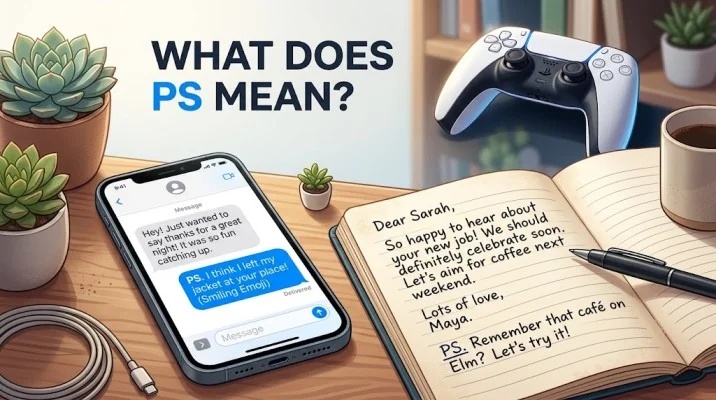
Hi Sarah,
Thanks for helping me with my project. I really appreciate it.
PS: Don’t forget to bring the notes tomorrow!
The main message is complete, but the sender adds one more detail afterward.
What does PS mean in texting?
In texting, PS usually keeps the same basic meaning.
Someone may finish a conversation and then add a final thought.
Alex: “I’ll meet you at 7. See you soon!”
Alex: “PS: Bring your charger.”
The PS works like a small afterthought.
What does PS mean on social media?
People also use PS in posts, captions, comments, and direct messages.
For example:
“The trip was amazing! PS: I still can’t believe we missed the train 😂”
Here, PS adds a humorous final thought.
Does PS have other meanings?
Yes. PS can mean different things in different contexts.
For example:
- Postscript in letters and messages
- PlayStation in gaming
- Public School in some educational contexts
- Personal Statement in education or applications
- Photoshop in some informal conversations
So, context matters.
If someone says:
“I bought a new PS yesterday.”
They may mean PlayStation, not postscript.
But if someone writes:
“PS: I forgot to tell you something.”
They almost certainly mean postscript.
Background & History
The history of PS goes back to the traditional practice of adding extra notes to written letters.
Before texting, email, and social media existed, people often wrote long letters by hand. After finishing a letter, a writer might suddenly remember an important detail.
Instead of rewriting the entire letter, they could simply add:
P.S.
Then they wrote the extra information.
For example:
P.S. Please give my regards to your family.
This made letters easier to write. The writer did not need to change the main text just because they remembered something at the end.
Where did “postscript” come from?
Postscript is built from Latin elements associated with after and writing. The term became established in English as a way to describe something written after the main text.
Over time, P.S. became a familiar feature of letters.
It was especially useful because handwritten letters could not easily be edited after completion.
PS in the digital age
Technology changed how people communicate, but PS survived.
Today, people use it in:
- Emails
- Text messages
- Social media captions
- Online comments
- Newsletters
- Personal messages
- Marketing copy
- Letters
Digital communication makes editing easy, but people still use PS because it gives the final thought a special feeling.
PS in marketing
Businesses also use PS strategically.
For example:
“P.S. The discount ends tonight.”
The main message may already explain a product or offer. The PS then highlights an important final detail.
Today, PS is both practical and stylistic.
Usage in Various Contexts
The meaning and tone of PS can change depending on where you see it.
PS in texting
In text messages, PS often introduces a forgotten thought.
Mia: “Thanks for picking me up!”
Mia: “PS: I left my jacket in your car.”
It can also add humor.
Sam: “I promise I’ll start eating healthy tomorrow.”
Sam: “PS: I just ordered pizza.”
PS in social media
Social media users often add PS to captions to make a final comment feel more personal.
“Best weekend ever! PS: Yes, I really ate all that cake.”
It can create a casual and friendly tone.
PS in emails
PS is common in personal emails and can sometimes appear in business emails.
Subject: Meeting Tomorrow
“Hi James, I’ll see you at 10 a.m. tomorrow.
PS: Please bring the sales report.”
In a formal email, however, it may be better to place important information directly in the main message.
PS in gaming
Gaming creates a different possibility.
If someone says:
“I just bought a new PS.”
They may mean PlayStation.
For example:
Player A: “What console do you use?”
Player B: “PS5.”
Here, PS does not mean postscript.
This is why the surrounding words are important.
PS in casual conversation
People may also say “PS” aloud, although this is less common than writing it.
Friend: “I’ll see you tonight. PS, bring your camera.”
The speaker is simply adding a final thought.
Common Misconceptions & Clarifications
There are several common misunderstandings about PS meaning.
Misconception 1: PS always means PlayStation
Not at all.
PlayStation is a very common meaning in gaming, but PS traditionally means postscript when it appears at the end of a written message.
Compare:
“PS: I love your new shoes.”
Here, PS means postscript.
“I play games on PS5.”
Here, PS refers to PlayStation.
Misconception 2: PS is only used in letters
This was once more common, but today PS appears in many digital formats.
People use it in:
- Texts
- Emails
- Captions
- Comments
- Newsletters
- Direct messages
Misconception 3: PS means something secret
Usually, it does not.
PS is a standard abbreviation with widely recognized meanings.
Misconception 4: PS makes a message informal
Not always.
The abbreviation can appear in both personal and professional communication. The overall tone depends on the message.
Misconception 5: PS is the same as “by the way”
They are similar in some situations, but not identical.
By the way can introduce an additional point anywhere in a conversation.
PS traditionally comes after the main message has finished.
For example:
“By the way, don’t forget the meeting.”
This can appear naturally in the middle of a conversation.
But:
“PS: Don’t forget the meeting.”
Feels more like a final reminder.
Similar Terms & Alternatives
Several expressions can serve a purpose similar to PS.
| Term | Meaning | Typical use |
|---|---|---|
| PS | Postscript | Final extra note |
| PPS | Post-postscript | Extra note after a PS |
| BTW | By the way | Additional thought |
| Note | Extra information | Clarification or reminder |
| FYI | For your information | Useful information |
| Reminder | Something to remember | Important follow-up |
| Side note | Additional comment | Casual discussion |
| One more thing | Final point | Conversation or writing |
PS vs BTW
These are often confused.
BTW can appear anywhere:
“BTW, I changed the meeting time.”
PS usually comes at the end:
“See you tomorrow. PS: The meeting starts at 9.”
PS vs FYI
FYI means “for your information.” It introduces information that may be useful.
PS simply adds a final note.
What is PPS?
If you need to add another note after PS, you can use PPS, meaning post-postscript.
Example:
PS: Bring your umbrella.
PPS: And don’t forget your keys!
This is less common today but still understood.
How to Respond to This Term
If someone sends you a message with PS, you normally do not need to respond to the abbreviation itself. Simply respond to the information that follows it.
Casual response
Friend: “PS: Bring snacks.”
You: “Got it! Snacks are coming 😂”
Funny response
Friend: “PS: Don’t eat the cake before the party.”
You: “Too late. The PS arrived after the cake disappeared.”
Professional response
Manager: “PS: Please bring the updated report.”
You: “Understood. I’ll bring the updated report.”
If you are confused
If PS could have several meanings, ask for clarification.
“When you say PS, do you mean PlayStation or postscript?”
This is especially useful in gaming conversations.
Privacy-conscious response
If the PS contains a request for private information, you do not need to share it.
Person: “PS: Send me your private account details.”
You: “I’d prefer not to share private information here.”
The abbreviation itself is harmless. The content of the message is what matters.
Regional or Cultural Differences
PS is widely recognized in English-speaking communication, but the way people use it can vary by region and context.
In American and British English, P.S. is commonly understood as “postscript.”
British English may also use P.S. in traditional letters and modern emails.
In other countries, English abbreviations are often used online even when English is not the person’s first language.
For example, someone writing in another language may still add:
“P.S. Don’t forget!”
This happens because online communication has spread many English abbreviations across borders.
Cultural differences in tone
In some settings, PS can feel:
- Friendly
- Personal
- Playful
- Informal
- Warm
In a formal business environment, however, an important point is usually better placed in the main body of the message.
Gaming culture
Gaming communities create another major meaning.
PS can refer to PlayStation, especially when followed by a number:
- PS4
- PS5
So, cultural and community context can completely change the meaning.
Comparison with Similar Terms
Understanding PS becomes easier when you compare it with other abbreviations.
| Expression | Full form | Main purpose |
|---|---|---|
| PS | Postscript | Add a final thought |
| PPS | Post-postscript | Add another final thought |
| BTW | By the way | Introduce an extra point |
| FYI | For your information | Share useful information |
| ASAP | As soon as possible | Show urgency |
| TL;DR | Too long; didn’t read | Give a short summary |
| NB | Nota bene | Highlight something important |
Example
“The meeting is at 3 p.m. BTW, the room has changed.”
Here, BTW introduces an additional point during the message.
Compare:
“The meeting is at 3 p.m. PS: The room has changed.”
Here, PS feels like a final note.
Neither is automatically better. The right choice depends on your writing style and context.
Usage in Online Communities & Dating Apps
On social media, dating apps, forums, and gaming communities, PS can add personality to a message.
On a dating app such as Tinder, someone might write:
“I love hiking, coffee, and terrible movies. PS: I will absolutely judge your pizza toppings.”
This makes the profile feel more playful.
A match might also use PS in a message:
“You seem fun to talk to. PS: Your dog is adorable.”
That final note may add warmth or humor.
On platforms such as X, PS can be used at the end of posts:
“Finally finished the project! PS: I need a vacation.”
In gaming communities
PS is more likely to mean PlayStation when it appears with a console number or gaming terms.
“Are you on PS5?”
This clearly refers to PlayStation.
Tips for online conversations
Always read the words around the abbreviation.
If PS appears after a complete message:
Postscript is likely.
If PS appears next to a console:
PlayStation is likely.
If you are unsure, ask rather than guessing.
Hidden or Offensive Meanings
PS does not normally have a hidden offensive meaning.
The most common meanings are ordinary:
- Postscript
- PlayStation
- Public School
- Personal Statement
- Other context-specific abbreviations
However, abbreviations can sometimes have niche meanings in specific online communities.
That does not mean those meanings are universal.
Why context matters
Consider this message:
“PS: I forgot to tell you something.”
The meaning is almost certainly postscript.
Now consider:
“I bought a PS5.”
The meaning is PlayStation.
The same two letters can point to completely different ideas.
Tone can also matter
A PS can make a message sound playful:
“PS: You still owe me ice cream 😄”
But it can also deliver a serious reminder:
“PS: Please submit the documents before Friday.”
So, the abbreviation itself is not offensive. The message surrounding it determines the tone.
Suitability for Professional Communication
PS can be appropriate in professional communication, but it depends on the situation.
A short PS may work well in:
- Friendly workplace emails
- Marketing emails
- Newsletters
- Personal professional messages
- Informal business communication
For example:
“Thank you for attending the meeting.
PS: The next session will be held on Monday.”
However, if the information is important, placing it in the main body is often clearer.
Better professional alternatives
Instead of:
“PS: Please send the invoice.”
You could write:
“Please send the invoice by Friday.”
This puts the important action directly in the main message.
For formal documents, you can use:
- Note
- Additional information
- Important reminder
- Please note
- Additional details
When PS works well
PS can be useful when the main message is complete and you remember one small detail afterward.
For example:
“Thank you for your feedback. I look forward to working with you.
P.S. Please say hello to your team.”
This can feel warm without being overly formal.
FAQs
1. What does PS mean in texting?
In texting, PS usually means “postscript.” It introduces an extra thought, reminder, or comment added after the main message.
2. What does PS mean on social media?
On social media, PS usually means postscript, especially when it appears at the end of a caption or post. It can introduce a funny or personal final thought.
3. Does PS mean PlayStation?
It can. In gaming, PS often refers to PlayStation, especially in phrases such as PS4 or PS5.
4. What does P.S. stand for?
P.S. stands for “postscript.” It refers to something written after the main body of a message or letter.
5. What is the difference between PS and PPS?
PS means postscript. PPS means post-postscript and is used for an additional note after the PS.
6. Is PS formal or informal?
PS can be used in both settings, but it is more common in personal, casual, friendly, and semi-formal communication. Important information in formal writing is usually better placed in the main text.
7. Is PS an offensive word?
No. PS is not normally offensive. Its meaning depends on the context, and common meanings include postscript and PlayStation.
Conclusion
The PS meaning is usually simple: postscript, or an extra note written after the main message. It is often used when someone remembers a final detail, wants to add a reminder, or simply wants to finish with a funny or personal comment.
However, context is important. In texting, emails, letters, and social media, PS usually means postscript. In gaming, PS may mean PlayStation. Other fields can also give the abbreviation different meanings.
The good news is that you can usually understand PS by looking at the words around it. If it appears at the end of a message, think postscript. If it appears with PS4 or PS5, think PlayStation. Once you know these common uses, you can read and use PS confidently in everyday conversations, online communities, and professional messages.
Discover More Post:
- Spontaneous Meaning | What It Really Means Easy Examples …
- What Does GOAT Mean in Text, Slang & Social Media in 2026
- Sassy Meaning | Simple Definition, Examples, Uses, and What …