Quick answer:
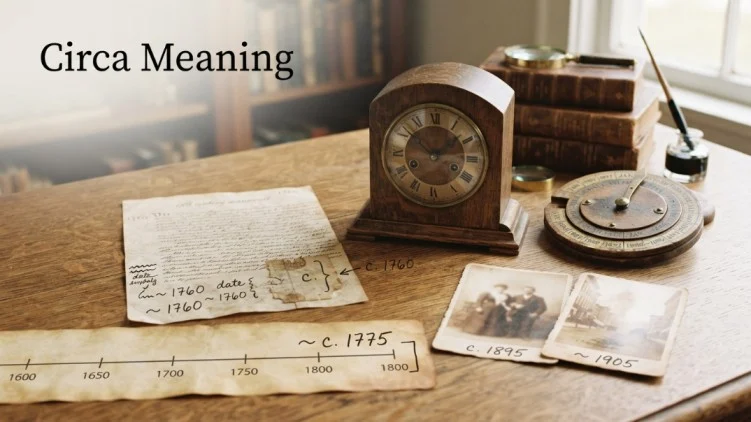
Circa means approximately or around a particular time or number.
It is often written as c. or ca., especially before dates.
A tiny word can sometimes carry a lot of meaning. Circa is one of those words. You may see it beside a date in history books, museum descriptions, biographies, articles, family records, or online posts. It tells you that the date is not exact, but it is close to the stated time.
If you are a student, writer, researcher, history fan, blogger, social media user, or professional, understanding circa meaning can help you read dates and historical information correctly. You may also notice it in captions, documentaries, genealogy records, or discussions about old buildings and events.
The word is simple once you know the idea behind it. Circa means “around” or “approximately.” It is especially useful when an exact date or number is unknown. Let’s explore its meaning, history, examples, online use, cultural differences, and the best ways to use it.
Definition & Meaning
The word circa means approximately, about, or around.
It is most often used when someone knows a general date or number but does not know the exact figure.
Simple definition
Circa = approximately or around a stated time or number.
For example:
The building was constructed circa 1850.
This means the building was probably built around 1850, but the exact year is uncertain.
You may also see:
Circa 1900
or:
c. 1900
Both communicate roughly the same idea.
Circa with dates
The most common use is with historical dates.
For example:
- circa 1750
- c. 1750
- circa 12th century
- c. 500 BC
- circa 1945
The word tells the reader not to treat the date as exact.
Imagine a museum label says:
“Portrait of an unknown woman, circa 1780.”
The museum may know that the painting was created around that period, but there may not be enough evidence to identify the exact year.
Circa with numbers
Although it is strongly associated with dates, circa can also mean approximately when discussing numbers.
“The village had circa 2,000 residents.”
This means the village had around 2,000 residents.
In modern everyday English, however, people usually say about, around, or approximately instead.
Circa in a sentence
“The castle was built circa 1400.”
This means:
“The castle was built around 1400.”
So, if you see circa before a date, remember one simple idea: the date is an estimate, not a confirmed exact date.
Background & History
The word circa comes from Latin. It is related to the Latin word circa, meaning around or about.
Because Latin was widely used in European scholarship, religion, law, science, and historical writing, many Latin terms entered English and other European languages.
Over time, circa became especially useful for historians and researchers.
Why did people need the word?
Historical records are often incomplete.
A person might know that an event happened in the middle of the 18th century but have no document proving the exact year. Instead of pretending the date is certain, researchers can write:
circa 1750
This tells readers that the date is an informed estimate.
Shortened forms
The word is often abbreviated as:
- c.
- ca.
- circa
For example:
c. 1600
and:
circa 1600
usually have the same basic meaning.
The abbreviation c. is especially common in historical timelines, academic writing, museum records, and reference works.
How usage evolved
In older scholarly writing, Latin terms were common. As English became the dominant language of many academic fields, some Latin expressions remained in regular use.
Circa survived because it performs a useful job very clearly.
Today, it is still common in:
- history
- archaeology
- art history
- genealogy
- museum catalogs
- biographies
- architecture
- historical research
- academic writing
You may also see it in online articles when writers discuss historical people, buildings, inventions, or events.
Usage in Various Contexts
The meaning of circa stays fairly consistent, but its use changes depending on the situation.
In texting
People rarely use circa in casual texting because about or around sounds more natural.
Alex: “When was the house built?”
Sam: “Circa 1920, I think.”
This is possible, but:
“Around 1920, I think.”
sounds more casual.
On social media
You may see circa in historical posts or captions.
Caption: “This photograph is from circa 1910.”
It can give a post a more historical or formal tone.
In gaming
Gaming communities may use circa when discussing the release period of an old game or event.
Player A: “When did this version come out?”
Player B: “Circa 2005, I believe.”
Again, around 2005 would sound more natural in casual conversation.
In casual conversation
The word is understandable, but it can sound slightly formal.
Person A: “When did your family move there?”
Person B: “Circa 1980.”
A more relaxed response would be:
“Around 1980.”
In professional writing
Circa works very well when an exact date is unknown.
“The structure dates to circa 1750.”
This is concise and professional.
In historical writing
This is where circa is most useful.
“The manuscript was produced circa 1200.”
The writer is making clear that the date is estimated.
Common Misconceptions & Clarifications
Several misunderstandings can arise when people encounter circa for the first time.
Misconception 1: Circa means exactly
It means the opposite.
Circa signals uncertainty or approximation.
If someone writes:
“Born circa 1850”
they are not claiming the person was definitely born in 1850.
They mean the birth occurred around that time.
Misconception 2: Circa only means “old”
Not at all.
The word does not mean something is ancient.
For example:
“The company was founded circa 1995.”
The company may be relatively modern. Circa simply means the date is approximate.
Misconception 3: Circa and circa are different words
No. Circa is the full word. You may also see c. or ca. as abbreviations.
Misconception 4: Circa means “before”
Not exactly.
Compare:
Circa 1900
means around 1900.
But:
Before 1900
means any time earlier than 1900.
They communicate different ideas.
Misconception 5: Circa means “after”
Again, no.
Circa 1900
does not specifically mean after 1900.
It gives an approximate period around that date.
Misconception 6: Circa makes information unreliable
Not necessarily.
An estimated date can still be based on strong historical evidence.
Researchers often use circa because being honest about uncertainty is better than presenting an estimate as an exact fact.
Similar Terms & Alternatives
Several words can replace circa, depending on the sentence.
| Term | Meaning | Example |
|---|---|---|
| Circa | Around an approximate date | “Circa 1800” |
| About | Approximately | “About 1800” |
| Around | Approximately | “Around 1800” |
| Approximately | Nearly or roughly | “Approximately 1800” |
| Roughly | Approximately | “Roughly 1800” |
| Nearly | Close to, but usually less than | “Nearly 1800” |
| Estimated | Based on an approximation | “Estimated date: 1800” |
Circa vs. about
Circa sounds more formal and historical.
About sounds more natural in everyday speech.
Formal: “The painting dates to circa 1700.”
Casual: “The painting is from about 1700.”
Circa vs. approximately
These can often be interchangeable.
“The event occurred circa 1500.”
“The event occurred approximately in 1500.”
The first is more concise and traditional in historical writing.
How to Respond to This Term
If someone uses circa in conversation, your response depends on the context.
Casual response
“So, around that time?”
This is a simple way to confirm the meaning.
Curious response
“Do you know the exact year, or is 1850 just an estimate?”
This works when you need more precise information.
Funny response
“So basically, history is saying, ‘Give or take a few years.’”
This can make the conversation lighter.
Professional response
“Understood. So the date is approximate rather than confirmed.”
This works well in academic or workplace discussions.
If you need an exact date
“Do we have a documented date, or should we keep it as circa 1850?”
This is useful when accuracy matters.
Regional or Cultural Differences
Circa is an international term within formal English, but its popularity varies by context.
In English-speaking countries, it is strongly associated with:
- history
- museums
- archaeology
- academic writing
- architecture
- genealogy
- historical records
British English uses circa regularly in formal and historical contexts.
American English also uses it, especially in academic, historical, and professional writing.
Everyday speech
Across English-speaking regions, people usually prefer simpler alternatives in conversation.
Instead of:
“Circa 1985.”
Someone may naturally say:
“Around 1985.”
The difference is mainly style and context, not meaning.
Other languages
Many languages have their own equivalent of circa or use a related Latin form.
For example, historical and academic texts may use words meaning around, approximately, or about.
The concept is universal because historical records often contain uncertain dates.
Comparison with Similar Terms
Knowing the difference between circa and related expressions can prevent confusion.
| Expression | Meaning | Exactness |
|---|---|---|
| Circa 1900 | Around 1900 | Approximate |
| About 1900 | Approximately 1900 | Approximate |
| Around 1900 | Near 1900 | Approximate |
| Exactly 1900 | Precisely 1900 | Exact |
| Before 1900 | Earlier than 1900 | Specific direction |
| After 1900 | Later than 1900 | Specific direction |
| By 1900 | At or before 1900 | Time limit |
| Since 1900 | From 1900 until now or another point | Starting point |
Example
Consider these statements:
“The building was completed circa 1900.”
The exact year is unknown.
“The building was completed in 1900.”
The writer presents 1900 as the exact year.
“The building was completed before 1900.”
The building existed before that year.
These small differences matter in historical writing.
Usage in Online Communities & Dating Apps
The word circa is not especially common on dating apps, but it can appear in profile descriptions, conversations, or discussions about age, photos, music, and historical interests.
For example:
Match: “When was that concert photo taken?”
You: “Circa 2010.”
A more natural dating-app response would probably be:
“Around 2010.”
On platforms such as Tinder, casual language is more common, so circa can sometimes sound playful or intentionally formal.
In online communities, it appears more often when people discuss:
- old games
- classic movies
- historical events
- vintage fashion
- old technology
- music eras
- architecture
For example:
“This design looks circa 1985.”
Here, the speaker means it looks like something from around 1985.
Tips for online use
Use circa when the approximate date matters.
Use around when you want your message to sound more natural and conversational.
Hidden or Offensive Meanings
Circa does not normally have a hidden, sexual, vulgar, or offensive meaning.
It is a standard word with a clear meaning: around or approximately.
Still, context can change how a sentence feels.
For example:
“He was circa 70 years old.”
This sounds unusual because circa is much more strongly associated with dates and historical references. About 70 years old would sound more natural.
Likewise:
“She arrived circa 8 p.m.”
This is understandable, but around 8 p.m. is more natural in everyday English.
Can circa sound pretentious?
Sometimes, yes.
If someone uses circa in a very casual conversation where around would be simpler, it may sound overly formal.
For example:
“I’ll be there circa 7 p.m.”
This can sound playful or deliberately fancy.
That does not make the word wrong. It simply means the style may not match the situation.
Suitability for Professional Communication
Circa is appropriate for professional communication, especially when discussing approximate dates.
It is common in:
- historical reports
- academic papers
- museum descriptions
- research
- genealogy
- architecture
- archival records
- biographies
- technical documentation
For example:
“The original structure dates to circa 1750.”
This sounds professional.
Professional alternatives
If your audience may not know the word, you can use:
- approximately
- around
- about
- estimated
- roughly
For example:
“The building dates to approximately 1750.”
This is very clear.
Choosing the right word
- Use circa when you want a concise, formal, historical style.
- Use around when writing for a general audience.
- Use approximately when precision and clarity are important.
The best choice depends on your readers.
FAQs
1. What does circa mean in simple English?
Circa means around or approximately. It is most often used when a date is not known exactly.
2. What does circa 1900 mean?
Circa 1900 means around the year 1900. The exact date may be unknown.
3. Is circa the same as approximately?
Yes, in many contexts. Both can mean roughly or about, although circa is especially common with dates.
4. What is the abbreviation for circa?
The most common abbreviation is c. You may also see ca.
5. Is circa formal?
Yes. Circa is more formal than “around” or “about.” It is especially common in historical and academic writing.
6. Can circa be used for numbers?
Yes. It can mean approximately when used with numbers, although about or approximately is more common in everyday English.
7. Does circa mean before or after a date?
Neither specifically. Circa means around the stated date, so it indicates an approximate period rather than a clear direction before or after.
Conclusion
Understanding circa meaning is easy once you remember one key idea: circa means around or approximately. It is most often placed before a date when the exact year or period is uncertain.
You may see it written as circa 1800, c. 1800, or ca. 1800. All are commonly used to show an estimated date. The word is especially useful in history, archaeology, museums, genealogy, architecture, biographies, and academic writing.
In casual conversation, around or about usually sounds more natural. In formal or historical writing, circa can be concise and precise about uncertainty. It also does not mean “before” or “after.” It simply tells the reader that the information is approximate.
Discover More Post:
Insatiable Meaning | Definition, Examples, Synonyms, Uses …
Spontaneous Meaning | What It Really Means Easy Examples …
What Does GOAT Mean in Text, Slang & Social Media in 2026