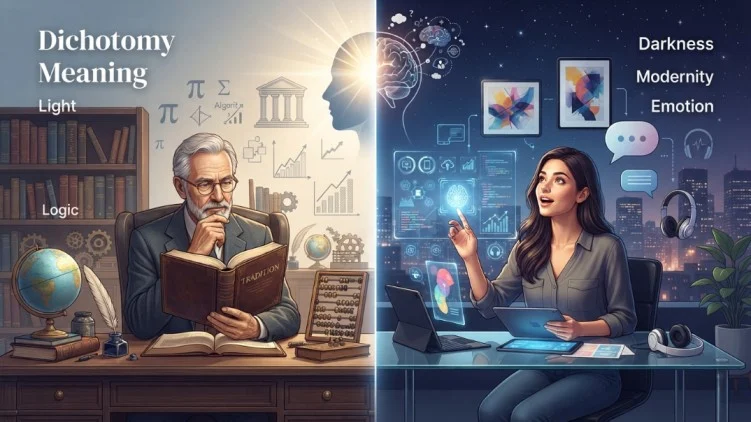
Quick answer:
Dichotomy means a clear division between two things that are presented as very different or opposite.
For example, “There is a dichotomy between work and leisure” means the two are viewed as separate or contrasting parts of life.
Sometimes, two ideas seem to stand on opposite sides of the same line. That clear split is where the dichotomy meaning becomes useful. The word dichotomy describes a division between two contrasting parts, ideas, groups, or choices. It often appears when people talk about differences, opposites, or two ways of seeing an issue.
If you are a student, writer, teacher, professional, gamer, social media user, or everyday English learner, knowing this word can make your communication sharper. You may see it in essays, news stories, online debates, psychology, business discussions, or casual conversations.
Understanding dichotomy also helps you recognize when people present something as “either this or that.” Sometimes that split is useful. Sometimes real life is more complicated. Let’s explore the meaning, history, examples, common misunderstandings, and everyday uses of this interesting word.
Definition & Meaning
The basic dichotomy meaning is a division or contrast between two things that are treated as separate or opposite.
The word usually describes two sides of an idea, situation, or category.
Simple definition
Dichotomy = a division into two contrasting parts.
For example:
Person A: “Why does everyone say you must choose between work and family?”
Person B: “They are creating a dichotomy between career and personal life.”
Here, dichotomy describes the way two areas are presented as opposing choices.
Common examples of dichotomy
You may see dichotomies such as:
- Good vs. evil
- Light vs. darkness
- Rich vs. poor
- Freedom vs. control
- Success vs. failure
- Tradition vs. modernity
- Theory vs. practice
- Online vs. offline
- Emotion vs. logic
These pairs do not always represent true opposites. Sometimes people simply frame them that way.
Dichotomy in a sentence
“The novel explores the dichotomy between appearance and reality.”
This means the book examines the contrast between how things look and how they really are.
Another example:
“The debate created a false dichotomy between safety and freedom.”
Here, false dichotomy means the debate incorrectly suggests that people must choose only one of the two.
Is dichotomy always about opposites?
Not necessarily.
The two sides usually have a strong contrast, but they do not have to be complete opposites.
For example:
“The dichotomy between urban and rural life.”
City and countryside are different, but they are not exact opposites.
The central idea is the clear division into two sides.
Background & History
The word dichotomy has a long history. It comes from the Greek word dichotomia, which is connected to the idea of cutting into two parts. The Greek roots relate to dicha, meaning “in two,” and tomē, meaning “a cutting.”
The idea therefore began with a very simple concept: divide something into two parts.
Over time, the word became useful in philosophy, science, mathematics, medicine, literature, and everyday language.
Dichotomy in philosophy
Philosophers have often examined ideas through pairs of contrasting concepts.
Examples include:
- mind and body
- appearance and reality
- freedom and necessity
- good and evil
- reason and emotion
These divisions can help people understand difficult ideas.
However, philosophers have also questioned whether reality can really be divided into only two categories.
Dichotomy in science
The word is also used in scientific and technical contexts.
For example, researchers may describe two distinct categories or outcomes as a dichotomy when studying a particular subject.
In biology, the word can describe branching into two parts. In mathematics, logic, and statistics, related concepts can describe two possible categories or outcomes.
Dichotomy in modern language
Today, dichotomy is common in academic writing and professional discussions.
You may see it in:
- essays
- journalism
- psychology
- sociology
- politics
- literature
- business
- education
- online debates
The phrase false dichotomy has also become common. It describes a situation where someone presents only two choices even though more possibilities exist.
For example:
“You either agree with me or you hate the idea.”
That creates a false dichotomy because a person could partly agree, disagree with some details, or simply need more information.
Usage in Various Contexts
The word dichotomy appears in many different situations.
In texting
People do not usually use dichotomy in very casual texting, but it can appear in thoughtful conversations.
Alex: “I feel like I have to choose between studying and having a social life.”
Sam: “That sounds like a dichotomy, but maybe you can balance both.”
Here, the speaker is describing two areas as opposing choices.
On social media
The word often appears in discussions about culture, relationships, work, and personal beliefs.
User 1: “People keep treating introverts and extroverts like completely different species.”
User 2: “Yeah, that dichotomy is too simple.”
It can also appear in posts about complex social issues.
In gaming
Gamers may use dichotomy when discussing game design or character choices.
Player A: “The game gives players a choice between stealth and combat.”
Player B: “That creates an interesting dichotomy.”
Game stories often use contrasting character types, such as hero and villain, order and chaos, or freedom and control.
In casual conversations
The word sounds more formal than everyday alternatives such as difference, split, or contrast.
Mia: “Why are you calling it a dichotomy?”
Noah: “Because people are treating the two choices as complete opposites.”
In academic writing
This is one of the most common settings for the word.
“The study examines the dichotomy between individual freedom and social responsibility.”
It gives writers a concise way to describe a major contrast.
Common Misconceptions & Clarifications
The word dichotomy is often misunderstood because people sometimes use it to describe any difference between two things.
Misconception 1: Dichotomy means any difference
Not quite.
A normal difference may be small.
A dichotomy usually involves a clear or meaningful division into two contrasting sides.
For example:
“Tea and coffee have different flavors.”
That is a difference.
But:
“The debate presents a dichotomy between tradition and innovation.”
This suggests a much stronger conceptual divide.
Misconception 2: Dichotomy always means complete opposites
Not necessarily.
Two categories can be different without being perfect opposites.
The important idea is that they are presented as two distinct sides.
Misconception 3: A dichotomy must be real
No.
A false dichotomy occurs when someone creates a two-sided division that does not fully reflect reality.
For example:
“You are either successful or a failure.”
Real life contains many stages between those extremes.
Misconception 4: Dichotomy and contradiction are the same
They are related but different.
A contradiction occurs when two statements or ideas conflict.
A dichotomy describes a division between two contrasting categories or ideas.
Misconception 5: Dichotomy is always negative
It can be neutral.
A writer may use the word simply to describe two distinct sides of a topic.
The meaning depends heavily on context.
Similar Terms & Alternatives
Several words are related to dichotomy, but each has a slightly different meaning.
| Term | Meaning | Example |
|---|---|---|
| Contrast | A noticeable difference | “There is a strong contrast between the colors.” |
| Division | A separation into parts | “The division created two groups.” |
| Opposition | Two sides against each other | “The teams were in opposition.” |
| Duality | Two connected or contrasting aspects | “The character represents a duality.” |
| Binary | Based on two categories or choices | “The system uses a binary classification.” |
| Difference | A way two things are not alike | “There is a difference in opinion.” |
| Conflict | A serious disagreement or struggle | “The story centers on a conflict.” |
| Split | A separation into two or more groups | “The vote caused a split.” |
Dichotomy vs. duality
These terms are close, but duality often emphasizes two sides that exist together.
A dichotomy tends to emphasize the division or contrast between them.
Dichotomy vs. binary
Binary often describes something structured around two categories or choices.
For example:
“A binary choice has two options.”
A dichotomy can describe the conceptual division created by those two sides.
How to Respond to This Term
If someone uses the word dichotomy in a conversation, your response can depend on the situation.
Casual response
“So you mean there are two very different sides?”
This is a simple way to confirm the meaning.
Funny response
“So basically, everyone put the idea into two boxes and called it a day?”
This can work when someone is discussing an overly simple division.
Professional response
“I understand the distinction. However, I think there may be additional factors to consider.”
This is useful in meetings, presentations, or academic discussions.
If you disagree
“I see the contrast, but I’m not sure the situation is completely divided into two sides.”
This is especially useful when you believe someone is creating a false dichotomy.
If you need clarification
“When you say dichotomy, which two categories are you referring to?”
This keeps the conversation clear without pretending you understand something that remains unclear.
Regional or Cultural Differences
Dichotomy is a standard English word and is widely understood across major English-speaking regions. Its basic meaning remains fairly consistent.
The biggest difference is usually not regional but contextual.
In academic English, the word is common.
In casual American or British conversation, people may prefer simpler words such as:
- difference
- contrast
- split
- divide
- two sides
For example, an academic writer may say:
“The article explores the dichotomy between public and private identity.”
A casual speaker might say:
“The article looks at the difference between public and private identity.”
Both communicate a similar idea, but dichotomy sounds more formal.
In multilingual settings, English learners may encounter the word in textbooks, research papers, news articles, and university courses more often than in everyday speech.
The phrase false dichotomy is also broadly understood in English-language discussions because it describes a common reasoning problem.
Comparison with Similar Terms
Understanding the differences between related concepts can help you use dichotomy correctly.
| Term | Main idea | Example |
|---|---|---|
| Dichotomy | Division into two contrasting sides | “A dichotomy between freedom and control.” |
| Duality | Two aspects existing together | “The character has a duality.” |
| Binary | Two categories or choices | “The system has a binary structure.” |
| Contrast | Difference between things | “The contrast is obvious.” |
| Opposition | Two sides positioned against each other | “The groups are in opposition.” |
| Contradiction | Two ideas that cannot both be true | “His statements contain a contradiction.” |
| Spectrum | A range between or beyond categories | “Political views exist on a spectrum.” |
Dichotomy vs. spectrum
This is an especially useful comparison.
A dichotomy divides something into two sides.
A spectrum suggests many positions between two ends.
For example:
“People are either creative or logical.”
That is a dichotomy.
But:
“People can be creative and logical in different ways.”
That treats the subject more like a spectrum.
Usage in Online Communities & Dating Apps
The word dichotomy can appear in online communities, dating discussions, gaming forums, and social platforms.
On dating apps such as Tinder, users may discuss the perceived difference between casual dating and serious relationships.
Match: “People act like dating is either casual or serious.”
You: “That sounds like a false dichotomy. There are many stages in between.”
In online communities, people may also discuss dichotomies such as:
- introvert vs. extrovert
- city vs. countryside
- traditional vs. modern
- casual vs. serious
- logic vs. emotion
- work vs. personal life
On gaming communities, users may describe opposing play styles or character philosophies as a dichotomy.
Tips for online use
Because dichotomy sounds formal, make sure it fits the conversation.
In a serious discussion, it can sound precise.
In a casual chat, simpler words may feel more natural.
If someone uses false dichotomy, pay attention. They may be pointing out that a discussion has been reduced to only two choices when more options exist.
Hidden or Offensive Meanings
Dichotomy does not normally have a hidden, sexual, vulgar, or offensive meaning. It is a standard academic and professional word.
Still, the way it is used can sometimes create a negative impression.
For example:
“The dichotomy between winners and losers.”
This wording may suggest that people can belong to only one of two categories.
The problem is not the word itself. The issue is the idea being divided into two groups.
False dichotomy and sensitive topics
A false dichotomy can become harmful when discussing complex subjects.
For example:
“People are either good or bad.”
Human behavior is often much more complicated.
Similarly:
“You either support the plan or you do not care about the company.”
This leaves no room for partial agreement or reasonable criticism.
So, when using dichotomy, consider whether the two categories genuinely describe the situation.
Suitability for Professional Communication
Dichotomy is appropriate for professional communication, especially when discussing complex ideas, opposing viewpoints, or categories.
It is common in:
- academic papers
- reports
- presentations
- research
- business discussions
- psychology
- sociology
- literature
- journalism
- professional analysis
For example:
“The report examines the dichotomy between short-term growth and long-term stability.”
This sounds professional and precise.
Professional alternatives
If your audience may not know the word, simpler alternatives can improve clarity.
Instead of:
“The dichotomy between the two approaches is clear.”
You could say:
“The difference between the two approaches is clear.”
Instead of:
“This creates a false dichotomy.”
You could say:
“This presents the issue as two choices when there may be other options.”
For formal writing, dichotomy is useful, but simple language is often better when clarity matters most.
FAQs
1. What does dichotomy mean in simple English?
Dichotomy means a clear division between two different or contrasting sides.
2. What is an example of a dichotomy?
“Good and evil” can be used as an example of a dichotomy because they are presented as two strongly contrasting ideas.
3. Is dichotomy the same as duality?
They are similar, but not identical. Dichotomy emphasizes division or contrast, while duality often describes two connected or coexisting aspects.
4. What does false dichotomy mean?
A false dichotomy occurs when someone presents only two choices even though other possibilities exist.
5. Is dichotomy a negative word?
No. The word itself is neutral. However, the division it describes can sometimes oversimplify a complicated issue.
6. Is dichotomy used in everyday conversation?
Yes, but it is more common in academic, professional, analytical, and formal discussions than in casual speech.
7. What is the opposite of dichotomy?
There is no single perfect opposite. Depending on context, ideas such as continuum, spectrum, integration, unity, or combination may express the opposite concept.
Conclusion
The dichotomy meaning is centered on a clear division between two contrasting sides. It can describe ideas, groups, choices, behaviors, or categories. You may encounter the word in academic writing, professional discussions, social media debates, gaming communities, and thoughtful conversations.
The most important distinction to remember is between a dichotomy and a false dichotomy. A dichotomy can be a useful way to describe two distinct sides. A false dichotomy, however, makes an issue seem limited to two choices when reality offers more possibilities.
Remember the simple idea: dichotomy means a two-sided division or contrast. Once you understand that core meaning, related expressions such as duality, binary, contrast, and false dichotomy become much easier to understand and use.
Discover More Post:
Insatiable Meaning | Definition, Examples, Synonyms, Uses …
Spontaneous Meaning | What It Really Means Easy Examples …
What Does GOAT Mean in Text, Slang & Social Media in 2026