Quick Answer:
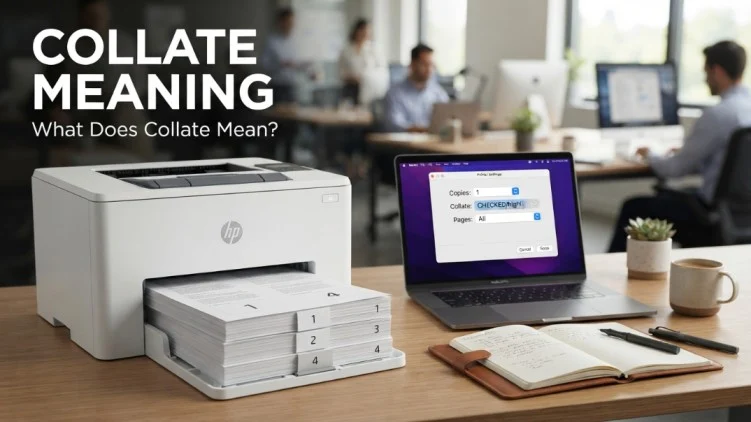
“Collate” means to collect and arrange information, papers, or pages in the correct order. On an iPhone or printer, it usually means putting pages into complete sets in the right sequence.
Imagine you print a 20 page document several times, and instead of getting one complete copy at a time, the printer gives you twenty stacks of page 1, twenty stacks of page 2, and so on. That is where the word collate becomes useful.
If you have seen “collate” while printing a document, using an iPhone, working with files, or reading instructions, you may wonder what it actually means. The word sounds formal, but the idea is quite simple: collect things and put them into the correct order.
This guide is useful for students, office workers, iPhone users, teachers, writers, and anyone who works with documents. You may also see the term in printers, PDF tools, scanners, and office software.
Understanding the collate meaning can save you time, especially when you need several organized copies of a multi-page document.
Definition & Meaning
The word collate is a verb. Its basic meaning is to collect, compare, and arrange items in a particular order.
The exact meaning can change slightly depending on the situation.
When people talk about documents, collate usually means arranging pages into the correct sequence.
For example, imagine you have a four-page document:
Page 1 → Page 2 → Page 3 → Page 4
If you need three copies, a collated printer produces:
1, 2, 3, 4 | 1, 2, 3, 4 | 1, 2, 3, 4
Instead of:
1, 1, 1 | 2, 2, 2 | 3, 3, 3 | 4, 4, 4
The first arrangement gives you three complete sets. The second gives you groups of the same page.
Collate in Printing
This is probably the most common modern use.
If a printer asks:
“Collate copies?”
It is asking whether you want each copy arranged as a complete document.
For example:
With collate:
Copy 1: 1, 2, 3, 4
Copy 2: 1, 2, 3, 4
Without collate:
1, 1
2, 2
3, 3
4, 4
Collate in General English
Outside printing, collate can mean bringing information together and checking it carefully.
For example:
“The researcher collated the survey results.”
This means the researcher collected and organized the results.
So, in simple terms:
Collate = collect + organize + arrange in order.
Background & History
The word collate has a long history and comes from Latin. It is related to the Latin word collatus, which carries the idea of bringing together.
The English word developed from this idea of comparing or bringing information together. Over time, its use became especially common in publishing, libraries, printing, research, and office work.
Before modern computers and printers, collating was often a physical task.
Imagine a printing office producing hundreds of copies of a book or report. Workers had to collect individual pages and place them in the correct order. If one page was missing or placed incorrectly, the final document would not be complete.
The word became closely connected with this process.
As technology changed, the meaning stayed useful. Modern printers can now collate pages automatically.
For example, a printer might receive an instruction to produce five copies of a ten-page report. Instead of requiring someone to manually arrange the pages, the printer can create five complete sets.
The term is also used in digital tools. PDF programs, document editors, scanners, and printing systems may use collate as a setting.
Although the word can sound old-fashioned, it is still common in professional and technical settings.
Today, you are most likely to see collate in:
- Printers
- Photocopiers
- PDF software
- Office programs
- Document management
- Publishing
- Academic research
- Libraries
- Data organization
The core idea has remained the same: bring things together and arrange them properly.
Usage in Various Contexts
The word collate appears in several different situations.
1. Printing
This is the most common everyday use.
Printer: “Do you want to collate your copies?”
You: “Yes, I need each copy as a complete set.”
Here, the printer will arrange the pages in sequence.
2. Office Work
An employee may be asked to collate reports.
Manager: “Can you collate these documents before the meeting?”
Employee: “Sure. I’ll put them in the correct order.”
The employee is being asked to collect and organize the documents.
3. Research
Researchers often gather information from different sources.
“The team collated data from five surveys.”
This means the team brought the information together for review.
4. Publishing
In publishing, pages need to appear in the correct order.
“The pages were collated before binding.”
This means the pages were arranged correctly before the book or document was assembled.
5. School Work
A teacher might say:
“Please collate your worksheets before submitting them.”
The students should gather their worksheets and arrange them properly.
6. Digital Documents
A PDF application may have a Collate option when printing multiple copies.
If you select it, the software or printer organizes each copy into the correct page order.
7. Data
Collate can also describe collecting information from several places.
“The assistant collated customer feedback.”
This means the feedback was gathered and organized for easier review.
Common Misconceptions & Clarifications
One common misunderstanding is thinking that collate simply means “print.” It does not.
Collating is about arranging items in order. Printing is a separate process.
For example, your printer can print 100 pages without collating them.
Another misconception is that collating always means putting pages in numerical order. In many cases, that is true, but the broader idea is to arrange things according to the required sequence.
Does Collate Mean Staple?
No.
A printer can collate pages without stapling them.
Collating: Arranges pages.
Stapling: Attaches pages together.
Some advanced printers can do both, but they are different functions.
Does Collate Mean Sort?
Sometimes, but the words are not exactly identical.
Sort usually means arranging things according to a particular category, value, or rule.
Collate often means gathering things and putting them together in the correct sequence.
Does Collate Mean Compare?
It can.
In older or formal usage, collate may involve comparing information or texts to identify differences.
For example:
“The editor collated the two versions of the manuscript.”
This means the editor compared them carefully.
Is Collate Difficult to Understand?
Not really.
A simple way to remember it is:
Collate = put related things together in the right order.
Similar Terms & Alternatives
Several words are related to collate, but each has a slightly different meaning.
Arrange
Arrange means to put things in a particular order or position.
Example:
“Arrange the pages from 1 to 10.”
Organize
Organize means to put things into a useful or logical system.
Example:
“Organize the files by date.”
Sort
Sort means to separate or arrange things according to a specific rule.
Example:
“Sort the documents alphabetically.”
Compile
Compile means to gather information or material into one collection.
Example:
“She compiled the research into a report.”
Assemble
Assemble means to bring separate parts together.
Example:
“Assemble the pages before binding.”
| Word | Basic meaning | Main idea |
|---|---|---|
| Collate | Collect and arrange | Put items in the correct sequence |
| Arrange | Put in order | Create a specific order |
| Organize | Structure systematically | Make things easier to manage |
| Sort | Group or order | Follow a category or rule |
| Compile | Gather material | Create one collection |
| Assemble | Bring parts together | Combine separate pieces |
How to Respond to This Term
If someone uses collate in conversation, your response depends on the situation.
Casual Response
Person 1: “Can you collate these pages?”
Person 2: “Sure, I’ll put them in order.”
Professional Response
Manager: “Please collate these reports before the meeting.”
Employee: “Of course. I’ll arrange them into complete sets.”
If You Do Not Understand
You can simply ask:
“Do you mean arrange them in the correct order?”
This is a clear way to confirm the meaning.
Funny Response
If a friend gives you a huge stack of papers:
“So basically, my new job is becoming a human printer?” 😂
When Using a Printer
If the printer asks whether you want to collate, choose Yes when you want each copy to come out as a complete document.
Choose No when you want the same pages grouped together.
Regional or Cultural Differences
The basic meaning of collate is fairly stable across English-speaking countries.
You may encounter the word in American English, British English, Canadian English, Australian English, and other varieties of English.
The spelling is normally the same:
collate
The pronunciation is also generally similar.
However, everyday usage can vary.
In casual conversation, people may prefer simpler words such as:
- Put in order
- Organize
- Sort
- Gather
- Put together
For example, an office worker may say:
“Can you put these pages in order?”
instead of:
“Can you collate these pages?”
Both can communicate a similar idea.
The word collate is more likely to appear in formal instructions, printing menus, publishing, academic work, and office software.
In other languages, the translation may focus on sorting, arranging, compiling, or comparing, depending on the context.
That is why translating the word directly without considering the situation can sometimes produce an unnatural result.
Comparison with Similar Terms
Understanding the difference between collate and similar words can make the term much easier to use.
| Term | What it means | Example |
|---|---|---|
| Collate | Collect and arrange in sequence | Collate the printed copies |
| Organize | Put into a logical system | Organize the files |
| Sort | Arrange by a rule | Sort names alphabetically |
| Compile | Gather information into one collection | Compile the research |
| Compare | Look for similarities and differences | Compare two reports |
| Assemble | Bring separate parts together | Assemble the document |
| Arrange | Put things into a chosen order | Arrange the pages |
Collate vs. Compile
These two words are often confused.
Compile focuses on gathering information or material.
Collate focuses more on bringing items together and arranging or comparing them.
Example:
- “She compiled ten reports.”
- She gathered the reports.
- “She collated the reports.”
- She gathered and organized them, possibly into a useful sequence.
Collate vs. Sort
Sort usually means putting things into categories or order.
Collate often means arranging complete sets or bringing related material together.
Both can involve organization, but their purpose may differ.
Usage in Online Communities & Dating Apps
Unlike internet slang, collate is not usually a popular texting abbreviation or dating-app expression.
You are unlikely to receive a Tinder message that simply says:
“Let’s collate.”
That would sound unusual.
However, the word can appear online when people discuss:
- Documents
- School assignments
- Work projects
- Printing
- Research
- Data
- PDFs
- Digital files
For example, someone in a Discord study group might say:
“Can someone collate all the notes into one PDF?”
They mean:
“Can someone collect and organize all the notes into one document?”
A gamer might also use the word in a technical or workplace conversation:
“I’ll collate the screenshots and send them later.”
This means they will gather and organize the screenshots.
Dating Apps
On dating apps, collate is not normally slang.
If someone uses it in a message, they probably mean the standard English meaning.
For example:
“I’ll collate our travel ideas and send you the list.”
They mean they will gather and organize the ideas.
So, do not assume that collate has a hidden romantic or sexual meaning simply because it appears in a dating conversation.
Hidden or Offensive Meanings
Collate does not have a common hidden, offensive, or sexual meaning.
It is a standard English verb used in professional, academic, and technical situations.
If someone says:
“Please collate these documents.”
They are simply asking you to organize them.
Likewise:
“I need to collate the data.”
means:
“I need to gather and organize the data.”
The word can sound formal, but being formal does not make it offensive.
Could It Be Used Sarcastically?
Yes, like almost any ordinary word.
For example:
“Great. They gave me another 500 pages to collate.” 😩
The speaker may be complaining about a boring task.
The sarcasm comes from the situation, not from the word itself.
If someone uses collate in a joke, meme, or sarcastic message, look at the surrounding words to understand the intended tone.
Suitability for Professional Communication
Collate is highly suitable for professional communication.
In fact, it is more common in professional and academic settings than in casual speech.
You might see it in:
- Office instructions
- Reports
- Emails
- Printing instructions
- Academic research
- Publishing
- Data analysis
- Administrative work
Professional Example
“Please collate the documents and place them in the meeting folders.”
This is clear and professional.
Another example:
“The research team will collate the responses before analyzing the results.”
This sounds natural in an academic or business setting.
Casual Alternatives
If you are speaking with a friend, you might simply say:
“Can you put these pages in order?”
or:
“Can you organize these for me?”
Both are easier and more conversational.
When Should You Use “Collate”?
Use it when you want to describe bringing documents, information, or pages together and arranging them properly.
It is especially useful when the process involves multiple items or complete sets.
FAQs
What does collate mean in simple words?
Collate means to collect things and arrange them in the correct order. It is often used for pages, documents, copies, and information.
What does collate mean on a printer?
On a printer, collate means arranging multiple copies into complete sets. For a four-page document, three collated copies would come out as 1-2-3-4, 1-2-3-4, 1-2-3-4.
What is the difference between collate and sort?
Sort usually means arranging items according to a specific rule. Collate often means bringing related items together and arranging them into complete or correct sequences.
Does collate mean staple?
No. Collate arranges pages, while stapling attaches pages together. A printer can perform both functions, but they are separate actions.
Is collate a formal word?
Yes. Collate is common in professional, academic, publishing, and technical settings. In casual speech, people may simply say “organize” or “put in order.”
What is another word for collate?
Depending on the context, alternatives include organize, arrange, compile, sort, assemble, and gather. The best alternative depends on exactly what you are doing.
Is collate used in everyday English?
Yes, but it is more common in work, printing, academic, and technical situations than in casual conversation.
Conclusion
The word collate may sound complicated, but its basic idea is simple: bring things together and arrange them in the correct order. You may see it when printing documents, organizing reports, compiling research, or working with digital files.
On a printer, collating means creating complete sets of a document instead of grouping all copies of the same page together. In professional English, it can also mean collecting and organizing information from different sources.
Remember the simple formula: collate = collect + organize + arrange. Once you understand that idea, the word becomes much easier to recognize in printers, office software, school assignments, research, and everyday professional communication.
Read More Related Articles:
What It Really Means in Messages and Online Chats
IDM Meaning in Text | Why Everyone Is Using This Popular …
IG Meaning in Text Messages | Definition, Uses, and Real …