Quick answer:
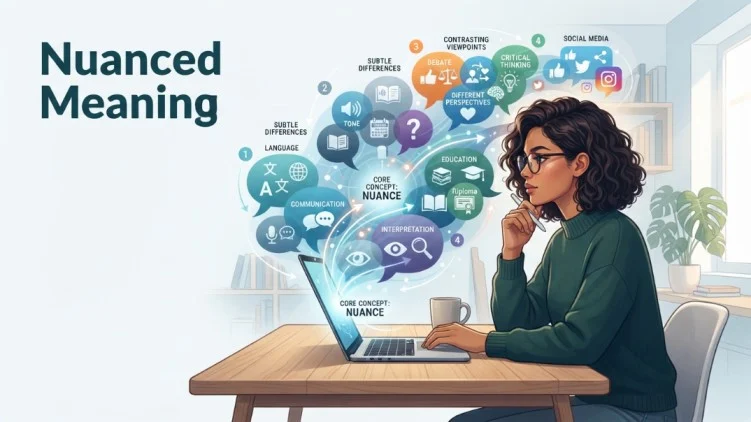
Nuanced means having small but important differences, details, or shades of meaning that are not obvious at first.
It describes ideas that are more complex than a simple yes-or-no answer.
Some ideas look simple until you look a little closer. That is where the nuanced meaning of a word, opinion, or situation becomes important. Nuanced describes something with small differences, hidden details, or subtle qualities that can change how we understand it.
If you are a student, writer, teacher, social media user, gamer, or professional, you may see this word often. People use it when talking about opinions, relationships, books, movies, news, debates, and everyday conversations. You may also hear someone say, “That is a nuanced point,” when a simple answer does not tell the whole story.
Understanding this word helps you express ideas with more care. It also helps you avoid judging something too quickly. Instead of seeing an issue as simply good or bad, a nuanced view looks at the details in between. Let’s explore what nuanced really means, how people use it, and why context matters.
Definition & Meaning
The nuanced meaning of nuanced is showing small, subtle, or important differences that make an idea more complex.
In simple English:
Nuanced = detailed, subtle, or not completely simple.
Imagine someone asks:
“Is that movie good or bad?”
A simple answer might be:
“It is good.”
A nuanced answer could be:
“The acting is excellent, but the story moves slowly and the ending may not work for everyone.”
The second answer gives more detail. It recognizes that the movie has both strengths and weaknesses.
What does nuanced mean?
Something is nuanced when it has layers.
It may include:
- small differences
- subtle emotions
- mixed opinions
- hidden details
- different perspectives
- conditions or exceptions
- ideas that cannot be explained with one simple answer
For example:
“She gave a nuanced response.”
This means her response was thoughtful and included more than one side of the issue.
Nuanced meaning in conversation
Imagine two friends discussing a person.
A: “Do you think Jake is rude?”
B: “Sometimes, but I think he is more socially awkward than intentionally rude.”
That is a nuanced opinion. Instead of labeling Jake as simply rude, the speaker considers another possible reason for his behavior.
Nuanced meaning in writing
Writers often use nuance to make characters and ideas feel realistic.
Instead of writing:
“The character hated her father.”
A more nuanced description might be:
“She was angry with her father, but she still wanted his approval.”
The second sentence shows mixed emotions.
Nuance does not always mean something is confusing. It means the subject has more depth than the simplest explanation suggests.
Background & History
The word nuanced comes from nuance, a word borrowed into English from French. The French nuance originally referred to a subtle shade or slight variation, especially in color.
Think about paint.
Red and pink are different colors, but there can be hundreds of tiny shades between them. A trained artist can notice differences that another person may barely see.
The same basic idea later became common when discussing language, emotions, opinions, and ideas.
From colors to ideas
The original idea of a nuance was connected to a subtle difference or shade.
Over time, English speakers began using the word more broadly.
For example:
- a nuanced argument
- a nuanced opinion
- a nuanced character
- a nuanced interpretation
- a nuanced answer
- a nuanced performance
In each case, the word suggests depth and subtle differences.
Nuanced in literature
Literature has long relied on nuance.
A character may love someone and still be angry with them. A hero may make a good choice for a selfish reason. A villain may have understandable motives.
These details create believable stories.
Nuanced in modern communication
Today, the word appears frequently in:
- journalism
- academic writing
- politics
- psychology
- film reviews
- social media
- education
- business
- everyday conversation
Online discussions especially use nuanced when people want to point out that an issue is more complicated than a short post or headline suggests.
The word has therefore become a useful way to describe careful thinking in a world where people often prefer quick answers.
Usage in Various Contexts
The word nuanced can be used in many situations.
In texting
People may use nuanced when discussing a complicated opinion.
Alex: “So you think the decision was wrong?”
Sam: “Not exactly. My view is more nuanced.”
Here, Sam means the answer is not simply yes or no.
On social media
Social media posts often simplify complex subjects. Someone may respond:
“This topic needs a more nuanced discussion.”
They mean the original post may have ignored important details.
Another example:
User 1: “Everyone who leaves that job is ungrateful.”
User 2: “That is a bit too simple. There are more nuanced reasons people leave.”
In gaming
Gamers may use nuanced when discussing strategy.
Player A: “Is this character overpowered?”
Player B: “It is more nuanced than that. The character is strong in experienced hands but weak for beginners.”
This answer considers different conditions.
In casual conversation
Mia: “Do you like working from home?”
Noah: “It is nuanced. I love the flexibility, but I miss talking to coworkers.”
The answer contains two sides instead of one simple opinion.
In professional settings
A manager might say:
“We need a more nuanced understanding of the customer feedback.”
This means the team should examine the details and different reasons behind the feedback.
Common Misconceptions & Clarifications
The word nuanced is sometimes misunderstood.
Misconception 1: Nuanced means confusing
Not necessarily.
A nuanced idea can be very clear. It simply recognizes that the subject has multiple layers or small differences.
For example:
“The product is useful but expensive.”
That is a simple statement, yet it contains more than one side.
Misconception 2: Nuanced means neutral
A nuanced opinion does not have to be neutral.
Someone can strongly support an idea while still recognizing its weaknesses.
For example:
“I support the new policy, but I think its implementation needs improvement.”
That is a nuanced opinion.
Misconception 3: Nuanced means complicated for no reason
Nuance should add useful detail.
If someone makes a simple issue sound extremely complicated without adding meaningful information, that is not necessarily nuance.
Misconception 4: Nuanced means intelligent
Being nuanced can show careful thinking, but simply using the word does not make an argument intelligent.
A good nuanced argument should still be:
- clear
- relevant
- logical
- supported by useful details
Misconception 5: Every opinion needs nuance
Not always.
Some questions have straightforward answers.
If someone asks:
“Did the store open at 9 a.m.?”
You may simply answer:
“Yes.”
There is no need to turn every simple fact into a complex discussion.
Similar Terms & Alternatives
Several words are related to nuanced, but each has a slightly different meaning.
| Term | Meaning | Example |
|---|---|---|
| Subtle | Difficult to notice | “There was a subtle change in her voice.” |
| Complex | Having many connected parts | “It is a complex issue.” |
| Detailed | Containing many specific facts | “She gave a detailed explanation.” |
| Sophisticated | Advanced or refined | “He has a sophisticated understanding of art.” |
| Layered | Having several levels of meaning | “The character is layered.” |
| Balanced | Considering different sides | “She gave a balanced opinion.” |
| Refined | Carefully developed or improved | “His argument became more refined.” |
| Subtlety | A small but meaningful difference | “The writer captures emotional subtlety.” |
Nuanced vs. subtle
These words are close but not identical.
Subtle often describes something that is hard to notice.
Nuanced usually describes something that contains small differences or layers of meaning.
For example:
“She gave a subtle smile.”
The smile is difficult to notice.
“She gave a nuanced explanation.”
The explanation contains different details and viewpoints.
How to Respond to This Term
If someone says something is nuanced, your response depends on the conversation.
Casual response
“Yeah, I see what you mean. It is not that simple.”
This shows that you understand their point.
Curious response
“What part do you think people usually miss?”
This invites the person to explain the deeper details.
Funny response
“So basically, my brain needs the extended version?”
This can work among friends.
Professional response
“I agree. We should consider the different factors before reaching a conclusion.”
This sounds appropriate in meetings or formal discussions.
If you disagree
You can still be respectful.
“I understand the nuance, but I think the main issue is still clear.”
This acknowledges the other person’s point without automatically agreeing.
If you need clarification
“Could you explain which distinction you think is most important?”
This is useful when someone uses nuanced but does not explain what they mean.
Regional or Cultural Differences
Nuanced is widely understood in modern English-speaking cultures. The basic meaning remains similar in American, British, Canadian, and Australian English.
However, the word can appear more often in certain settings.
American English
In the United States, nuanced is common in:
- journalism
- political discussions
- academic writing
- film reviews
- social media debates
You may see phrases such as:
“a nuanced perspective”
or
“a nuanced approach.”
British English
British speakers use the word in similar ways.
It is common in education, literature, politics, media, and professional communication.
Global English
People who learn English as a second language may encounter nuanced in advanced articles, books, and discussions.
Translations into other languages vary. Some languages may use separate words for ideas such as subtle, detailed, complex, or balanced.
The exact translation depends on context.
Cultural communication
Different cultures may also value directness and indirectness differently.
A communication style that seems simple in one culture may contain subtle social meaning in another.
That is another reason context matters when understanding nuance.
Comparison with Similar Terms
Here is a closer look at words that can be confused with nuanced.
| Expression | Main idea | Key difference |
|---|---|---|
| Nuanced | Small differences and layers | Focuses on subtle distinctions |
| Complex | Many connected parts | Focuses on difficulty or structure |
| Subtle | Hard to notice | Focuses on small or indirect signals |
| Detailed | Lots of information | Focuses on specific facts |
| Balanced | Multiple sides considered | Focuses on fairness or different viewpoints |
| Complicated | Difficult to understand or solve | Often suggests difficulty |
| Sophisticated | Advanced or refined | Suggests maturity or skill |
| Layered | Several levels of meaning | Often used for stories, people, or ideas |
Nuanced vs. complex
Something can be complex without being nuanced.
For example, a machine may have hundreds of parts. It is complex.
A person’s feelings about that machine may involve pride, frustration, memories, and financial concerns. That emotional view may be nuanced.
Nuanced vs. complicated
Complicated can sound negative.
Nuanced is often more positive because it suggests careful attention to meaningful differences.
Usage in Online Communities & Dating Apps
The word nuanced is common in online discussions because digital conversations often reduce complicated subjects to short statements.
On platforms such as Tinder, people may use the concept of nuance when discussing relationships and attraction.
For example:
Match: “Do you think someone is either compatible or incompatible?”
You: “I think compatibility is more nuanced than that.”
The speaker means that relationships can depend on many factors.
Dating conversations
People may describe feelings as nuanced when they have mixed emotions.
“I like him, but I am not sure we want the same things.”
That is a nuanced position.
Social media
On X, someone might write:
“There is a lot of nuance missing from this discussion.”
They may believe the conversation has been reduced to two extreme positions.
Gaming communities
Gamers may use the word when discussing:
- character balance
- strategy
- game mechanics
- player skill
- competitive advantages
A useful tip is to avoid using nuanced simply to sound intelligent. Explain what the nuance actually is.
Hidden or Offensive Meanings
Nuanced does not normally have a hidden, sexual, vulgar, or offensive meaning.
It is a standard English adjective.
However, tone can affect how it sounds.
For example:
“That is a nuanced opinion.”
This is usually positive.
But:
“Wow, what a nuanced opinion.”
Depending on the speaker’s tone, this could be sarcastic.
Someone might use it to mock a person who is trying too hard to make a simple issue sound complicated.
Context matters
Online communication makes tone harder to understand.
A short sentence such as:
“Very nuanced.”
could be sincere praise or sarcasm.
Look at:
- the surrounding conversation
- punctuation
- emojis
- previous messages
- the person’s usual communication style
The word itself is not offensive. The tone and intention create the meaning.
Suitability for Professional Communication
Nuanced is completely suitable for professional communication.
It is commonly used in:
- reports
- presentations
- academic writing
- business meetings
- research
- journalism
- education
- workplace discussions
For example:
“The report provides a nuanced analysis of customer behavior.”
This sounds professional and natural.
Another example:
“We need a more nuanced approach to the problem.”
This suggests the current approach may be too simple.
Professional alternatives
Depending on your intended meaning, you can also use:
- detailed
- thoughtful
- balanced
- careful
- comprehensive
- sophisticated
- context-sensitive
- multi-layered
However, these words are not exact replacements in every situation.
If you mean small but meaningful differences, nuanced is often the best choice.
FAQs
1. What does nuanced mean in simple English?
Nuanced means having small differences, details, or layers that make something more than a simple idea.
2. What is an example of a nuanced opinion?
“I like the new policy, but I think some parts need improvement.”
It recognizes both strengths and weaknesses.
3. Is nuanced a positive word?
Usually, yes. It often suggests that someone is thoughtful and able to recognize details. However, it can sometimes be used sarcastically.
4. Is nuanced the same as complicated?
No. Complicated usually means difficult to understand or deal with. Nuanced means something contains subtle differences or layers of meaning.
5. What is the opposite of nuanced?
Depending on context, possible opposites include simplistic, one-sided, absolute, or oversimplified.
6. Can I use nuanced in professional writing?
Yes. It is a common and appropriate word in academic, professional, business, and analytical writing.
7. What does “a nuanced perspective” mean?
It means looking at a subject from more than one angle and recognizing important details instead of making a simple judgment.
Conclusion
Understanding the nuanced meaning of a word means looking beyond the most obvious definition. Nuanced describes ideas, opinions, emotions, arguments, and situations that contain subtle differences, layers, or important details.
A nuanced answer does not have to be long or confusing. It simply avoids reducing everything to a basic yes-or-no judgment. It may recognize two sides, explain a condition, or point out a detail that changes the bigger picture.
The word is useful in everyday conversations, writing, social media, gaming, dating discussions, school, and professional settings. It is also important to remember that nuanced is not the same as complicated or confusing. Good nuance makes an idea clearer by showing what a simple answer might leave out.
When you hear someone say, “That is nuanced,” think of it as a reminder to look a little closer before making a final judgment.
Discover More Post:
Insatiable Meaning | Definition, Examples, Synonyms, Uses …
Spontaneous Meaning | What It Really Means Easy Examples …
What Does GOAT Mean in Text, Slang & Social Media in 2026