Quick Answer:
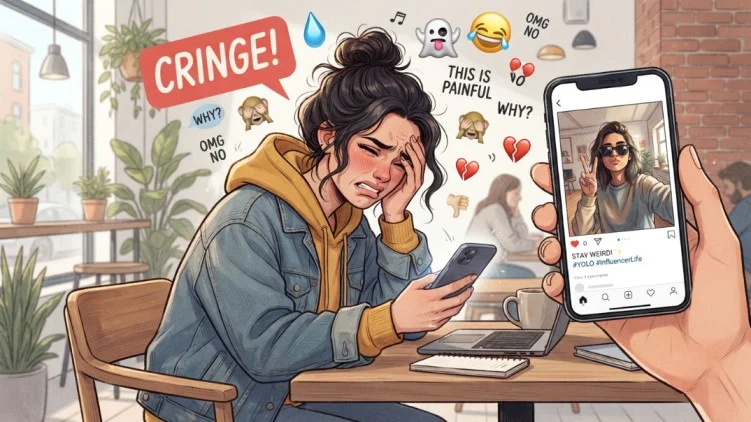
“Cringe” means feeling embarrassed, awkward, or uncomfortable because of someone’s behavior or something you see. It can also describe something that feels embarrassing or awkward.
Have you ever watched a video and felt so embarrassed for the person that you wanted to look away? That feeling is often called cringe. The word is now common in everyday speech, texting, social media, gaming, and online comments.
If you are a student, content creator, gamer, social media user, or simply someone who wants to understand modern English, knowing the cringe meaning can help you understand conversations better. People use it to describe awkward jokes, forced behavior, embarrassing posts, strange comments, and uncomfortable moments.
You may see someone write “That was so cringe” under a video or text a friend, “Bro, you’re making me cringe.” The meaning is usually clear from the situation, but tone can change how the word feels. Let’s break it down with simple examples.
Definition & Meaning
The word cringe describes a strong feeling of embarrassment, awkwardness, discomfort, or secondhand embarrassment.
It can be used as a verb, noun, or informal adjective.
As a verb, cringe means to react to something embarrassing or uncomfortable.
Example:
Ali: “I accidentally called my teacher ‘Mom.’”
Sara: “Oh no! I would cringe so hard!”
Here, Sara means she would feel very embarrassed.
Online, people often use cringe as a description.
“That video is so cringe.”
This means the video feels awkward, embarrassing, or uncomfortable to watch.
The word can also describe a person’s behavior.
“He was trying too hard to look cool. It was cringe.”
The speaker thinks the behavior looked forced or embarrassing.
Cringe does not always mean something is terrible. Sometimes people use it playfully. A friend might do something silly, and another friend may say, “You’re so cringe!” while laughing.
The meaning can also depend on the speaker. Something one person finds funny may feel cringe to another person.
In simple terms, cringe is the uncomfortable feeling you get when something seems awkward, embarrassing, forced, or socially uncomfortable.
Background & History
Cringe is not a new internet word. The original English verb cringe has been used for centuries. It referred to physically shrinking, bending, or drawing back because of fear, pain, or discomfort.
Over time, the word developed a broader emotional meaning. People began using it when they felt embarrassed or uncomfortable because of something they saw or experienced.
The internet gave the word a new life.
As social media became popular, users needed quick words to describe awkward videos, strange posts, forced jokes, and embarrassing behavior. Cringe became an easy and powerful label.
The word became especially common in online communities, memes, gaming spaces, and social platforms.
You may now see phrases such as:
- “That is cringe.”
- “So cringe.”
- “I’m cringing.”
- “Cringe post.”
- “Cringe behavior.”
- “Secondhand cringe.”
Modern internet culture also uses cringe as a noun and informal adjective. This is why phrases like “That was cringe” are common, even though traditional grammar may prefer “That was cringeworthy.”
Today, cringe is widely understood in casual English, especially among younger internet users.
Usage in Various Contexts
The meaning stays similar across different situations, but the way people use it can change.
In Texting
Friends often use cringe when talking about embarrassing situations.
Mia: “I sent my crush a message meant for my sister.”
Noah: “OMG 😭 That’s so cringe.”
On Social Media
People may comment “cringe” on videos, photos, captions, or posts they consider awkward.
Comment: “Why did he make that speech like he was in a movie? Cringe.”
In Gaming
Gamers may use the word when someone acts strangely, boasts too much, or makes an awkward comment.
Player 1: “I’m the greatest gamer alive!”
Player 2: “Bro, that was cringe.”
In Casual Conversation
People can use it for real-life situations.
“My old school photos are so cringe.”
In Professional Settings
The word is usually too casual for formal communication. Instead of saying “The presentation was cringe,” a professional might say:
“The presentation felt awkward and did not connect well with the audience.”
Common Misconceptions & Clarifications
One common misunderstanding is that cringe always means bad. That is not true.
Something can be cringe because it is awkward without being harmful or badly made.
For example:
“My dad tried to use Gen Z slang. It was cringe, but honestly, it was funny.”
Here, cringe expresses embarrassment mixed with humor.
Another misconception is that cringe always describes another person. You can also describe your own behavior.
“I just read my old messages. Why was I so cringe?”
The word can also describe an experience rather than a person.
“That whole conversation was cringe.”
Tone is important. Saying “That’s cringe” jokingly among friends may be harmless. Saying it aggressively to someone can sound insulting or dismissive.
It is also worth remembering that cringe is subjective. Different people have different ideas about what feels awkward.
Similar Terms & Alternatives
Several words are close to cringe, but they do not always mean exactly the same thing.
| Term | Meaning |
|---|---|
| Cringe | Awkward or embarrassing |
| Awkward | Uncomfortable or socially difficult |
| Embarrassing | Causing shame or discomfort |
| Cringeworthy | Extremely awkward or embarrassing |
| Uncomfortable | Making you feel uneasy |
| Secondhand embarrassment | Feeling embarrassed for someone else |
| Cheesy | Overly sentimental or predictable |
| Corny | Too obvious, silly, or old-fashioned |
| Forced | Not natural or genuine |
For example, a romantic speech may be cheesy, while someone pretending to be extremely cool may be called cringe.
How to Respond to “Cringe”
Your response should depend on the situation.
Casual Response
“Haha, I know. I was embarrassed too!”
Funny Response
“Please delete this conversation immediately 😂.”
Confident Response
“Maybe cringe, but I had fun.”
Professional Response
If someone uses cringe about your work, stay calm.
“Thanks for the feedback. What part felt awkward to you?”
Privacy-Conscious Response
If someone is criticizing something personal:
“I’d rather not discuss that publicly.”
You do not always need to defend yourself. Sometimes ignoring the comment is the best response.
Regional or Cultural Differences
The word cringe is widely understood in modern internet English. It appears in social media conversations across many English-speaking communities.
However, the exact feeling connected to the word can vary by culture.
What seems embarrassing in one culture may be normal in another. Humor, public behavior, fashion, romance, and social manners are not judged the same way everywhere.
People who speak other languages may also use local words that express similar ideas. For example, a language may have its own slang for something awkward, embarrassing, or socially uncomfortable.
Online English has made cringe especially recognizable around the world. Still, context matters more than geography.
Comparison With Similar Terms
| Expression | Main Idea | Example |
|---|---|---|
| Cringe | Awkward or embarrassing | “That video was cringe.” |
| Awkward | Socially uncomfortable | “That silence was awkward.” |
| Embarrassing | Causes personal shame | “Forgetting his name was embarrassing.” |
| Cringeworthy | Very embarrassing | “That speech was cringeworthy.” |
| Corny | Too predictable or sentimental | “That pickup line was corny.” |
| Cheesy | Overly emotional or romantic | “That movie was cheesy.” |
| Weird | Strange or unusual | “That was a weird comment.” |
These terms can overlap, but they are not interchangeable in every situation.
Usage in Online Communities & Dating Apps
Cringe is extremely common in online communities. People may use it when discussing posts, memes, videos, usernames, comments, or behavior.
On platforms such as Tinder, users may call an overly aggressive pickup line “cringe.”
“Are you a magician? Because every time I see you, everyone else disappears.”
Reply: “That pickup line is kind of cringe 😂.”
On social media, someone might describe a forced motivational video as cringe. In gaming communities, the word may describe bragging, dramatic reactions, or awkward voice-chat moments.
The safest way to use the word online is to consider the person and situation. A joke between friends is different from publicly humiliating a stranger.
Hidden or Offensive Meanings
Cringe does not normally have a secret offensive meaning. Its main meaning is embarrassment, awkwardness, or discomfort.
However, it can become insulting depending on how it is used.
For example:
“That video is cringe.”
This is a criticism of the content.
But:
“You are a disgusting cringe person.”
This becomes a direct personal insult.
Online, people sometimes overuse cringe simply because they dislike something. It can become a way to mock people for their interests, personality, appearance, or harmless hobbies.
For this reason, tone and context matter. Calling something cringe jokingly is very different from using the word to shame someone.
Suitability for Professional Communication
The word cringe is best suited to casual communication.
You can use it with close friends, in informal messages, social media posts, gaming chats, and relaxed conversations.
It is usually better to avoid it in:
- Business emails
- Academic writing
- Job applications
- Formal reports
- Client communication
- Official presentations
Instead of:
“The advertisement was cringe.”
Use:
“The advertisement felt awkward and did not match the brand’s tone.”
Instead of:
“His speech was cringe.”
Use:
“His speech felt uncomfortable and did not connect with the audience.”
Professional alternatives include awkward, inappropriate, uncomfortable, ineffective, forced, unprofessional, or poorly received.
FAQs
1. What does cringe mean?
Cringe means feeling embarrassed, awkward, or uncomfortable because of something you see, hear, or experience.
2. Is cringe a bad word?
No. Cringe is not a swear word or inherently offensive term. However, it can sound insulting when directed at someone.
3. What does “that’s so cringe” mean?
It usually means “That is very awkward or embarrassing.”
4. What does “I’m cringing” mean?
It means the person is feeling uncomfortable or embarrassed because of something.
5. Is cringe slang?
Yes. Cringe is an established English word, but its modern use as an informal description is especially common in internet slang.
6. What is the difference between cringe and awkward?
Awkward is broader and can describe an uncomfortable situation. Cringe often carries a stronger feeling of embarrassment or secondhand embarrassment.
7. Can I use cringe at work?
You can, but it is usually better to choose a more professional word such as awkward, inappropriate, forced, or ineffective.
Conclusion
The cringe meaning is simple: it describes something that makes you feel embarrassed, awkward, uncomfortable, or like you want to look away. The word has become a major part of modern online language, especially in texting, social media, gaming, and casual conversations.
You may use cringe for an awkward joke, embarrassing memory, forced behavior, strange post, or uncomfortable social moment. It can be funny among friends, but it can also sound harsh when used to attack someone.
Remember that cringe is subjective. What feels embarrassing to one person may seem funny or normal to another. Use the word with context and care, especially when speaking about someone directly. In formal settings, choose clearer alternatives such as awkward, inappropriate, or uncomfortable.
Read More Related Articles:
IG Meaning in Text Messages | Definition, Uses, and Real …
What Is OML in Text | Meaning, Examples, Snapchat, TikTok …
What It Really Means in Messages and Online Chats