Quick answer:
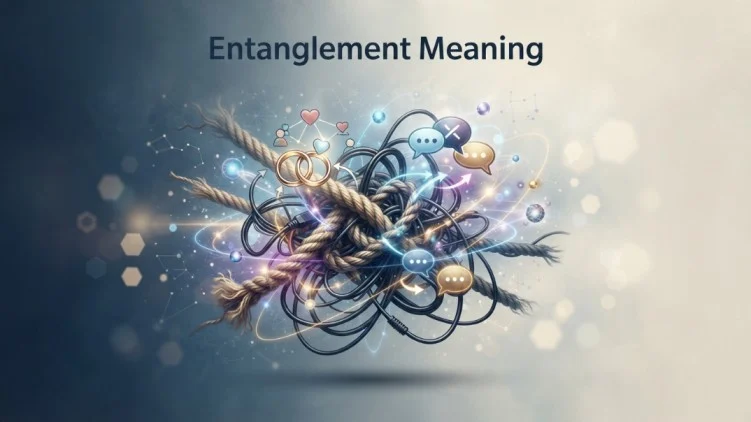
Entanglement means a complicated connection, involvement, or situation that is difficult to escape or separate from.
It can describe relationships, problems, physical knots, or even a special idea in quantum physics.
Some connections are simple. Others pull you into a maze of emotions, problems, or unexpected links. That is where the entanglement meaning becomes useful. The word entanglement describes a state where things become closely connected, tangled, or difficult to separate. It can refer to a complicated relationship, a messy situation, or a physical object caught with another object.
If you are a student, writer, social media user, gamer, professional, or everyday texter, you may come across this word in very different settings. Someone might describe a complicated romance as an entanglement, while a scientist may use the same word when discussing quantum physics.
Understanding the word helps you read messages, conversations, news, books, and online posts with greater confidence. The meaning depends heavily on context, so learning its different uses can help you avoid confusion and choose the right interpretation.
Definition & Meaning
The basic entanglement meaning is a complicated connection or situation in which things, people, or ideas become closely involved with one another.
The word comes from the verb entangle, which means to twist things together or become involved in something complicated.
Simple definition
Entanglement = a complicated connection, involvement, or situation that is difficult to separate.
For example:
Person A: “Why are you still dealing with that problem?”
Person B: “I got caught in an emotional entanglement.”
Here, entanglement means a complicated emotional situation.
Physical entanglement
The word can describe objects that become physically tangled.
“The fishing line became tangled in the branches.”
This is a literal form of entanglement.
Hair, wires, ropes, cables, vines, and strings can all become entangled.
Emotional entanglement
The word is also common when people describe complicated personal relationships.
Friend: “Are you two dating?”
Alex: “It’s complicated. We’re in an entanglement.”
This can suggest that two people are emotionally or romantically involved without having a clear relationship.
Social or professional entanglement
Entanglement can also describe complicated involvement in a situation.
“The company became involved in a legal entanglement.”
Here, the word suggests a difficult problem involving several connected factors.
Scientific meaning
In physics, quantum entanglement has a highly specific meaning. It describes a quantum relationship in which the states of particles are connected in ways that cannot be described as completely independent.
So, the word can have a simple everyday meaning or a highly technical scientific meaning.
Background & History
The word entanglement comes from the verb entangle, which developed from the idea of becoming tangled or caught together. Its roots are connected to the word tangle, which refers to things becoming twisted, knotted, or confused.
Over time, the meaning expanded beyond physical objects.
At first, the concept was easy to understand in a literal sense. A rope could become entangled with another rope. A person’s clothing could become caught in something. Branches could become tangled together.
Eventually, English speakers began using the word in a figurative way.
Figurative entanglement
People started using entanglement to describe complicated involvement.
For example:
“He became entangled in a difficult dispute.”
The person was not physically tied to the dispute. Instead, they became deeply involved in it.
This figurative meaning is now common in everyday English.
Romantic use
The word also became useful for describing complicated romantic situations.
Instead of simply saying:
“They have a complicated relationship.”
Someone might say:
“They are caught in a romantic entanglement.”
This can sound more dramatic and can suggest unclear boundaries or emotions.
Scientific development
The word gained another major meaning through quantum entanglement, a concept associated with the development of quantum mechanics in the 20th century.
Scientists use the term in a technical way that is very different from everyday relationship talk.
Today, entanglement appears in literature, psychology, relationships, business, law, technology, science, and casual conversation.
Usage in Various Contexts
The meaning of entanglement changes depending on the situation.
In texting
Someone may use entanglement to describe a confusing relationship.
Friend: “So, are you two officially together?”
You: “Not really. It’s more of an entanglement.”
The word can suggest emotional closeness without a clear label.
On social media
People may use it when talking about complicated relationships, drama, or personal situations.
“I stayed away from that whole situation. Too much entanglement.”
It can also describe getting involved in someone else’s problems.
In gaming
Gamers may use entanglement literally or figuratively.
A character might have an ability that traps enemies or connects objects.
Player A: “Why can’t the enemy move?”
Player B: “The entanglement effect is keeping it trapped.”
Some games may also use the word for systems, quests, or storylines involving several connected events.
In casual conversation
People often use the word to describe a complicated situation.
Sam: “Why don’t you just leave the group?”
Mia: “It’s not that easy. I’m too involved now.”
Sam: “Sounds like an entanglement.”
In professional settings
The word can describe complicated business or legal involvement.
“The company became involved in a financial entanglement with several partners.”
In this context, it sounds more formal and serious.
Common Misconceptions & Clarifications
The word entanglement can be confusing because it has several meanings.
Misconception 1: Entanglement always means romance
No. Romance is only one possible use.
Entanglement can describe:
- physical objects
- relationships
- legal problems
- business connections
- emotional situations
- social conflicts
- scientific concepts
Misconception 2: Entanglement always means something bad
Not necessarily.
The word often has a negative feeling because complicated situations can be stressful. However, physical or scientific entanglement is not automatically negative.
For example, quantum entanglement is a scientific phenomenon, not a problem.
Misconception 3: Entanglement means marriage
It does not.
An entanglement can describe a romantic or emotional connection without implying marriage, commitment, or even an official relationship.
Misconception 4: Entanglement and attachment mean the same thing
They are related but different.
Attachment usually focuses on emotional connection or dependence.
Entanglement suggests that the connection is complicated, intertwined, or difficult to separate.
Misconception 5: Quantum entanglement means two people are mentally connected
No.
Quantum entanglement is a scientific concept involving quantum systems. It should not be confused with emotional or spiritual claims about people being connected.
Similar Terms & Alternatives
Several words are related to entanglement, but each has a slightly different meaning.
| Term | Meaning | Example |
|---|---|---|
| Complication | Something that makes a situation harder | “The plan has a complication.” |
| Involvement | Participation or connection | “He became involved in the dispute.” |
| Connection | A link between things or people | “They have a strong connection.” |
| Attachment | Emotional or personal bond | “She formed an attachment.” |
| Tangle | A twisted or confusing situation | “The wires are in a tangle.” |
| Bind | A difficult situation with limited choices | “I am in a difficult bind.” |
| Knot | A physical or figurative complication | “We need to untie this knot.” |
| Web | A complex network or situation | “He got caught in a web of lies.” |
Which word should you choose?
- Use entanglement when several things become closely connected and separating them is difficult.
- Use complication when you want to emphasize difficulty.
- Use attachment when the focus is emotional connection.
- Use tangle when the situation feels messy or confusing.
- Use involvement when you simply mean participation or connection.
How to Respond to This Term
Your response to the word entanglement depends on what the speaker means.
Casual response
“Yeah, that sounds complicated.”
This works when someone is talking about a difficult situation.
Funny response
“Sounds like you need an emotional untangling service!”
This can work with a close friend when humor is appropriate.
Curious response
“What kind of entanglement do you mean?”
This is useful when the meaning is unclear.
Professional response
“I understand. Let’s identify the factors causing the complication.”
This works better in a workplace or business discussion.
Relationship response
If someone says:
“We are in an entanglement.”
You might reply:
“Do you mean you are dating, or is the situation more complicated?”
This avoids making assumptions.
Privacy-conscious response
If someone asks about a personal entanglement you do not want to discuss, you can say:
“It’s personal, so I’d rather not go into details.”
You are not required to explain private relationships or personal problems.
Regional or Cultural Differences
Entanglement is widely understood in English-speaking countries, but the word may be used differently depending on culture and context.
American English
In American English, entanglement can appear in everyday speech, literature, news, relationships, and science.
It became especially recognizable in popular culture after celebrities and media discussions used the phrase “entanglement” to describe a complicated romantic relationship.
Because of this, some people now associate the word with complicated romantic situations.
British English
British speakers also understand and use entanglement, particularly in formal writing, literature, relationships, and technical contexts.
Australian English
The word is also understood in Australian English and can describe physical tangles, complicated relationships, or difficult situations.
Across cultures
The basic idea is easy to translate: things become closely connected and difficult to separate.
However, some languages may use separate words for physical tangling, emotional involvement, and complicated social situations.
This means the exact emotional tone can change when the word is translated.
Comparison with Similar Terms
Understanding the difference between related expressions makes the word easier to use.
| Expression | Main idea | Example |
|---|---|---|
| Entanglement | Complicated connection | “Their relationship is an entanglement.” |
| Complication | Something making a situation difficult | “There is a new complication.” |
| Attachment | Emotional bond | “He has a strong attachment to her.” |
| Relationship | Connection between people | “They have a close relationship.” |
| Involvement | Participation or connection | “She became involved in the project.” |
| Tangle | Messy or confused state | “The cables are tangled.” |
| Affair | Secret or romantic relationship | “The story involved an affair.” |
| Situationship | Unclear romantic relationship | “They are in a situationship.” |
Entanglement vs. situationship
These words can overlap in dating conversations.
A situationship usually describes a romantic connection that does not have a clear relationship label.
An entanglement is broader. It can describe a situationship, but it can also describe other complicated emotional or social connections.
Usage in Online Communities & Dating Apps
The word entanglement can appear in dating conversations, social media posts, online forums, and gaming communities.
On dating apps such as Tinder, someone may use it to describe a relationship that has become complicated.
For example:
Match: “What are you looking for?”
User: “Something simple. I am done with complicated entanglements.”
This communicates a desire to avoid unclear relationships.
On social platforms such as X, users may use the word dramatically or humorously.
“My weekend turned into a complete entanglement.”
Gaming communities may use the term more literally when discussing mechanics, abilities, or storylines.
Tips for online use
Do not assume that entanglement always means cheating or an affair.
Ask for context if the meaning is unclear.
You can say:
“What do you mean by entanglement?”
This is especially useful in dating conversations because people may use the word differently.
Hidden or Offensive Meanings
Entanglement does not have a standard hidden offensive meaning. It is a normal English word.
However, its tone can become sensitive when it describes a person’s romantic life.
Calling a relationship an entanglement can suggest:
- confusion
- secrecy
- emotional complexity
- unclear commitment
- unwanted involvement
Because of these associations, someone may feel judged if you describe their relationship this way.
Romantic and sexual context
In some conversations, entanglement can be a softer or indirect way of describing a romantic or sexual relationship.
However, the word itself does not automatically mean a sexual relationship.
Context is important.
For example:
“Their business entanglement caused problems.”
This has nothing to do with romance.
But:
“She is involved in a romantic entanglement.”
clearly points toward a relationship.
Suitability for Professional Communication
Entanglement is appropriate in professional communication, but you should use it carefully.
It works well when describing complex connections or situations.
For example:
“The project has become an entanglement of overlapping responsibilities.”
This sounds professional, although a simpler phrase may be clearer.
You can also say:
“The legal case created several complications.”
Professional alternatives
Depending on your meaning, you can use:
- complicated situation
- complex involvement
- overlapping responsibilities
- interconnected issues
- conflicting interests
- dependency
- complication
- difficult relationship
- operational complexity
In technical writing, entanglement is completely appropriate when discussing physics or systems that genuinely involve the concept.
For example:
“The experiment demonstrates quantum entanglement.”
In workplace writing, avoid using the word to label a person.
Instead of:
“He is an entanglement.”
Say:
“The situation has become complicated.”
This is clearer and more respectful.
FAQs
1. What does entanglement mean in simple words?
Entanglement means a complicated connection or situation that is difficult to separate.
2. Does entanglement mean a relationship?
It can. In casual or romantic conversations, entanglement can describe a complicated emotional or romantic connection.
3. Is entanglement the same as a situationship?
Not exactly. A situationship usually refers to an undefined romantic relationship. Entanglement is broader and can describe many kinds of complicated connections.
4. Is entanglement a negative word?
It often has a negative or complicated tone, but it is not automatically negative. The meaning depends on the context.
5. What does quantum entanglement mean?
Quantum entanglement is a scientific phenomenon in which quantum systems can have linked states that cannot be fully described independently.
6. Can entanglement describe a physical object?
Yes. It can describe things such as wires, ropes, hair, fishing lines, or branches that become tangled together.
7. What is another word for entanglement?
Depending on the context, alternatives include complication, involvement, attachment, tangle, connection, bind, and situationship.
Conclusion
The entanglement meaning is centered on the idea of things becoming closely connected, tangled, or difficult to separate. In everyday English, it can describe a messy relationship, a complicated problem, or objects physically caught together. In professional and scientific contexts, it can have more specific meanings.
The word is especially interesting because its meaning changes with context. A romantic entanglement may suggest an unclear relationship, while a legal entanglement may describe a complicated dispute. A physical entanglement can simply mean that objects are tangled together, while quantum entanglement refers to a specialized scientific phenomenon.
When you see this word, look at the surrounding conversation before deciding what it means. That small step can help you understand texts, social media posts, workplace discussions, and everyday conversations much more accurately.
Discover More Post:
The Simple Meaning Behind This Popular Word in 2026
Spontaneous Meaning | What It Really Means Easy Examples …
What Does GOAT Mean in Text, Slang & Social Media in 2026