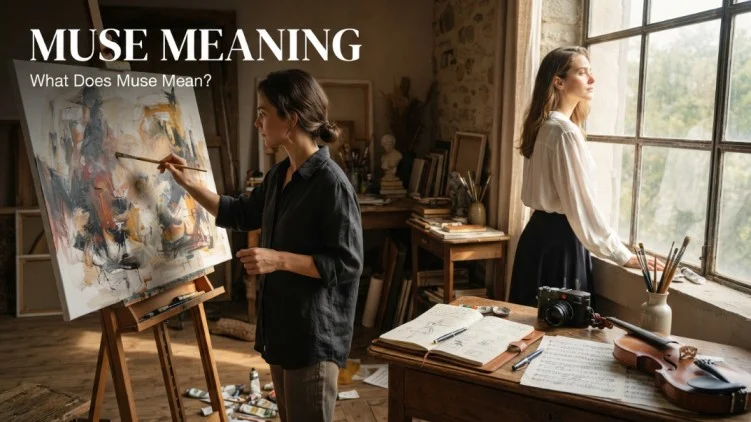
Quick Answer:
A muse is a person, idea, or source that inspires someone to create art, writing, music, or other creative work. It can also refer to the Greek goddesses traditionally associated with the arts and inspiration.
Sometimes, one person can spark an entire poem, painting, song, or story. That person may be called a muse. The word sounds simple, but it has a rich history and several uses that can change with context.
If you are a student, writer, artist, music fan, social media user, or someone who enjoys learning new English words, understanding the muse meaning can help you understand conversations about creativity and inspiration. You may see the word in books, song lyrics, captions, dating posts, movies, or art discussions.
Today, “muse” is often used in a personal and creative way. Someone might call their partner their muse because that person inspires their work. A writer might describe a beautiful place as a muse. An artist may even call an emotion or memory a muse.
Definition & Meaning
The word muse has two main meanings.
First, a muse can be a person or thing that inspires someone to create. This is the meaning you are most likely to see in modern conversations about art, writing, music, photography, or fashion.
For example:
“She was his muse for the entire album.”
This means she inspired him while he created the album.
A muse does not have to be a romantic partner. It could be:
- A friend
- A family member
- A place
- A memory
- Nature
- An emotion
- Another artist
- An idea
- A personal experience
For example:
“The ocean became my muse while I was writing the novel.”
Here, the ocean is the source of creative inspiration.
The second meaning comes from Greek mythology. The Muses were divine figures associated with the arts, literature, music, and knowledge. Traditionally, there were nine Muses, each connected with a different creative or intellectual area.
In modern English, however, “muse” is usually used as a common noun.
Muse as a Person
“The photographer found a new muse.”
This suggests that someone became a strong source of inspiration for the photographer.
Muse as an Idea
“Loneliness became the muse behind her poetry.”
Here, an emotion inspires creative work.
Muse as a Verb
“Muse” can also be a verb. When someone muses, they think deeply or reflect on something.
For example:
“He mused about what might happen next.”
This meaning is different from calling someone a muse.
So, context matters.
Background & History
The word muse has roots in ancient Greek mythology. The Greek Muses were traditionally described as divine figures who inspired poets, musicians, artists, and thinkers.
The Greek word Mousa is connected with these figures. The concept later influenced Latin and European languages, eventually giving English the word muse.
The traditional nine Muses were associated with different forms of artistic and intellectual activity. Their names are:
| Muse | Traditional association |
|---|---|
| Calliope | Epic poetry |
| Clio | History |
| Erato | Love poetry |
| Euterpe | Music and lyric poetry |
| Melpomene | Tragedy |
| Polyhymnia | Hymns and sacred poetry |
| Terpsichore | Dance |
| Thalia | Comedy |
| Urania | Astronomy |
Over time, the word moved beyond mythology.
Instead of referring only to the Greek figures, people began using muse metaphorically for anyone or anything that inspired creative work.
By the modern era, artists, writers, musicians, photographers, and designers commonly used the term to describe their sources of inspiration.
Today, you might see it in an art gallery, fashion interview, Instagram caption, novel, song discussion, or personal conversation.
The meaning has therefore expanded from a mythological figure to a broad idea of creative inspiration.
Usage in Various Contexts
“Muse” appears in many settings, and the meaning can shift slightly depending on the situation.
1. Art
An artist may call a person their muse because that person inspires paintings, drawings, sculptures, or photography.
Artist: “Who inspired this portrait?”
Artist: “My sister was my muse.”
The sister is the source of inspiration.
2. Writing
Writers may describe an experience, person, or place as their muse.
Writer: “The old village became my muse.”
Friend: “So that’s where the story came from?”
Writer: “Exactly.”
3. Music
Musicians may call someone their muse when that person inspires songs or albums.
“She became the muse behind his newest songs.”
This often suggests a strong emotional connection.
4. Fashion
The word is also common in fashion.
“The designer chose her as the muse for the new collection.”
Here, the person may influence the clothing, mood, style, or visual direction.
5. Photography
Photographers sometimes use “muse” to describe a person who inspires a series of images.
Photographer: “You are my favorite muse.”
Model: “I’ll take that as a compliment!”
6. Social Media
On Instagram, TikTok, Pinterest, or other platforms, people may use “muse” in captions.
“My little muse ✨”
This might refer to a child, partner, friend, pet, outfit, place, or creative idea.
7. Everyday Conversation
The word can also appear outside professional art.
“Coffee is my muse when I need to write.”
This is usually playful rather than literal.
Common Misconceptions & Clarifications
One common misunderstanding is that a muse must always be a romantic partner.
That is not true.
A muse can be anyone or anything that inspires creativity.
For example:
“Rain is my muse.”
There is no person involved.
Another misconception is that a muse must actively help create the work. Usually, that is not necessary. A muse can simply inspire the creator.
Is a Muse Always a Woman?
No.
Historically, the Greek Muses were female figures, which influenced the traditional image of a muse. But modern English does not require a muse to be a woman.
A man can be a muse.
A friend can be a muse.
A place can be a muse.
An idea can be a muse.
Is Calling Someone a Muse Romantic?
It can be.
If someone says:
“You are my muse.”
the phrase may sound romantic or emotionally intimate.
But it can also be artistic or professional.
For example:
“The designer’s muse for the collection was a famous actress.”
That does not necessarily imply romance.
Is “Muse” a Compliment?
Usually, yes.
Calling someone your muse often means they have a meaningful effect on your creativity or imagination.
However, the tone depends on the relationship and context.
Similar Terms & Alternatives
Several words are close to muse, but they are not exact replacements.
Inspiration
Inspiration is the broadest alternative.
Example:
“Nature is my inspiration.”
This is very similar to saying:
“Nature is my muse.”
Influence
An influence is something that affects your ideas, style, behavior, or creative work.
A person can influence an artist without being their muse.
Role Model
A role model is someone whose behavior or achievements you admire and may want to follow.
A role model does not necessarily inspire artistic work.
Motivation
Motivation is the reason or drive that pushes someone to act.
A muse can provide motivation, but the words are not identical.
Creative Spark
Creative spark is an informal phrase for something that triggers an idea.
| Term | Main meaning | Creative connection |
|---|---|---|
| Muse | Source of creative inspiration | Strong |
| Inspiration | Something that sparks ideas | Strong |
| Influence | Something that shapes your thinking or style | Moderate to strong |
| Motivation | Reason or drive to act | Indirect |
| Role model | Person admired and followed | Sometimes |
| Creative spark | Something that starts an idea | Strong |
How to Respond to This Term
How you respond to “muse” depends on how someone uses it.
If Someone Calls You Their Muse
That is usually a compliment.
You could say:
“That’s such a sweet thing to say. Thank you!”
Or:
“I’m honored to inspire you.”
Romantic Response
If someone you like says:
“You’re my muse.”
you could respond:
“And maybe you’re mine. ❤️”
Funny Response
For a playful reply:
“Does being your muse come with royalties?” 😂
Or:
“So when do I get my official muse paycheck?”
Professional Response
If an artist or designer calls you their muse:
“Thank you. I’m glad I could contribute to your creative vision.”
If You Feel Uncomfortable
You do not have to accept the label.
You can say:
“That’s kind of you, but I’d rather not be described that way.”
The word itself is generally positive, but your comfort still matters.
Regional or Cultural Differences
Unlike slang terms that change dramatically between countries, muse has a fairly stable meaning in English.
It is commonly understood in the United States, Canada, the United Kingdom, Australia, and other English-speaking regions.
The artistic meaning is also recognized internationally because the idea comes from Greek mythology and has influenced Western art and literature for centuries.
However, cultural expectations can affect how the word feels.
- In artistic communities, calling someone a muse may sound natural.
- In casual conversation, it can sound poetic or dramatic.
- In a romantic relationship, it may sound affectionate.
- In a professional environment, it may sound creative but slightly personal.
Translations also vary.
For example, many languages have words related to inspiration, but the exact emotional feeling of “muse” may not always transfer perfectly.
That is why a direct translation can sometimes lose the artistic tone.
Comparison with Similar Terms
The best way to understand “muse” is to compare it with words people commonly confuse with it.
| Word | What it means | Example |
|---|---|---|
| Muse | A source of creative inspiration | “She is my muse.” |
| Inspiration | Something that gives you creative ideas | “Nature inspires me.” |
| Influence | Something that shapes your ideas or style | “He influenced my art.” |
| Motivation | Something that drives you to act | “Success motivates me.” |
| Idol | Someone greatly admired | “She is my idol.” |
| Role model | Someone whose example you want to follow | “He is my role model.” |
| Subject | Person or thing being represented in art | “She is the subject of the painting.” |
A person can be both a muse and a role model, but the two words highlight different things.
A role model is someone you admire.
A muse is someone or something that inspires creation.
Usage in Online Communities & Dating Apps
The word muse has become popular in online creative spaces.
On Instagram, Pinterest, TikTok, X, and photography communities, users may describe people, places, outfits, or ideas as their muse.
For example:
“This city is my current muse.”
A photographer might post:
“My latest muse 📸✨”
A fashion creator could write:
“Vintage cinema was my muse for this look.”
The word can also appear on dating apps.
Someone might write:
“Looking for someone who inspires me.”
Another person might use the more poetic:
“Maybe you could be my next muse.”
That line can sound flirtatious.
Dating Tip
If someone calls you their muse, do not automatically assume they are declaring romantic feelings.
Look at the rest of the conversation.
If they are talking about photography, writing, music, or art, they may simply mean that you inspire their creativity.
If the conversation is clearly romantic, the phrase may carry a more affectionate meaning.
Hidden or Offensive Meanings
There is no common offensive meaning attached to the word “muse” in standard English.
Its normal use is positive, artistic, or thoughtful.
Still, there are a few things worth understanding.
Calling someone a muse can sometimes make them feel as if they are being valued mainly for their appearance or for how they inspire someone else.
For example:
“You exist only to inspire my art.”
That would sound uncomfortable because it reduces the person to their creative value.
The word itself is not offensive. The problem is how someone uses it.
It can also sound overly dramatic in casual situations.
For example:
“My muse is this sandwich.”
This is clearly playful.
Tone, relationship, and setting all matter.
If someone uses “muse” respectfully, it is generally a positive term. If they use it to objectify, control, or pressure someone, the issue is the behavior rather than the dictionary meaning of the word.
Suitability for Professional Communication
Muse can be appropriate in professional communication, especially in creative industries.
You may see it in:
- Art
- Photography
- Fashion
- Music
- Film
- Advertising
- Writing
- Design
For example:
“The actress served as the creative muse for the campaign.”
That can sound natural in a fashion or advertising context.
However, the word may be less suitable in formal business writing where precision matters.
Instead of:
“She is our muse.”
you might write:
“She was a key creative inspiration for the project.”
That sounds clearer and more professional.
Professional Alternatives
Use creative inspiration, influence, creative reference, or source of inspiration when you want a more neutral tone.
For example:
Casual: “She is my muse.”
Professional: “She was a major source of inspiration for the project.”
Both communicate a similar idea, but the second sounds more formal.
FAQs
What is the simple meaning of muse?
A muse is a person, thing, or idea that inspires someone to create art, music, writing, or another form of creative work.
Is a muse always a person?
No. A muse can be a person, place, memory, emotion, idea, experience, or anything else that sparks creativity.
What does “you are my muse” mean?
“You are my muse” means “You inspire my creativity.” Depending on the relationship, it can sound romantic, affectionate, or purely artistic.
Is calling someone a muse romantic?
It can be romantic, but it does not have to be. Artists often use the word in a creative or professional sense.
What is the opposite of a muse?
There is no exact opposite of “muse.” If something blocks or reduces creativity, words such as distraction, creative block, or discouragement may fit depending on the context.
Can a man be a muse?
Yes. Modern English does not limit the word to women. Anyone can be a muse if they inspire someone’s creative work.
What is the difference between a muse and inspiration?
A muse is usually a specific person, thing, or source that inspires creativity. Inspiration is a broader term for the feeling, idea, or influence that encourages creative action.
Conclusion
The word muse describes a person, thing, or idea that inspires creativity. It can refer to a romantic partner, friend, place, memory, emotion, or even a simple everyday experience. The word also has deep roots in Greek mythology, where the Muses were associated with art, music, poetry, history, and knowledge.
In modern English, calling someone “my muse” is usually a compliment. It means that they inspire ideas or creative work. The phrase can sound romantic, artistic, playful, or professional depending on the context.
If you see “muse” online, in a song, or in a conversation, look at the surrounding words. That context will tell you whether the person means creative inspiration, admiration, affection, or simply a source of ideas.
Read More Related Articles:
What Does “Mhm” Mean in Texting and Chat in 2026
What Does “Petite” Mean? Simple Definition & Examples in …
What Does “Cringe” Mean in Text, Slang & Social Media in 2026