Quick answer:
Sine is a basic trigonometric function used to find the relationship between an angle and the sides of a right triangle.
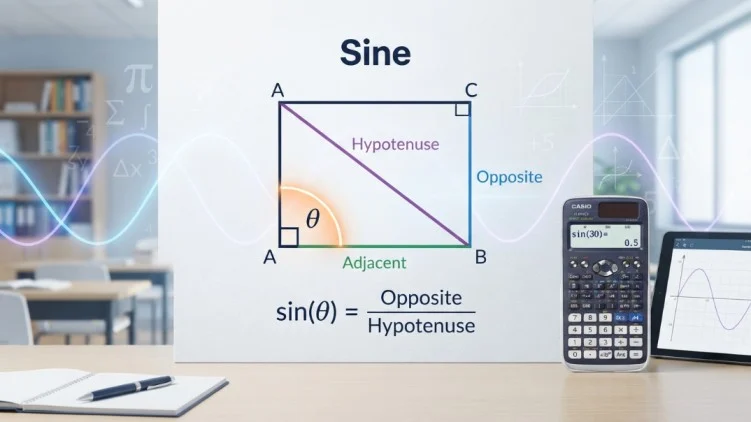
In a right triangle, sine = opposite side ÷ hypotenuse.
A single angle can tell you something surprising about the sides of a triangle. That is the simple idea behind sine. If you are a student, teacher, engineer, programmer, gamer, math learner, or anyone trying to understand trigonometry, knowing the sine function can make many problems much easier.
You may see sine written as sin in math problems, calculators, graphs, physics, engineering, and computer programs. It is one of the three main trigonometric functions, along with cosine and tangent.
The concept may look difficult at first, but its basic idea is simple. Sine compares two sides of a right triangle based on a chosen angle. Once you understand which sides to use, you can solve many common problems with confidence. This guide explains the sine meaning, formula, history, real-life uses, common mistakes, and related terms in simple language.
Definition & Meaning
The sine meaning is a mathematical relationship between an angle and the sides of a right triangle. It is usually written as sin.
For a selected angle in a right triangle:
Sine = Opposite ÷ Hypotenuse
The opposite side is the side directly across from the angle you are using.
The hypotenuse is the longest side of a right triangle. It is always opposite the 90-degree angle.
For example, imagine a right triangle with an angle of 30 degrees. If the side opposite that angle is 5 and the hypotenuse is 10, then:
sin(30°) = 5 ÷ 10 = 0.5
This tells us that the sine of 30 degrees is 0.5.
What does “sin” mean?
In mathematics, sin is simply the standard abbreviation for sine.
You may see:
- sin(30°)
- sin(45°)
- sin(90°)
- sin(x)
The letter x often represents an unknown angle.
A simple example
Teacher: “Which sides do we need for sine?”
Student: “The opposite side and the hypotenuse.”
Teacher: “Exactly.”
A useful memory trick is SOH:
- S = Sine
- O = Opposite
- H = Hypotenuse
So:
SOH → Sine = Opposite / Hypotenuse
Sine is not limited to triangles. It also plays a major role in waves, circular motion, sound, light, physics, engineering, and computer graphics.
Background & History
The history of sine goes back many centuries. Early forms of trigonometry developed as people studied astronomy, geometry, and the movement of objects in the sky.
Ancient mathematicians in India made important contributions to the development of the sine concept. Indian mathematicians worked with tables that described relationships between angles and chord-like measurements.
The concept later spread through mathematical traditions in the Islamic world. Scholars translated, developed, and expanded earlier mathematical knowledge. Trigonometric tables became useful for astronomy, geography, navigation, and other calculations.
The modern word sine has an interesting history. It developed through several languages and mathematical traditions before reaching English.
From geometry to modern mathematics
Early trigonometric work often focused on chords in circles. Over time, mathematicians developed the half-chord relationship that became closely connected to the modern sine function.
Today, sine is not just a triangle formula.
It is also understood as a function that can be defined using the unit circle. This broader view allows sine to work with angles greater than 90 degrees and even negative angles.
Sine today
Modern students may first meet sine through right triangles.
Later, they may use it in:
- algebra
- calculus
- physics
- engineering
- astronomy
- signal processing
- computer science
- architecture
- navigation
So, although the basic idea comes from geometry, sine has become one of the most useful functions in mathematics and science.
Usage in Various Contexts
Sine appears in many different areas. Its use depends on the problem being solved.
In school mathematics
Students often use sine to find an unknown side.
For example:
Student: “I know the angle and the hypotenuse, but I need the opposite side.”
Teacher: “Use sine.”
If the angle is known, you can use the sine function to calculate the missing side.
In physics
Sine helps describe repeating patterns and waves.
Sound waves, vibrations, and many other physical systems can be represented using sine functions.
For example, a simple wave may be modeled with an expression such as:
y = A sin(x)
The sine function creates a smooth repeating pattern.
In engineering
Engineers use sine when studying:
- electrical signals
- mechanical vibrations
- waves
- rotating systems
- structural forces
Alternating current is often modeled using sinusoidal functions.
In computer graphics
Sine can help computers calculate movement and rotation.
For example, a game developer might use sine to make an object move smoothly up and down.
Developer: “Why does the character move in a wave?”
Programmer: “The movement uses a sine function.”
In navigation
Trigonometry helps calculate distances, directions, and positions. Sine can be part of these calculations when angles and distances are involved.
Common Misconceptions & Clarifications
Sine is easy to use once the basic rule is clear, but several mistakes are common.
Misconception 1: Sine means opposite divided by adjacent
No.
Sine = opposite ÷ hypotenuse.
The ratio involving opposite and adjacent is tangent.
Misconception 2: The hypotenuse changes with the chosen angle
The hypotenuse is always the side opposite the 90-degree angle.
It does not change simply because you choose a different angle.
However, the opposite side does change when you select a different acute angle.
Misconception 3: Sine only works for 30, 45, and 90 degrees
Not at all.
You can calculate sine for many angles, including:
- 15°
- 20°
- 30°
- 45°
- 60°
- 90°
- 120°
- 180°
- and many more
Misconception 4: Sine is always positive
Not always.
When using the unit circle, sine can be positive, zero, or negative depending on the angle.
For example, sine is positive in the first and second quadrants and negative in the third and fourth quadrants.
Misconception 5: Sine and “sign” mean the same thing
No.
Sine is a trigonometric function.
Sign can mean a symbol, indication, or gesture.
The two words sound similar in some contexts, but they have completely different meanings.
Similar Terms & Alternatives
Sine belongs to a group of related mathematical functions called trigonometric functions.
The three basic functions are:
| Function | Ratio | Main sides |
|---|---|---|
| Sine | Opposite / Hypotenuse | O and H |
| Cosine | Adjacent / Hypotenuse | A and H |
| Tangent | Opposite / Adjacent | O and A |
A common memory trick is:
SOH-CAH-TOA
This stands for:
- SOH: Sine = Opposite / Hypotenuse
- CAH: Cosine = Adjacent / Hypotenuse
- TOA: Tangent = Opposite / Adjacent
Sine vs cosine
Sine uses the opposite and hypotenuse.
Cosine uses the adjacent side and hypotenuse.
Sine vs tangent
Sine uses the hypotenuse.
Tangent does not.
This difference is important when choosing a formula.
How to Respond to This Term
If someone asks you about the meaning of sine, your answer can be short or detailed depending on the situation.
Casual response
Friend: “What does sine mean?”
You: “It compares the opposite side of a right triangle with its hypotenuse.”
Student-friendly response
“Sine is a trig function. For a right triangle, sin(angle) equals opposite divided by hypotenuse.”
Funny response
Friend: “What is sine?”
You: “The math function that turns triangles into homework.”
Professional response
“Sine is a trigonometric function that represents the ratio of the opposite side to the hypotenuse for a given angle in a right triangle.”
If someone means “sign”
If the person actually wrote sign rather than sine, ask for clarification.
“Do you mean sine, the trigonometric function, or sign, meaning a symbol or indication?”
This avoids confusion.
Regional or Cultural Differences
The mathematical meaning of sine does not change significantly between countries. Students around the world learn the same basic trigonometric relationship.
The main difference may be the way people pronounce the word or write mathematical notation.
In English, sine is commonly pronounced like “sign.” This can create confusion for learners because sine and sign sound the same.
In many countries, mathematics classes use the abbreviation sin.
For example:
- sin 30°
- sin 45°
- sin x
Different countries may teach angles using degrees or radians depending on the level of mathematics.
Degrees and radians
School-level problems often use degrees:
sin(30°)
Advanced mathematics often uses radians:
sin(π/6)
Both describe angles. The notation simply uses different units.
The underlying sine function remains the same.
Comparison with Similar Terms
Sine is often confused with other trigonometric functions.
| Function | Formula | Best known for |
|---|---|---|
| Sine | Opposite / Hypotenuse | Relating opposite side to hypotenuse |
| Cosine | Adjacent / Hypotenuse | Relating adjacent side to hypotenuse |
| Tangent | Opposite / Adjacent | Relating opposite side to adjacent side |
| Secant | Hypotenuse / Adjacent | Reciprocal of cosine |
| Cosecant | Hypotenuse / Opposite | Reciprocal of sine |
| Cotangent | Adjacent / Opposite | Reciprocal of tangent |
Sine and cosecant
These two functions are closely related.
Cosecant is the reciprocal of sine.
So if sine gives a value of 0.5, its reciprocal is 2.
Sine and cosine
Sine and cosine are also connected through important mathematical identities.
For example, their squares satisfy the Pythagorean identity:
sin²(x) + cos²(x) = 1
This relationship becomes especially important in algebra and calculus.
Usage in Online Communities & Dating Apps
The word sine is mainly mathematical, so it does not have a major special meaning on dating apps or social media.
However, you may see it in online education communities, math forums, coding groups, gaming discussions, and student chats.
On platforms such as Tinder, someone might mention sine only as part of a joke, profile description, or conversation about school or science.
For example:
Match: “I survived calculus this semester.”
You: “So you must be a sine specialist now.”
Match: “Absolutely not. I barely survived.”
In gaming communities, sine can appear in discussions about:
- movement
- rotation
- physics engines
- animation
- game development
- 3D graphics
A developer might write:
“Use sine to create smooth vertical movement.”
Online tip
Do not assume sine is slang just because you see it in a casual message. Most of the time, it still means the mathematical function.
If someone writes “sine” when they seem to mean sign, the difference may simply be a spelling mistake.
Hidden or Offensive Meanings
Sine does not normally have a hidden offensive or inappropriate meaning. It is a standard mathematical term.
Its pronunciation can create confusion because it sounds like sign.
For example:
“What is your sine?”
Depending on context, someone may have accidentally written sine when they meant sign.
Sine vs sign
Sine = a mathematical function.
Sign = a symbol, signal, indication, or written mark.
There is also signature, which is sometimes shortened informally to “sign” in certain contexts.
The surrounding words usually make the intended meaning clear.
Why context matters
If someone says:
“Calculate the sine of 45 degrees.”
The meaning is clearly mathematical.
If someone says:
“That was a good sign.”
They are talking about an indication or signal.
So, while the words sound alike, they should not be treated as the same word.
Suitability for Professional Communication
Sine is completely appropriate in professional communication when discussing mathematics, science, engineering, programming, physics, or related subjects.
You may see it in:
- research papers
- technical reports
- engineering documents
- classroom materials
- software documentation
- scientific presentations
- academic writing
For example:
“The displacement can be modeled using a sine function.”
This is clear and professional.
Professional alternatives
There is no need to replace sine when you are referring to the mathematical function.
However, if your audience is unfamiliar with mathematics, explain it in simple language.
Instead of:
“Apply sin to the angle.”
You could write:
“Use the sine function for the angle.”
For beginners, you can also explain the ratio:
“Sine is the ratio of the opposite side to the hypotenuse.”
This makes technical writing easier to understand.
FAQs
1. What is the simple meaning of sine?
Sine is a trigonometric function that compares the opposite side of a right triangle with its hypotenuse.
2. What is the formula for sine?
The basic formula is:
sin(θ) = opposite ÷ hypotenuse
3. What does “sin” mean in math?
Sin is the standard abbreviation for sine.
4. Is sine the same as sign?
No. Sine is a trigonometric function, while sign can mean a symbol, signal, or indication. They sound alike but have different meanings.
5. What is sine used for?
Sine is used in geometry, physics, engineering, astronomy, navigation, computer graphics, programming, and many other fields.
6. What is SOH in trigonometry?
SOH means Sine = Opposite / Hypotenuse. It is part of the common SOH-CAH-TOA memory trick.
7. Can sine be negative?
Yes. When working with angles beyond a basic right triangle, sine can be positive, zero, or negative, depending on the angle.
Conclusion
The sine meaning is much simpler than it may first appear. Sine is a basic trigonometric function that compares the opposite side of a right triangle with its hypotenuse. Its common formula is sin = opposite ÷ hypotenuse, which students can remember with SOH.
Sine is not limited to school geometry. It is used in physics, engineering, astronomy, navigation, programming, computer graphics, waves, and many technical fields. You may also see it written as sin on calculators, formulas, and software.
One important point is that sine and sign are different words, even though they sound alike. Sine belongs to mathematics, while sign has several everyday meanings. Once you understand this difference and remember the basic SOH rule, the word becomes much easier to recognize and use correctly.
Discover More Post:
The Simple Meaning Behind This Popular Word in 2026
Spontaneous Meaning | What It Really Means Easy Examples …
What Does GOAT Mean in Text, Slang & Social Media in 2026