Quick Answer:
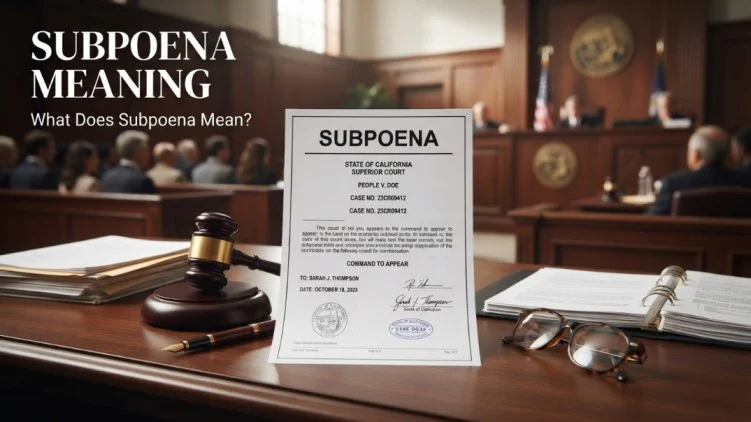
A subpoena is a legal order that requires someone to provide documents, evidence, or testimony for a legal case.
Ignoring a valid subpoena can lead to legal consequences, depending on the situation and jurisdiction.
Imagine receiving an official document that says you must appear in court or provide certain records. It may look confusing, especially if you have never dealt with the legal system before. One word that often stands out is “subpoena.” So, what does it actually mean?
If you are a student, employee, business owner, witness, journalist, or simply someone who wants to understand legal language, knowing the subpoena meaning can help you understand what an official legal notice is asking you to do. You may see the term in court reports, news stories, TV shows, workplace disputes, or legal documents.
A subpoena is not just a casual request. It is a formal legal command connected to a legal proceeding. It may require a person to appear and answer questions, or it may require them to provide specific documents or other evidence.
Definition & Meaning
A subpoena is a formal legal order that requires a person to do something related to a legal proceeding.
The word comes from Latin and is commonly understood as meaning “under penalty.” In simple terms, a subpoena tells someone that the law requires them to provide certain information, evidence, records, or testimony.
There are two common types of subpoenas.
Subpoena to Testify
A subpoena may require someone to appear at a particular place and time to give testimony.
For example:
Court Officer: “You have been ordered to appear and provide testimony.”
Witness: “Do I have to attend?”
Court Officer: “If the subpoena is valid and applies to you, you generally must comply unless the court excuses you or another legal basis applies.”
Subpoena for Documents
A subpoena may also require a person or organization to provide documents or other evidence.
For example, a business might be asked to produce:
- Emails
- Contracts
- Financial records
- Text messages
- Business files
- Photographs
- Electronic records
- Other relevant evidence
Simple Example
Suppose two companies are involved in a legal dispute. One company believes the other has important emails related to the case.
A court-related legal process may require those emails to be produced.
The company receiving the subpoena cannot simply treat it like an ordinary email asking for information. It is a formal legal demand.
The exact rules for issuing, challenging, and enforcing subpoenas vary by jurisdiction and by the type of legal proceeding.
Background & History
The word subpoena has a long legal history. It comes from the Latin phrase “sub poena,” which means “under penalty.”
The phrase reflected the idea that a person was required to comply with a legal command under the possibility of a penalty for failing to do so.
Over centuries, the term became part of English legal language. Courts and legal systems developed procedures for requiring people to appear, provide testimony, or produce evidence.
Today, the word remains common in legal systems that use English legal terminology.
A subpoena can appear in many types of proceedings, including:
- Civil lawsuits
- Criminal cases
- Investigations
- Administrative proceedings
- Business disputes
- Employment disputes
- Regulatory matters
Modern subpoenas can involve much more than paper documents.
Because so much information is stored electronically, a legal demand may involve emails, cloud records, computer files, messages, databases, or other digital information.
Example From Modern Life
Imagine that a company is involved in a lawsuit. A person who worked there may receive a subpoena requesting certain emails from a specific period.
The request may look something like:
“Please provide the requested records by the date stated in the subpoena.”
That does not necessarily mean the person is accused of wrongdoing. They may simply have information that could be relevant to the case.
This is an important point: receiving a subpoena does not automatically mean you are a suspect or defendant.
Usage in Various Contexts
The word subpoena is mostly used in legal and formal settings, but it can appear in everyday conversations when people discuss lawsuits, investigations, or court cases.
1. In Court Cases
A lawyer may discuss whether a witness should receive a subpoena.
Lawyer: “We need the witness to appear at the hearing.”
Assistant: “Should we request a subpoena?”
Here, the term refers to the legal process used to require the person’s participation.
2. In Business
Businesses may receive subpoenas requesting records.
Manager: “We received a subpoena asking for several years of financial documents.”
Employee: “Should I send the files?”
Manager: “We need to follow the instructions and consult the appropriate legal team first.”
3. In News Reports
You may read:
“The company received a subpoena for internal records.”
This means a legal authority or party with appropriate legal power has formally required the company to provide specified information.
4. In Texting
People sometimes use the word jokingly.
For example:
- Friend 1: “Send me the screenshots.”
- Friend 2: “Why?”
- Friend 1: “I need evidence.”
- Friend 2: “Whoa, did I just get subpoenaed? 😂”
This is informal and humorous. It does not mean the person has actually received a legal subpoena.
5. In Movies and TV
Legal dramas often show lawyers saying:
“We can subpoena the records.”
The basic idea is that the legal process may require certain records to be produced.
However, television often simplifies legal procedures. Real-world subpoena rules can be more complicated.
Common Misconceptions & Clarifications
The word subpoena is often misunderstood because movies and news reports sometimes make it sound more dramatic than it is.
Misconception 1: A subpoena means you are being arrested
Not necessarily.
A subpoena generally concerns testimony, documents, or evidence. It is not the same thing as an arrest warrant.
Misconception 2: Everyone who receives a subpoena is accused of a crime
False.
A person may receive a subpoena simply because they have information or records relevant to a case.
For example, a witness may be required to testify even though they did nothing wrong.
Misconception 3: A subpoena is just a request
This is an important distinction.
A valid subpoena is generally a formal legal demand or command, not an ordinary request.
The exact legal effect depends on the jurisdiction and circumstances.
Misconception 4: You can always ignore it
Ignoring a valid subpoena can create serious legal problems.
Possible consequences may include court proceedings or penalties for noncompliance, depending on applicable law.
If someone receives a subpoena, they should carefully review it and consider getting appropriate legal advice.
Misconception 5: A subpoena always comes directly from a judge
Not necessarily.
Who may issue or serve a subpoena depends on the jurisdiction and type of proceeding. Lawyers, courts, government agencies, and other authorized parties may have different powers under applicable rules.
Similar Terms & Alternatives
Several legal terms can sound similar to subpoena, but they are not identical.
Summons
A summons is generally an official notice requiring someone to respond to a legal proceeding or appear before a court.
It often relates to notifying a person that a case has been filed or that they must respond.
Warrant
A warrant is a legal authorization, often issued by a court or judge, that permits certain actions by law enforcement or other authorities.
Examples include arrest warrants and search warrants.
Court Order
A court order is an instruction issued by a court that requires or prohibits certain actions.
A subpoena is a specific type of legal demand used to obtain testimony or evidence, while a court order can cover many different matters.
Deposition Notice
A deposition involves sworn testimony taken outside the courtroom, often during the discovery phase of a civil case.
A subpoena may sometimes be used to require a non-party to attend a deposition.
| Term | Basic meaning | Common purpose |
|---|---|---|
| Subpoena | Legal demand for testimony or evidence | Obtain information |
| Summons | Official notice to respond or appear | Notify a party about legal action |
| Warrant | Legal authorization for specific action | Search, arrest, or other authorized action |
| Court order | Instruction from a court | Require or prohibit an action |
| Deposition notice | Notice of a deposition | Arrange sworn testimony |
How to Respond to This Term
If someone tells you that they received a subpoena, your response should depend on the situation.
Casual Response
If a friend is simply telling you about a real legal document:
“That sounds serious. Have you talked to a lawyer about it?”
Supportive Response
“I hope everything works out. Make sure you understand what the document requires.”
Funny Response
If they are only joking about being asked for information:
“Wow, suddenly our group chat has become a courtroom. 😂”
Humor is fine when everyone understands that no real legal obligation exists.
Professional Response
If a coworker mentions a real subpoena:
“Please follow the document’s instructions and coordinate with the appropriate legal or compliance team before providing records.”
Privacy-Conscious Response
You do not need to ask someone for private legal details.
You can say:
“I hope it gets resolved smoothly. You do not have to share anything you would rather keep private.”
If you personally receive a subpoena, do not rely on a casual online explanation to decide what to do. Read the document carefully and consider speaking with a qualified lawyer.
Regional or Cultural Differences
The word subpoena is strongly associated with English-language legal systems, especially in the United States and other jurisdictions influenced by common-law traditions.
However, legal systems around the world use different terms and procedures for compelling witnesses or obtaining evidence.
For example, another country may have a legal document that performs a similar function but uses a completely different name.
Even within English-speaking countries, the exact subpoena process can differ.
Rules may vary regarding:
- Who can issue a subpoena
- How it must be served
- What information it can request
- How much notice is required
- Whether objections can be made
- What happens if someone refuses to comply
This is why you should not assume that a U.S. subpoena works exactly like a legal document in the United Kingdom, Canada, Australia, or another country.
Language Differences
The English word subpoena is sometimes used in international business or media because it is widely recognized.
But when dealing with an actual legal matter, the local legal terminology is more important than the English translation.
Comparison with Similar Terms
Understanding the difference between a subpoena and related legal words can prevent confusion.
| Legal term | What it generally does | Is it about evidence? | Is it about appearance? |
|---|---|---|---|
| Subpoena | Requires testimony or records | Yes | Sometimes |
| Summons | Notifies or requires a response to legal proceedings | Usually no | Sometimes |
| Arrest warrant | Authorizes an arrest | No | Yes |
| Search warrant | Authorizes a search | Can involve evidence | No |
| Court order | Directs a person or organization to do or avoid something | Sometimes | Sometimes |
| Deposition | Takes sworn testimony outside court | Yes | Yes |
The biggest point to remember is this:
A subpoena is generally connected to obtaining evidence or testimony.
It does not automatically mean that the recipient is accused of a crime.
Usage in Online Communities & Dating Apps
The word subpoena occasionally appears in online communities, social media posts, memes, and dating-app conversations.
Most casual online uses are humorous.
For example:
“You have to show me those vacation photos.”
“Are you subpoenaing me now? 😂”
Here, the speaker is exaggerating an ordinary request by comparing it to a legal demand.
On social media, you may also see jokes such as:
“My friends subpoenaed the group chat for evidence.”
Again, this is usually not a real legal statement.
Dating Apps
Someone might jokingly write:
“I need proof that your food recommendations are actually good. Subpoena the evidence. 😂”
This is playful rather than legal.
However, if someone says they have actually received a subpoena, do not treat the matter as a joke.
Online Safety Tip
Avoid asking strangers online to send you private legal documents, court records, addresses, or personal information.
If someone mentions a legal dispute, respect their privacy.
And if you receive a real subpoena through an online platform or electronic system, verify its authenticity before taking action, especially if it requests sensitive information or money.
Hidden or Offensive Meanings
Subpoena does not have a standard hidden or offensive meaning.
Its ordinary meaning is legal.
Still, people may use the word sarcastically or as a joke.
For example:
“You subpoenaed my entire camera roll just to find one picture? 😂”
The speaker is using the legal word to exaggerate how strongly someone is asking for information.
The term can also sound intimidating because it is associated with courts and legal obligations. That emotional reaction does not necessarily mean that the person receiving the subpoena has done something wrong.
Tone Matters
Compare these two statements:
“The court issued a subpoena for the records.”
This is a serious legal statement.
“Bro, why are you subpoenaing my snacks?”
This is clearly a joke.
The word has not changed meaning. The context has changed.
Suitability for Professional Communication
Subpoena is completely appropriate in professional and legal communication when it accurately describes a legal document or process.
For example:
“The company received a subpoena requesting financial records.”
This is clear and professional.
You may see the word in:
- Legal emails
- Court documents
- Compliance communications
- Business correspondence
- News reports
- Government communications
- Corporate investigations
However, avoid using subpoena casually in formal writing when you simply mean request.
For example, this sentence:
“Please subpoena the sales report.”
could be inappropriate if you simply want a coworker to send the report.
A better professional phrase might be:
“Please provide the sales report by Friday.”
Use subpoena when an actual legal process is involved.
Professional Alternatives
Depending on the situation, you may use:
- Legal request
- Formal request
- Court order
- Request for records
- Request for testimony
- Document request
But these are not exact synonyms. If a document is legally a subpoena, calling it merely a “request” may make its nature sound less formal than it actually is.
FAQs
What does subpoena mean in simple words?
A subpoena is a formal legal demand requiring someone to provide testimony, documents, records, or other evidence connected to a legal proceeding.
Does receiving a subpoena mean you are in trouble?
Not necessarily. A person may receive a subpoena because they have information or records relevant to a case. Being subpoenaed does not automatically mean you are accused of wrongdoing.
Can you ignore a subpoena?
You should not simply ignore a valid subpoena. The consequences of noncompliance depend on the applicable law and circumstances. If you receive one, consider getting advice from a qualified legal professional.
What is the difference between a subpoena and a summons?
A subpoena generally seeks testimony or evidence, while a summons generally notifies a person about legal proceedings and may require them to respond or appear.
Is a subpoena the same as a warrant?
No. A subpoena and a warrant serve different purposes. A warrant can authorize actions such as an arrest or search, while a subpoena generally requires testimony or evidence.
Can a subpoena request emails or text messages?
Yes, depending on the applicable rules and the scope of the subpoena, electronic records such as emails or messages may be requested.
How do you pronounce subpoena?
Subpoena is commonly pronounced roughly like “suh-PEE-nuh.” The spelling can look difficult, but the pronunciation is much simpler than it appears.
Conclusion
The word subpoena may sound intimidating, but its basic meaning is straightforward. It is a formal legal demand connected to a legal proceeding, often requiring someone to provide testimony, documents, records, or other evidence.
Receiving one does not automatically mean that you are accused of a crime. You could simply be a witness or have information that is relevant to a case. Still, a valid subpoena should not be treated like an ordinary request.
The term is also sometimes used jokingly online, especially when someone wants information from a friend. In that setting, it usually means nothing more than “I really want that evidence!”
The most important distinction is between a real legal subpoena and casual online use. If you receive an actual subpoena, read it carefully and consider getting appropriate legal advice before responding.
Read More Related Articles:
WTM Meaning in Texting | Definition, Examples & How to Use …
What Does Soursop Mean and What Is This Fruit – Similixy.com
IG Meaning in Text Messages | Definition, Uses, and Real …