Quick Answer:
Soursop is a tropical fruit known for its green, spiky skin and soft, creamy flesh. It is also called graviola or guanabana in different regions.
Imagine cutting open a bright green, spiky fruit and finding soft, white flesh inside with a sweet yet slightly tangy flavor. That unusual fruit is soursop. If you have seen the word online, heard it in a conversation, or spotted it on a juice menu, you may have wondered what it means.
For food lovers, travelers, health-conscious readers, and anyone learning English or exploring tropical fruits, understanding the soursop meaning can make the word much easier to recognize. It is not slang or an internet abbreviation. It is the common English name for a tropical fruit that has become popular far beyond the regions where it originally grew.
You may also see it called graviola or guanabana, depending on the country and language. Its unusual appearance, creamy texture, and strong flavor have made it popular in drinks, desserts, smoothies, and other foods.
Definition & Meaning
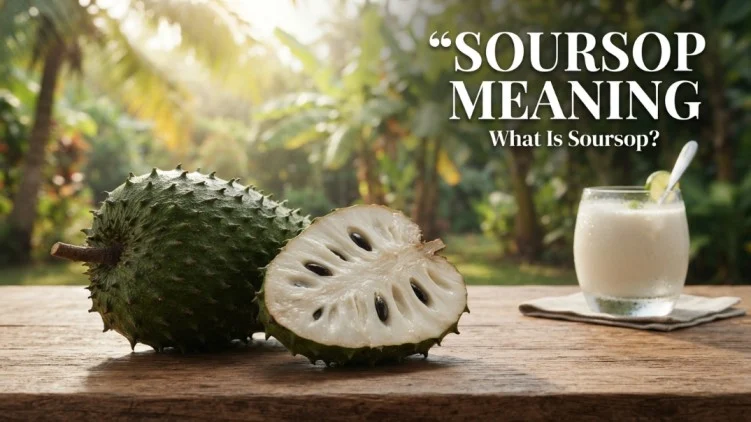
Soursop is the common English name for the fruit of the Annona muricata tree. It is a tropical fruit with green skin covered in soft, curved spikes. Inside, it has white, juicy flesh containing black seeds.
The fruit is usually described as having a flavor that combines several notes. People often compare it to a mix of strawberry, pineapple, citrus, and other tropical flavors, although the exact taste can vary depending on ripeness.
The word soursop refers to the fruit itself. It does not normally describe a person, emotion, slang phrase, or personality trait.
What Does Soursop Look Like?
A ripe soursop is generally:
- Green on the outside
- Soft or slightly yielding when ripe
- White and creamy inside
- Filled with dark seeds
- Covered with short, soft-looking spikes
Its size can vary, and some fruits can become quite large.
What Does Soursop Taste Like?
The taste is one reason the fruit gets so much attention.
Soursop has a sweet, tangy, tropical flavor. Its texture is often soft and creamy, which makes it popular for drinks and desserts.
Someone trying it for the first time might say:
“It tastes sweet, but there is a sharp, citrus-like kick.”
Another person might describe it as:
“Creamy, tropical, and slightly sour.”
Both descriptions can make sense because taste is personal.
Is Soursop the Same as Guanabana?
Yes. Guanabana is a Spanish name commonly used for soursop.
You may also see the fruit called graviola, especially in Portuguese-speaking regions or in product marketing.
So these names can refer to the same fruit:
| Name | Common use |
|---|---|
| Soursop | English |
| Guanabana | Spanish |
| Graviola | Portuguese and international product use |
| Annona muricata | Scientific name |
Background & History
Soursop comes from tropical regions of the Americas and is now grown in many warm parts of the world.
The plant belongs to the Annonaceae family. Its scientific name is Annona muricata.
Over time, soursop spread to other tropical areas because the tree grows well in warm climates. Today, it can be found in parts of the Caribbean, Central America, South America, Southeast Asia, and other tropical regions.
The fruit has been part of local food traditions for generations. People have used the soft flesh in fresh preparations, juices, desserts, and other drinks.
In Spanish-speaking countries, guanabana is a familiar name. In English-speaking markets, soursop is more common.
The name itself is interesting because it appears to describe the fruit’s flavor. “Sour” refers to its tangy taste, while “sop” is an old English term connected with something soaked or softened in liquid.
Modern interest in soursop has also grown because of social media. Photos and videos showing the unusual fruit often attract attention from people who have never seen it before.
You may now find soursop products in:
- Juice bars
- Smoothie shops
- Tropical restaurants
- Frozen-food sections
- Dessert menus
- International grocery stores
- Online food communities
Its journey from a regional tropical fruit to an internationally recognized food is part of what makes soursop interesting.
Usage in Various Contexts
The word soursop is mostly used literally. It refers to the fruit, a tree, or food and drinks made from it.
1. Everyday Conversation
Mia: “Have you ever tried soursop?”
Daniel: “No, but I keep seeing it at the market.”
Here, soursop simply means the fruit.
2. Food Menus
A restaurant might list:
Soursop Smoothie
This means a smoothie made with soursop or soursop-based ingredients.
3. Social Media
Someone may post:
“Trying fresh soursop for the first time! 🌿🥤”
The word is being used as a food term.
4. Grocery Shopping
You might ask:
“Do you have fresh soursop today?”
The seller would understand that you are looking for the tropical fruit.
5. Cooking
A recipe may say:
“Remove the seeds before blending the soursop flesh.”
Again, the word has its literal meaning.
6. Travel
A traveler visiting a tropical country might ask:
“What is that green fruit? Is it soursop?”
This is a natural way to use the word when exploring local foods.
7. Online Communities
Food communities may discuss:
“What does soursop taste like?”
or
“Where can I buy frozen soursop?”
The meaning remains the same across these situations.
Common Misconceptions & Clarifications
Soursop is sometimes misunderstood because its appearance is unusual and its name sounds descriptive.
Misconception 1: Soursop Is a Sour Fruit Only
Not exactly.
Although soursop has a tangy quality, it is also sweet and creamy. The flavor is more complex than the word “sour” might suggest.
Misconception 2: Soursop Is a Citrus Fruit
It is not.
Soursop is not related to oranges, lemons, or other common citrus fruits. It belongs to the Annonaceae family.
Misconception 3: Soursop and Guanabana Are Different Fruits
Usually, no.
Guanabana is a Spanish name for soursop. If someone says they bought guanabana, they are generally talking about the same fruit.
Misconception 4: Soursop Is Slang
In standard English, soursop is not common slang. It is primarily a fruit name.
If you see the word in a joke, meme, or unusual online conversation, the surrounding context may create a different meaning, but that is not the standard definition.
Misconception 5: The Spikes Are Dangerous
The outside of soursop can look intimidating, but its soft-looking spines are quite different from sharp thorns.
Still, handling any unfamiliar fruit carefully is sensible.
Similar Terms & Alternatives
Several words can appear alongside soursop, especially when people discuss tropical foods.
Guanabana
This is one of the most common alternative names for soursop in Spanish-speaking communities.
Graviola
Graviola is another widely recognized name, especially in Portuguese and international health-food contexts.
Custard Apple
This term can cause confusion.
Soursop belongs to the same broader plant family as some fruits called custard apples, but soursop and the fruit commonly called custard apple are not always the same fruit.
Annona
Annona is the name of the plant genus that includes soursop and several related fruits.
| Term | Meaning |
|---|---|
| Soursop | Common English name |
| Guanabana | Spanish name |
| Graviola | Portuguese/common international name |
| Annona muricata | Scientific name |
| Custard apple | Related but not necessarily the same fruit |
Knowing these names can help when shopping in international markets or reading recipes from different countries.
How to Respond to This Term
If someone mentions soursop, your response depends on the conversation.
Casual Response
“I’ve heard of it, but I’ve never tried it.”
This works well when discussing food with friends.
Curious Response
“What does soursop taste like?”
This is a natural question if you have never eaten it.
Funny Response
“That fruit looks like it belongs in a fantasy movie! 😂”
The unusual appearance makes it easy to joke about.
Food-Lover Response
“I love tropical fruits. I definitely want to try fresh soursop.”
Professional Response
If discussing food in a business or culinary setting, you could say:
“Soursop is a tropical fruit commonly used in beverages and desserts.”
If Someone Sends You the Word in a Message
You can ask:
“Do you mean the tropical fruit?”
That is useful if the context is unclear.
Because soursop is normally a literal food term, there is usually no complicated response needed.
Regional or Cultural Differences
Soursop is known by different names around the world.
In many Spanish-speaking communities, the fruit is called guanabana. This name is especially common in Latin America and the Caribbean.
In English-speaking areas, soursop is the standard name.
In Portuguese, particularly in Brazil, you may encounter graviola.
This means a person from one country may use a completely different word for the same fruit.
Example
Traveler: “Do you sell soursop?”
Shopkeeper: “You mean guanabana?”
Traveler: “Yes!”
Both people are talking about the same fruit.
Regional food traditions also differ. Some communities enjoy the fruit fresh, while others use it in juices, smoothies, ice cream, desserts, or other recipes.
Its popularity has also spread through international restaurants and grocery stores.
This is a good example of how food vocabulary changes across cultures. Learning the alternative names can make travel and shopping much easier.
Comparison with Similar Terms
Soursop is often confused with other tropical fruits because several have creamy flesh or belong to related plant families.
| Fruit | Appearance | Flavor | Main Difference |
|---|---|---|---|
| Soursop | Green and spiky | Sweet and tangy | Large soft spikes |
| Cherimoya | Green, textured skin | Sweet and creamy | Usually smoother skin |
| Custard apple | Green, segmented skin | Sweet and creamy | Different fruit type |
| Sugar apple | Bumpy green skin | Very sweet | Smaller segments |
| Papaya | Smooth orange flesh | Sweet and mild | Orange flesh and no spikes |
| Jackfruit | Large, rough green skin | Sweet and fruity | Much larger and fibrous |
Soursop stands out because of its green spiky exterior and soft white interior.
Its taste is also distinct, even though people often compare it with other tropical fruits.
Usage in Online Communities & Dating Apps
Unlike words such as “rizz,” “ghosting,” or “simp,” soursop is not a common dating-app slang term.
On platforms such as Tinder, Instagram, TikTok, X, Reddit, Discord, and Facebook, you are most likely to see it in conversations about:
- Food
- Tropical fruit
- Travel
- Recipes
- Smoothies
- Restaurants
- International cuisine
- Gardening
For example, someone might post:
“Finally found fresh soursop at the international market! 😍”
A food creator could write:
“Soursop smoothie recipe coming tomorrow.”
A traveler might say:
“I tried fresh guanabana while visiting Costa Rica.”
On dating apps, the word could appear in someone’s profile because they enjoy the fruit or tropical food. For example:
“Coffee, beaches, and soursop smoothies are my happy place.”
That does not create a special hidden dating meaning. It is most likely just a food reference.
Online Tip
Do not assume a common noun is slang just because it appears in a playful message. Always look at the surrounding conversation before assigning another meaning.
Hidden or Offensive Meanings
There is no widely recognized offensive meaning attached to the standard English word soursop.
It is simply the name of a tropical fruit.
Someone could use the word jokingly in a meme or create a personal nickname from it, but those uses depend on the individual context.
For example:
“You brought another soursop smoothie? 😂”
This is simply playful teasing.
The word could also appear in a username, joke, or social-media caption. That does not automatically give it a secret meaning.
If someone sends you only:
“Soursop”
and you are unsure why, the easiest response is:
“Do you mean the fruit?”
That avoids making an incorrect assumption.
The important point is that context matters. A word can be used creatively online, but that does not change its standard dictionary meaning.
Suitability for Professional Communication
Soursop is completely appropriate in professional communication when discussing the fruit.
You may see it in:
- Restaurant menus
- Food descriptions
- Agricultural reports
- Grocery listings
- Recipes
- Product labels
- Academic writing
- Culinary articles
- Import and export documents
For example:
“The company imports frozen soursop pulp for beverage production.”
That is clear and professional.
A restaurant could write:
“Our tropical smoothie contains fresh soursop, pineapple, and coconut.”
There is no need to replace soursop with slang or another informal term.
If your audience may know the fruit by another name, you can introduce the alternative:
“Soursop, also known as guanabana, is a tropical fruit with creamy white flesh.”
This is especially useful in international business or food writing.
FAQs
What does soursop mean?
Soursop is the English name for a tropical fruit from the Annona muricata tree. It has green, spiky skin and soft white flesh.
Is soursop the same as guanabana?
Yes. Guanabana is a common Spanish name for soursop. Graviola is another name used in some regions.
What does soursop taste like?
Soursop usually tastes sweet, tangy, and tropical. Its creamy texture makes it popular in smoothies, juices, and desserts.
Is soursop a slang word?
No. In standard English, soursop is the name of a tropical fruit. It does not have a common slang meaning.
Why is it called soursop?
The name is generally associated with the fruit’s tangy or sour flavor and an older English word connected with something softened or soaked in liquid.
What is the scientific name for soursop?
The scientific name is Annona muricata. It belongs to the Annonaceae plant family.
What are other names for soursop?
Common names include guanabana and graviola. The exact name depends on the language and region.
Conclusion
The word soursop refers to a tropical fruit known for its green, spiky skin, creamy white flesh, and sweet-tangy flavor. It is not normally slang or an internet abbreviation.
You may encounter the same fruit under different names, especially guanabana in Spanish and graviola in Portuguese. These regional names can be useful when traveling, shopping, or reading international recipes.
Soursop appears in everyday food conversations, restaurant menus, social media posts, recipes, smoothies, and travel discussions. While its unusual appearance may make it look mysterious, the word itself has a simple meaning.
So, when someone mentions soursop, they are almost certainly talking about the tropical fruit not a hidden slang term or secret expression.
Read More Related Articles:
What Does “Mhm” Mean in Texting and Chat in 2026
What Does “Petite” Mean? Simple Definition & Examples in …
What Does “Cringe” Mean in Text, Slang & Social Media in 2026