Quick answer:
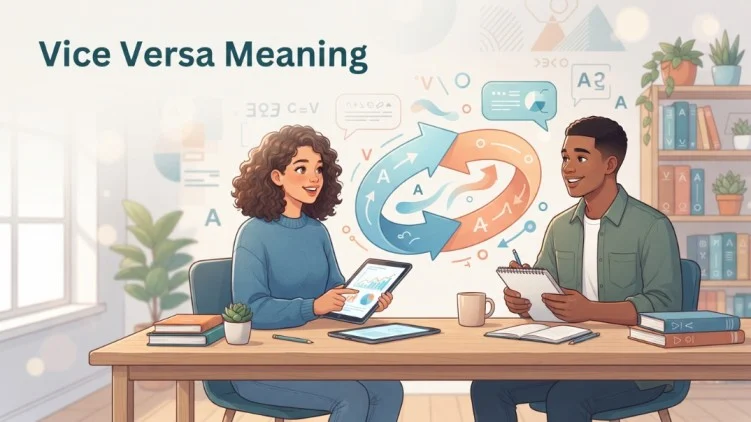
Vice versa means the opposite way around or with the two people or things reversed.
For example, “I help her, and vice versa” means she helps me too.
One small phrase can save you from repeating an entire sentence. That phrase is vice versa. You may have seen it in texts, school assignments, social media posts, conversations, emails, or even gaming chats. It sounds formal, but its basic meaning is very simple: the reverse is also true.
If you are a student, writer, teacher, professional, gamer, social media user, or everyday texter, knowing the vice versa meaning can make your English clearer and more natural. It helps you avoid repeating the same information and lets you express two-way relationships in fewer words.
You might say, “I respect my friends, and vice versa,” instead of repeating the whole idea. The phrase is useful, but it can also confuse learners because it comes from Latin. Let’s break down its meaning, history, examples, online uses, and common mistakes in simple English.
Definition & Meaning
The phrase vice versa means the other way around, in reverse order, or with the positions of two things exchanged.
It is used when a statement applies in the opposite direction too.
Simple definition
Vice versa = the reverse is also true.
For example:
Alex: “I help Sarah with her homework, and vice versa.”
Sam: “So Sarah helps you with your homework too?”
Alex: “Exactly.”
The phrase prevents Alex from having to say:
“I help Sarah with her homework, and Sarah helps me with my homework.”
Instead, vice versa communicates the reversed relationship.
Another simple example
“Parents learn from their children, and vice versa.”
This means:
Parents learn from children, and children learn from parents.
The phrase works because the two sides are reversed.
What does “vice versa” literally mean?
The expression comes from Latin and roughly means “with the order turned around.”
It does not mean “vice” as in bad behavior or wrongdoing. The two words simply form a Latin expression that English has adopted.
Common examples
Here are some natural examples:
- “I trust him, and vice versa.”
- “She teaches me, and vice versa.”
- “You can call me, and vice versa.”
- “Dogs understand people, and vice versa.”
- “We support each other, and vice versa.”
In each sentence, the phrase tells the reader that the same relationship works in the opposite direction.
Vice versa in everyday English
The phrase is common in both casual and formal English. It can make a sentence shorter and prevent unnecessary repetition.
However, it should only be used when the reversed meaning is clear. If the relationship changes when reversed, vice versa may create confusion.
Background & History
The phrase vice versa comes from Latin, an ancient language that has influenced English vocabulary for centuries.
The Latin expression vice versa can be understood as meaning “with the order reversed” or “the other way around.” English adopted the expression because it offered a short way to describe a reversed relationship.
Unlike many old Latin expressions, vice versa remains very common in modern English.
Why did English keep it?
Language often keeps foreign expressions when they are useful and easy to understand within a particular context. Vice versa became especially useful in writing because it replaces a longer explanation.
“I respect my teacher, and my teacher respects me.”
You could instead write:
“I respect my teacher, and vice versa.”
The second version is shorter while keeping the same basic meaning.
Vice versa in older writing
The phrase has historically appeared in formal writing, academic discussions, legal language, and educated conversation. Over time, it moved beyond formal writing and became part of everyday English.
Today, people use it in:
- casual conversations
- emails
- essays
- textbooks
- business writing
- social media
- online forums
- gaming discussions
- relationships
Has the meaning changed?
The central meaning has stayed remarkably stable.
It still means the reverse is true or the other way around.
What has changed is the range of situations where people use it. A phrase that once sounded more formal can now appear in everyday texting.
For example:
“I annoy my brother, and vice versa 😂.”
This sounds casual and natural online.
The phrase may have Latin roots, but you do not need to know Latin to use it correctly.
Usage in Various Contexts
The meaning of vice versa stays the same, but its tone can change depending on the situation.
In texting
People use vice versa when two people do the same thing to each other.
Mia: “You always make me laugh.”
Noah: “Vice versa 😂.”
Here, Noah means Mia makes him laugh too.
Another example:
Sam: “I text you when I’m bored.”
Alex: “Vice versa.”
Alex means Alex also texts Sam when Alex is bored.
On social media
The phrase often appears in captions, comments, and short posts.
“Support your friends, and vice versa.”
This means friends should support you too.
It can also appear in relationship posts:
“I choose her every day, and vice versa.”
The meaning is that she chooses the speaker too.
In gaming
Gamers can use vice versa to describe two-way actions or relationships.
Player A: “You cover me while I reload, and vice versa.”
Player B: “Got it.”
This means both players should protect each other while the other reloads.
Another example:
“This weapon works well against that character, and vice versa.”
The writer is saying the reverse matchup is also true.
In casual conversations
The phrase can replace repeated information.
Friend 1: “I borrow your notes, and you borrow mine.”
Friend 2: “So basically, we help each other, vice versa.”
Friend 1: “Exactly.”
A more natural sentence would be:
“We help each other.”
Still, vice versa can be useful when the two actions are more specific.
In professional settings
“The marketing team provides data to the sales team, and vice versa.”
This means both teams provide information to each other.
The phrase is especially useful when explaining two-way communication.
Common Misconceptions & Clarifications
Many English learners understand the general idea of vice versa but still make mistakes when using it.
Misconception 1: Vice versa means “the same thing”
Not exactly.
It means the reverse is also true.
For example:
“I help John, and vice versa.”
This does not simply mean John also exists or agrees. It means John helps me.
Misconception 2: Vice versa means “again”
No.
Vice versa does not mean something happens again.
It means the roles or directions are reversed.
Misconception 3: It means “both people do exactly the same thing”
Not always.
The phrase refers to reversing the relationship expressed in the original statement.
For example:
“I introduced her to my friends, and vice versa.”
This suggests she introduced me to her friends.
The exact reverse depends on the original action.
Misconception 4: Vice versa is slang
It is not slang.
It is a standard English expression with Latin origins. It works in casual and formal communication.
Misconception 5: Vice versa can be added anywhere
This is where care is needed.
Consider:
“I gave Tom my old phone, and vice versa.”
This could mean Tom gave the speaker his old phone, which may or may not make logical sense.
The phrase works best when the reversed action is clear and reasonable.
Misconception 6: It means “opposite”
Sometimes it does involve an opposite direction, but vice versa is more specific than simply “opposite.”
It means the roles, order, or relationship are reversed.
Similar Terms & Alternatives
Several expressions can replace vice versa, depending on the sentence.
| Term | Meaning | Example |
|---|---|---|
| Vice versa | The reverse is also true | “I help her, and vice versa.” |
| The other way around | The reverse situation | “It works the other way around.” |
| In reverse | In the opposite order or direction | “Read it in reverse.” |
| Conversely | In contrast or in the opposite case | “Conversely, the second method is slower.” |
| Back and forth | Moving between two sides | “They argued back and forth.” |
| Mutually | Done by both sides | “They mutually support each other.” |
| Both ways | Applying in both directions | “The rule works both ways.” |
Vice versa vs. the other way around
These are often interchangeable.
“I help her, and vice versa.”
means:
“I help her, and the other way around.”
The second version sounds more conversational.
Vice versa vs. conversely
These words are not always interchangeable.
Vice versa means the relationship is reversed.
Conversely usually introduces a contrasting or opposite point.
For example:
“Cats may avoid loud sounds, and vice versa.”
This sentence may not make sense because the relationship is unclear.
But:
“The first option is cheaper. Conversely, the second option is faster.”
works because conversely introduces a contrast.
How to Respond to This Term
If someone uses vice versa in conversation, your response depends on the situation.
Casual response
“Yep, same goes for me.”
This is a natural alternative to repeating vice versa.
Short response
“Exactly.”
This works when the reversed meaning is obvious.
Funny response
“So basically, right back at you 😂.”
This is useful in friendly texting.
Professional response
“Understood. The same applies in the opposite direction.”
This is useful when you want to avoid ambiguity.
If you are confused
You can simply ask:
“Do you mean the same applies the other way around?”
This is a clear way to confirm the meaning.
In texting
Friend: “I miss you, and vice versa.”
You: “Aww, right back at you ❤️.”
The phrase can make emotional messages shorter without changing their meaning.
If the sentence is unclear
Do not guess.
“Just to clarify, what do you mean by ‘vice versa’ here?”
This is especially useful in professional communication where misunderstanding can cause problems.
Regional or Cultural Differences
Vice versa is widely understood in English-speaking regions, including the United States, United Kingdom, Canada, Australia, and New Zealand.
Its meaning is generally stable across these regions.
British English
The phrase is common in both casual and formal communication.
“We help each other, and vice versa.”
American English
American speakers use it frequently in conversation and writing.
It may sound slightly more polished than:
“the other way around.”
Canadian and Australian English
The expression is also familiar and commonly used.
Non-native English speakers
Learners may recognize vice versa from textbooks or formal writing before hearing it in everyday speech.
The phrase is not normally translated word-for-word into other languages. Many languages have their own expressions meaning:
- the other way around
- in reverse
- both ways
- reciprocally
The exact phrase may not exist in every language, but the underlying idea is universal.
Cultural tone
Using vice versa can sometimes sound more formal than saying:
“same goes for you.”
This makes word choice important.
In a casual chat, “same here” may sound warmer.
In an academic sentence, “vice versa” may sound more natural.
Comparison with Similar Terms
The following comparison can help you choose the right expression.
| Expression | Main meaning | Best use |
|---|---|---|
| Vice versa | The reverse is also true | Two-way relationships |
| The other way around | Reverse the situation | Casual conversation |
| Same goes for me | The same applies to me | Texting and casual speech |
| Both ways | Applies in both directions | Rules and situations |
| Conversely | In contrast or opposite case | Formal writing |
| In reverse | Reversed order or direction | Instructions and processes |
| Reciprocally | In a mutual way | Formal or technical writing |
| Back and forth | Moving between two sides | Repeated exchanges |
Example comparison
Vice versa:
“I support her, and vice versa.”
The other way around:
“I support her, and it works the other way around too.”
Same goes for me:
“I appreciate you.”
“Same goes for me.”
All can communicate related ideas, but their tone and structure differ.
Usage in Online Communities & Dating Apps
The phrase vice versa is common in online communities because people often need to express two-way relationships quickly.
On dating apps such as Tinder, someone might write:
“Looking for someone who respects me, and vice versa.”
The meaning is simple: the person wants mutual respect.
Another example:
“I make her laugh, and vice versa.”
This means both people make each other laugh.
In online discussions, users may write:
“You can criticize my opinion, and vice versa.”
That means the other person is free to criticize the speaker’s opinion too.
Gaming communities may use the phrase when discussing team strategies:
“You protect the healer, and vice versa.”
The meaning depends on the game mechanics and the exact relationship.
Tips for online use
Keep the sentence clear before adding vice versa.
If the reversed meaning is difficult to understand, spell it out instead.
For example:
“We support each other.”
may be clearer than:
“I support her, and vice versa.”
Online communication is fast, so clarity matters more than sounding formal.
Hidden or Offensive Meanings
Vice versa has no standard hidden, sexual, insulting, or offensive meaning.
It is a normal English expression.
However, context can affect how a sentence feels.
For example:
“I trust you, and vice versa.”
sounds positive.
But:
“I blame you, and vice versa.”
can sound hostile because the underlying statement is negative.
The phrase itself is not offensive. The meaning of the sentence around it determines the tone.
Can it sound sarcastic?
Yes, depending on context.
“You think I’m annoying, and vice versa.”
This could be a joke, but it could also be a serious insult.
Likewise:
“You ignore me, and vice versa.”
may sound cold or sarcastic.
Is vice versa rude?
No.
The phrase is not inherently rude. It becomes negative only when it is used with negative language or a hostile tone.
Suitability for Professional Communication
Vice versa is suitable for professional communication when the reversed meaning is clear.
You may see it in:
- business emails
- reports
- academic writing
- presentations
- technical documents
- workplace conversations
- instructions
For example:
“The customer provides feedback to the company, and vice versa.”
This is concise and professional.
Professional alternatives
If you want maximum clarity, you can use:
- “the same applies in reverse”
- “the reverse also applies”
- “in both directions”
- “the other way around”
- “mutually”
For example:
“The teams share information with each other.”
This may be clearer than:
“Team A shares information with Team B, and vice versa.”
When should you avoid it?
Avoid vice versa when the reversed meaning is ambiguous.
For example:
“The manager approved the employee, and vice versa.”
The reader may wonder exactly what the reverse action means.
A clearer version would explain the second action directly.
In formal writing, clarity should always come before brevity.
FAQs
1. What does vice versa mean in simple English?
Vice versa means “the other way around” or “the reverse is also true.”
2. Is vice versa a Latin phrase?
Yes. Vice versa comes from Latin and means roughly “with the order reversed.”
3. Can I use vice versa in texting?
Yes. It is common in texting and online conversations, especially when two people do something for each other.
4. Is vice versa formal or informal?
It can be used in both formal and informal English. In casual texting, phrases like “same goes for me” may sound more relaxed.
5. What is an example of vice versa?
“I help my sister, and vice versa” means my sister helps me too.
6. Is vice versa the same as conversely?
No. Vice versa means the reverse is also true, while conversely usually introduces a contrasting or opposite point.
7. Is vice versa rude or offensive?
No. Vice versa is a neutral expression. The tone depends on the sentence in which it appears.
Conclusion
The vice versa meaning is simple: the other way around, with the relationship or order reversed. It is a useful phrase because it lets you avoid repeating information that works in both directions.
You can use vice versa in everyday conversations, texting, social media, gaming, academic writing, and professional communication. For example, “I support you, and vice versa” means you support me too.
Remember that vice versa is not slang, and it does not have a hidden offensive meaning. It comes from Latin and has kept its basic meaning for centuries. The main thing to check is clarity. If the reversed meaning is obvious, vice versa can make your sentence short and smooth. If the reversal could confuse the reader, simply explain the idea in full. That small choice can make your English much clearer and more natural.
Discover More Post:
- Spontaneous Meaning | What It Really Means Easy Examples …
- What Does GOAT Mean in Text, Slang & Social Media in 2026
- Sassy Meaning | Simple Definition, Examples, Uses, and What …