Quick answer:
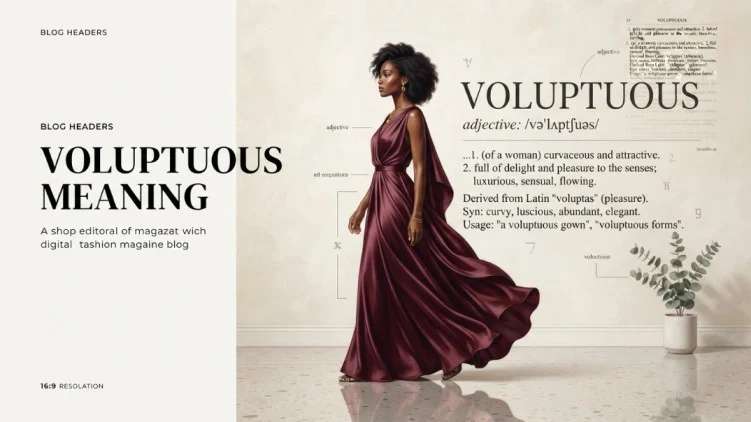
Voluptuous usually means having a full, curvy, and attractive body shape. It can also describe something that gives strong physical or sensual pleasure.
Some words sound simple but carry more meaning than you might expect. Voluptuous meaning is a good example. The word voluptuous is often used to describe a person with a full, curvy, and attractive figure, but it can also describe something rich, luxurious, or deeply pleasurable.
If you are a student, writer, social media user, language learner, content creator, or someone who enjoys understanding English words, knowing this term can help you read and communicate with more confidence. You may see voluptuous in fashion posts, books, movies, dating conversations, beauty discussions, or everyday descriptions.
The word can sound flattering in one situation and overly personal in another. That is why context matters. Understanding its meaning, tone, history, and appropriate use can help you choose the right words without causing confusion or discomfort.
Definition & Meaning
The basic voluptuous meaning is full, rounded, curvy, or physically attractive in a sensual way.
The word is often used to describe a person’s body, especially when someone has noticeable curves and a fuller figure.
Simple definition
Voluptuous = full-bodied, curvy, sensual, or richly pleasurable.
For example:
Person A: “How would you describe the model’s figure?”
Person B: “She has a voluptuous figure.”
Here, voluptuous suggests a body with full and rounded curves. It is usually connected with physical attractiveness.
However, the word does not only describe people.
It can also describe things that provide a strong sense of pleasure.
For example:
“The restaurant served a voluptuous dessert.”
This use is more literary. It suggests the dessert was rich, indulgent, luxurious, or highly pleasurable.
Voluptuous vs. curvy
The words voluptuous and curvy can overlap, but they are not exactly the same.
Curvy is usually a neutral description of body shape.
Voluptuous often adds a sense of sensuality or attractiveness.
For example:
“She has a curvy figure.”
This mainly describes body shape.
“She has a voluptuous figure.”
This describes the shape while also suggesting sensual appeal.
Can voluptuous be a compliment?
Yes. In many contexts, it can be a compliment.
However, it is also a personal and appearance-focused word. The speaker should consider the relationship, setting, and comfort level of the person being described.
Background & History
The word voluptuous comes from the Latin word voluptas, meaning pleasure, delight, or enjoyment. The same root is connected to the idea of something that gives strong pleasure.
Over time, the English word developed several related meanings. It became associated with sensual pleasure, luxury, richness, and physical beauty.
Older literary writing often used voluptuous in a broader way than modern casual speech.
A writer might describe:
- a luxurious meal
- rich music
- a beautiful landscape
- soft textures
- sensual experiences
- physical beauty
Today, the word is especially common when discussing body shape and physical attractiveness.
Voluptuous in literature
Writers have long used the word to create vivid descriptions.
For example:
“The room had a voluptuous richness.”
Here, the word does not describe a person. It suggests an atmosphere that feels rich, luxurious, and pleasurable.
Voluptuous in modern language
Modern usage is often more direct.
You may see phrases such as:
- voluptuous figure
- voluptuous woman
- voluptuous curves
- voluptuous body
- voluptuous shape
Fashion, beauty, entertainment, and social media have helped make these uses more visible.
The word has also become part of conversations about body shape and beauty standards.
Because beauty standards vary across cultures and generations, the emotional meaning of voluptuous can also change depending on the audience.
Usage in Various Contexts
The meaning and tone of voluptuous can change depending on where you see it.
In texting
People may use voluptuous when talking about appearance.
Alex: “What does voluptuous mean?”
Sam: “It usually describes someone with a full, curvy figure.”
A person may also use it as a compliment.
Alex: “She described herself as voluptuous.”
Sam: “That usually means she sees herself as having a fuller, curvy body.”
Because the word focuses on physical appearance, it should be used thoughtfully.
On social media
The word can appear in captions, fashion discussions, beauty content, and body-positive posts.
For example:
“Celebrating voluptuous curves.”
Here, the word has a positive and confident tone.
In fashion
Fashion writers may use voluptuous to describe clothing designed for fuller body shapes.
For example:
“The collection celebrates voluptuous silhouettes.”
This sounds more polished than simply saying “big body.”
In literature
The word can have a more artistic meaning.
“The cake had a voluptuous texture.”
Here, it suggests richness and pleasure rather than body shape.
In casual conversation
People should be careful when using the word directly about another person’s body.
Friend: “Can I describe her as voluptuous?”
Friend 2: “You can, but it depends on the situation. It is a personal description.”
The same word can sound flattering to one person and uncomfortable to another.
Common Misconceptions & Clarifications
There are several common misunderstandings about voluptuous meaning.
Misconception 1: Voluptuous only means overweight
This is incorrect.
Voluptuous does not simply mean overweight. It usually suggests a full, curvy, or rounded figure associated with physical attractiveness.
Body weight and body shape are not the same thing.
Misconception 2: Voluptuous always means sexual
Not always.
The word can have a sensual tone, especially when describing a person’s body. But it can also describe rich food, luxurious surroundings, music, textures, or other pleasurable experiences.
Misconception 3: Voluptuous is always a compliment
Not necessarily.
The word can be positive, but using it to describe someone’s body without knowing how they feel about appearance-based comments may be uncomfortable.
Misconception 4: Voluptuous and beautiful mean the same thing
They do not.
Beautiful is a broad word for attractiveness.
Voluptuous is more specific. It often suggests fullness, curves, sensuality, or luxurious pleasure.
Misconception 5: Only women can be described as voluptuous
Historically and commonly, the word is more often applied to women. However, its broader meaning can describe anyone or anything that has a full, rich, or pleasurable quality.
Similar Terms & Alternatives
Several words are related to voluptuous, but each has a slightly different tone.
| Term | Meaning | Tone |
|---|---|---|
| Curvy | Having noticeable body curves | Usually neutral |
| Full-figured | Having a fuller body shape | Neutral/polite |
| Busty | Having a large or prominent bust | Appearance-focused |
| Shapely | Having an attractive body shape | Positive |
| Sensual | Suggesting physical or emotional pleasure | More intimate |
| Glamorous | Attractive and stylish | Positive |
| Lush | Rich, abundant, or luxurious | Literary |
| Plump | Soft and somewhat rounded | Can be sensitive |
| Statuesque | Tall and attractively proportioned | Elegant |
Best alternative for everyday use
- If you want a neutral body description, curvy or full-figured may be safer.
- If you want an elegant or literary description, voluptuous can work well.
- If you want to describe something luxurious rather than a person, words such as rich, indulgent, lush, or sumptuous may fit better.
How to Respond to This Term
If someone uses the word voluptuous around you, your response depends on the situation.
Casual response
“Yes, it usually means curvy or full-bodied.”
This works when someone simply asks about the definition.
Funny response
“That is a fancy way of saying someone has serious curves!”
This is suitable only in a relaxed conversation where the tone is comfortable.
Professional response
“The term usually describes a fuller, curvy figure, but ‘curvy’ may sound more neutral in professional communication.”
This works well when discussing language or writing.
If someone describes you as voluptuous
You can simply say:
“Thanks, I’ll take that as a compliment.”
If you do not like the comment:
“I’d rather not have my body described that way.”
You are allowed to set that boundary.
If you are unsure
Ask:
“What do you mean by voluptuous?”
This gives the other person a chance to explain their intended meaning.
Regional or Cultural Differences
The word voluptuous is widely recognized in English, but its use can differ across cultures.
American English
In American English, the word is often connected with curvy female body types, fashion, beauty, and sensual attractiveness.
British English
British speakers also use voluptuous in this sense. The word can sound somewhat literary or polished compared with simpler terms such as curvy.
Other English-speaking regions
In countries such as Canada and Australia, the basic meaning is generally understood in a similar way.
However, people may prefer different terms depending on social norms.
Cultural differences in body descriptions
Body-related language is especially sensitive to culture.
One culture may view a fuller figure as a symbol of beauty, health, or prosperity. Another may favor a slimmer body type.
Because of these differences, the safest approach is to consider context and personal preference.
The word also translates differently across languages. A direct translation may not always carry exactly the same emotional or cultural tone.
Comparison with Similar Terms
Understanding related words can help you choose the right expression.
| Expression | Main meaning | Common use |
|---|---|---|
| Voluptuous | Full, curvy, sensual | Literary, beauty, appearance |
| Curvy | Noticeable body curves | Everyday conversation |
| Full-figured | Fuller body shape | Fashion, polite description |
| Shapely | Attractive body proportions | Compliments |
| Sensual | Suggesting physical pleasure | Appearance, art, atmosphere |
| Glamorous | Stylish and attractive | Fashion and entertainment |
| Plump | Soft and rounded | Body or food description |
| Lush | Rich and abundant | Nature, food, writing |
Voluptuous vs. sensual
These words are close but different.
Voluptuous often focuses on fullness, richness, or physical form.
Sensual focuses more directly on the experience or suggestion of physical pleasure.
Voluptuous vs. curvy
Curvy is usually more neutral.
Voluptuous often sounds more expressive, sensual, or flattering.
Usage in Online Communities & Dating Apps
The word voluptuous can appear frequently in online dating profiles and beauty discussions.
On dating apps such as Tinder, someone may use the word to describe their own body type.
For example:
“Voluptuous and confident.”
Here, the person is likely using the word positively as part of their self-description.
Someone else might write:
“I like voluptuous women.”
This communicates a physical preference.
Why context matters
Dating conversations can become uncomfortable when someone comments on another person’s body too quickly.
Instead of:
“You look very voluptuous.”
A more respectful approach may be:
“You have a great sense of style.”
If the other person has openly used voluptuous to describe themselves, discussing the term may feel more natural.
Online communities can also use the word in fashion, art, fitness, body-positive, and entertainment discussions.
Hidden or Offensive Meanings
Voluptuous does not normally have a hidden offensive meaning. It is a standard English word.
However, the word can have a sensual or sexual undertone when used to describe a person’s body.
That does not automatically make it offensive. The issue is usually context, relationship, and tone.
For example:
“The novel describes a voluptuous character.”
This can be a normal literary description.
But saying to a stranger:
“You are very voluptuous.”
may feel overly personal.
When can it become inappropriate?
It may be inappropriate when:
- used toward a stranger
- used in a workplace
- used to objectify someone
- used repeatedly after someone asks you to stop
- used in a context where body comments are unwanted
The word itself is not inherently offensive. The way it is used matters more than the dictionary definition.
Suitability for Professional Communication
The word voluptuous can appear in professional writing, but it requires careful context.
It may be suitable in:
- fashion writing
- beauty journalism
- literary criticism
- art reviews
- food writing
- advertising
- creative writing
For example:
“The designer created garments that celebrate voluptuous silhouettes.”
This is suitable for fashion content.
However, using voluptuous to describe a coworker’s body is generally not appropriate in a professional environment.
Instead, use neutral language when discussing appearance.
Professional alternatives
Depending on the context, consider:
- curvy
- full-figured
- rounded
- elegant
- well-proportioned
- luxurious
- rich
- indulgent
- sumptuous
If you are writing about a person, make sure the description is relevant to the topic.
For example:
“The article discusses fashion for curvy body types.”
This is more neutral than making a personal comment about someone’s body.
FAQs
1. What does voluptuous mean in simple English?
Voluptuous means full, curvy, rounded, or strongly pleasurable. It is often used to describe an attractive, curvy body.
2. Is voluptuous a compliment?
It can be. Many people use it positively to describe a curvy or full figure. However, body-related compliments depend on the person and situation.
3. Does voluptuous mean fat?
No. Voluptuous does not simply mean fat. It usually suggests a fuller, curvy, and attractive body shape.
4. Is voluptuous a sexual word?
It can have a sensual or sexual undertone when describing someone’s body. However, it can also describe rich food, luxury, art, music, or other pleasurable things.
5. What is another word for voluptuous?
Depending on the context, alternatives include curvy, full-figured, shapely, sensual, lush, rich, or sumptuous.
6. Can I use voluptuous in professional writing?
Yes, when the context calls for it, such as fashion, beauty, literature, art, or food writing. It is usually inappropriate to use it as an unsolicited comment about a coworker’s body.
7. Is voluptuous positive or negative?
It is usually positive or descriptive, but the tone can change based on context. When used toward a person, consider whether the comment is welcome.
Conclusion
Understanding voluptuous meaning is easier when you remember its two main ideas: full, curvy physical beauty and rich or intense pleasure. The word often describes a fuller body shape, but it can also appear in literature, fashion, food writing, art, and descriptions of luxurious experiences.
It is usually a positive word, yet it can sound personal because of its sensual undertone. That makes context and tone especially important. Curvy is often a more neutral everyday alternative, while voluptuous sounds more expressive and sometimes more intimate.
If you are writing, speaking, texting, or creating online content, choose the word that fits your audience. When describing another person’s body, respect their comfort and boundaries. Used thoughtfully, voluptuous can be a vivid and elegant word that adds richness to your language.
Discover More Post:
What Does “Petite” Mean? Simple Definition & Examples in …
What Does Soursop Mean and What Is This Fruit – Similixy.com
Redundant Meaning | Simple Definition, Examples, Uses, and …