Quick answer:
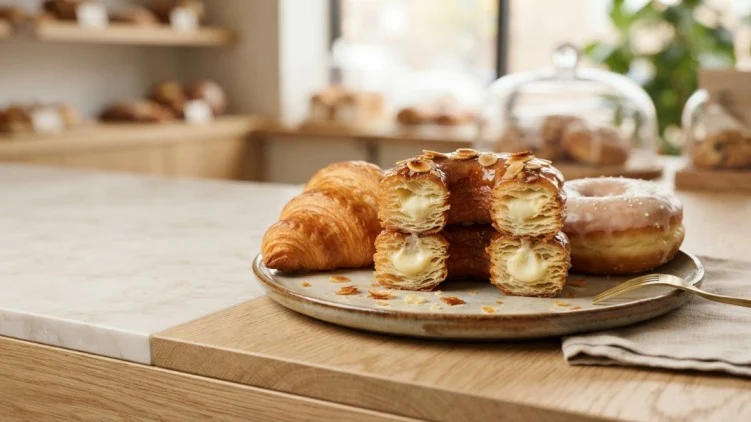
A cronut is a pastry that combines features of a croissant and a doughnut. It is flaky like a croissant but shaped and prepared like a doughnut.
The word cronut is a blend of croissant + doughnut.
One bite can turn two favorite pastries into something completely new. That is the simple idea behind the cronut. A cronut is a popular pastry made from laminated, flaky dough that is shaped like a doughnut and usually filled, glazed, or topped with sweet ingredients. The name itself is a playful blend of croissant and doughnut.
If you are a food lover, student, writer, traveler, baker, social media user, or simply someone who came across the word online, knowing the cronut meaning can help you understand menus, food posts, recipes, and casual conversations. The term is strongly linked with modern pastry culture and became famous because of its unusual texture and creative flavors. From bakeries to social media, the cronut has become more than a dessert. It is also an example of how food trends can create entirely new words and experiences.
Definition & Meaning
The cronut meaning is quite easy to understand. A cronut is a pastry that combines characteristics of a croissant and a doughnut.
The word cronut is a portmanteau, which means a new word formed by combining parts of two existing words.
In this case:
Croissant + Doughnut = Cronut
A traditional cronut has layers of dough similar to a croissant. The dough is laminated, meaning butter is folded into it repeatedly to create thin layers. The pastry is then shaped into a ring and cooked in a way that gives it a doughnut-like appearance.
Cronuts are often finished with:
- Cream or custard filling
- Glaze
- Sugar
- Chocolate
- Fruit flavors
- Caramel
- Frosting
- Other pastry toppings
Simple example
Person A: “What did you order?”
Person B: “A cronut.”
Person A: “What is that?”
Person B: “It is basically a croissant and doughnut combined.”
The term does not simply mean “a doughnut made with croissant dough” in every possible recipe. Different bakeries may create their own versions, and the exact preparation can vary.
What makes a cronut different?
A normal doughnut is usually softer and breadier or cakier. A croissant is known for its flaky layers and buttery texture.
A cronut aims to bring some of these qualities together.
You get a pastry with:
Flaky layers + doughnut shape + sweet filling or topping = cronut
The name is now widely recognized in food culture, especially among people interested in pastries, bakery trends, and creative desserts.
Background & History
The story behind the cronut is one of the most interesting parts of its meaning.
The pastry became famous after French pastry chef Dominique Ansel introduced the Cronut in New York City in 2013. It was created at his bakery and quickly attracted huge public attention.
The pastry was unusual because it combined two familiar ideas into one product. People already knew croissants and doughnuts, but putting their characteristics together created something that felt new.
The original Cronut quickly became a major food trend.
People began waiting in line to buy them. News outlets covered the craze, food bloggers wrote about it, and social media helped spread photographs of the pastry around the world.
Why did it become so popular?
Several factors helped.
First, the concept was easy to understand.
Croissant + doughnut immediately tells you what makes the pastry special.
Second, the pastry looked attractive. Its layered structure, fillings, glaze, and toppings made it highly shareable online.
Third, the bakery introduced new flavors over time. This encouraged customers to return and try different versions.
The trademark issue
There is also an important detail about the word Cronut.
The name became associated with Dominique Ansel’s creation, and the term has been protected as a trademark. As a result, other bakeries may sell pastries that are inspired by the same concept but use different names.
You may therefore see terms such as:
- Croissant doughnut
- Croissant-doughnut
- Croissant ring
- Layered doughnut
The general pastry concept can be recreated, but the specific name Cronut has a strong connection to the original creation.
Today, the cronut remains a well-known example of modern food innovation and culinary branding.
Usage in Various Contexts
The word cronut is mainly used in food-related conversations, but its popularity has allowed it to appear in many settings.
In casual conversations
People may simply use the word to describe what they are eating.
Sara: “Want anything from the bakery?”
Mike: “Yes. Get me a cronut if they still have one.”
The listener usually understands that the person means a pastry.
In restaurants and bakeries
You may see the term on menus or bakery displays.
Customer: “What is the cronut filled with?”
Baker: “Today’s version has vanilla cream and a chocolate glaze.”
On social media
Food photos often use the word in captions and hashtags.
“Finally tried a cronut today. The layers are amazing!”
Food creators may use cronut when reviewing pastries or showing bakery visits.
In texting
The word does not usually function as internet slang. It keeps its normal food meaning.
Friend 1: “What are you bringing to brunch?”
Friend 2: “Cronuts!”
Friend 1: “Okay, now I’m definitely coming.”
In food writing
Food writers may use cronut when discussing:
- Pastry trends
- Bakery culture
- Food innovation
- Fusion desserts
- Culinary branding
- Viral foods
The meaning stays consistent, but the tone changes according to the setting.
Common Misconceptions & Clarifications
The cronut has a simple name, but several misconceptions surround it.
Misconception 1: A cronut is just a doughnut
Not exactly.
Although it has a doughnut-like shape, a cronut is known for its laminated, flaky pastry layers.
A standard doughnut does not usually have the same layered structure.
Misconception 2: Every croissant-shaped doughnut is a Cronut
This is another common misunderstanding.
The word Cronut specifically refers to the branded pastry associated with its creator. Other bakeries may produce similar pastries under different names.
Misconception 3: Cronut means any croissant with a hole
No.
The name refers to a particular pastry concept, not simply the shape.
A regular croissant cut into a ring would not automatically become a cronut.
Misconception 4: Cronuts are always filled with cream
Not necessarily.
Fillings and toppings can vary.
A cronut might contain:
- Pastry cream
- Fruit filling
- Chocolate
- Caramel
- Vanilla cream
- Other seasonal flavors
Misconception 5: The word is internet slang
Usually, no.
Unlike abbreviations such as “LOL” or “BRB,” cronut is a food term.
If someone uses it in a text message, they are generally talking about the pastry.
Similar Terms & Alternatives
Several words can appear similar to cronut, especially when people describe hybrid pastries.
| Term | Meaning |
|---|---|
| Cronut | A pastry combining croissant-like layers with a doughnut-style form |
| Croissant | A flaky, crescent-shaped French-style pastry |
| Doughnut | A fried or baked sweet pastry, often ring-shaped |
| Croissant doughnut | A descriptive name for a pastry combining these styles |
| Doughssant | A name sometimes used for a similar croissant-doughnut concept |
| Pastry | A broad category that includes many baked or laminated products |
| Hybrid dessert | A general term for a dessert combining different food concepts |
Cronut vs. croissant
A croissant is traditionally crescent-shaped and known for buttery layers.
A cronut has a ring-like doughnut shape and is often filled or glazed.
Cronut vs. doughnut
A doughnut generally has a soft or cakey texture, depending on its type.
A cronut is known for its flaky laminated layers.
These differences are why the cronut has its own identity.
How to Respond to This Term
If someone says cronut in a conversation, your response depends on the situation.
Casual response
“I have heard of them, but I’ve never tried one.”
This is a simple way to continue the conversation.
Curious response
“What does it taste like compared with a normal doughnut?”
This invites the other person to explain the texture and flavor.
Funny response
“So the croissant and doughnut finally decided to work together?”
This works well in a friendly conversation.
Food-lover response
“That sounds amazing. What flavor did you get?”
This keeps the conversation focused on the food.
If you do not know the word
You can simply ask:
“What exactly is a cronut?”
There is nothing unusual about asking. The word is a blend of two familiar pastry names, so its meaning may not be obvious to everyone.
Regional or Cultural Differences
The word cronut is strongly connected with modern American food culture, particularly because of its rise to fame in New York City.
However, the concept of combining familiar foods is not limited to one country.
Different cultures have long created hybrid foods by combining:
- Ingredients
- Cooking methods
- Shapes
- Traditional recipes
- International influences
The word itself is most familiar in English-language food culture.
In the United States
The cronut became famous as a major bakery trend and is closely associated with New York’s food scene.
In the United Kingdom
People generally understand the term, especially in cities with international food trends. You may also see descriptive terms such as croissant doughnut.
In other countries
The concept may be recognized even when the English word is less common. Bakeries may translate or describe the pastry instead of using the trademarked term.
This is an important distinction:
The food concept can travel across cultures, while the specific name may remain tied to its original branding.
Comparison with Similar Terms
Understanding similar pastry names can prevent confusion.
| Feature | Cronut | Croissant | Doughnut |
|---|---|---|---|
| Basic concept | Hybrid pastry | Laminated pastry | Sweet pastry |
| Shape | Usually ring-shaped | Usually crescent-shaped | Often ring-shaped |
| Texture | Flaky and layered | Flaky and layered | Soft, cakey, or chewy |
| Typical toppings | Glaze, cream, sugar | Often plain or lightly topped | Glaze, sugar, frosting |
| Name origin | Croissant + doughnut | French pastry name | English pastry term |
| Famous for | Hybrid design | Buttery layers | Wide variety of flavors |
Why the comparison matters
A person unfamiliar with the term may assume a cronut is simply a fancy doughnut.
The comparison shows why it is different.
Its main appeal comes from combining the layered structure associated with a croissant with the shape and sweet presentation associated with a doughnut.
Usage in Online Communities & Dating Apps
The word cronut occasionally appears in online communities, especially those focused on food, travel, lifestyle, baking, and restaurant recommendations.
On platforms such as Tinder, someone might mention food preferences in a profile or conversation.
For example:
Match: “Coffee, museums, and cronuts are my weekend essentials.”
You: “The cronut part definitely got my attention.”
In food communities, people may discuss:
- Best pastry shops
- New flavors
- Bakery trends
- Food photography
- Recipes
- Travel experiences
On gaming communities, the word is less common unless players are discussing food, memes, or jokes.
Online communication tips
If someone mentions a cronut, context usually makes the meaning clear.
You can respond naturally:
“Have you tried the original one?”
or:
“Which flavor do you recommend?”
There is normally no hidden slang meaning to worry about.
Hidden or Offensive Meanings
The word cronut does not normally have a hidden offensive, sexual, or insulting meaning.
It is primarily a food term.
If someone uses the word jokingly online, the joke usually depends on the situation rather than a secret definition.
For example:
“That cronut disappeared faster than my paycheck.”
This is simply humor about enjoying the pastry.
Context still matters
Online communities sometimes create unusual slang from ordinary words. If you see cronut used in a strange sentence, the surrounding conversation matters.
But without special context, the safest interpretation is the ordinary one:
Cronut = a croissant-doughnut pastry.
The word should not automatically be interpreted as slang just because it appears in a casual text or social media post.
Suitability for Professional Communication
The word cronut is perfectly suitable in professional communication when the topic is food.
For example:
“The bakery introduced a new cronut flavor this month.”
This is appropriate for:
- Food blogs
- Restaurant reviews
- Marketing
- Bakery menus
- Culinary articles
- Business reports about food trends
- Social media marketing
However, if you are writing formal business content, it can help to explain the term the first time you use it.
For example:
“The bakery introduced a cronut, a pastry combining croissant-style layers with a doughnut-like shape.”
After that, simply using cronut is clear.
Professional alternatives
If the audience may not know the word, you can use:
- Croissant-doughnut pastry
- Croissant-style doughnut
- Laminated doughnut pastry
- Croissant and doughnut hybrid
These descriptions can be useful in technical or explanatory writing.
Still, cronut is the simplest and most recognizable term for the specific pastry concept.
FAQs
1. What does cronut mean?
Cronut means a pastry that combines features of a croissant and a doughnut. The name comes from croissant + doughnut.
2. Is a cronut a croissant or a doughnut?
It is a hybrid pastry with characteristics of both. It typically has flaky, layered dough and a doughnut-like shape.
3. Who invented the cronut?
The Cronut was created by pastry chef Dominique Ansel and introduced at his New York bakery in 2013.
4. Why is it called a cronut?
The name is a combination of croissant and doughnut.
5. Is cronut a slang word?
Usually, no. Cronut is primarily a pastry name, not common internet slang.
6. Are all croissant doughnuts called cronuts?
No. Cronut is a specific name associated with the original pastry, while similar products may use descriptive names such as croissant doughnut.
7. What does a cronut taste like?
A cronut can taste buttery and flaky like a croissant while also having the sweet fillings, glaze, or toppings often associated with a doughnut.
Conclusion
The cronut meaning is simple but surprisingly interesting. A cronut is a pastry that combines the flaky, layered qualities of a croissant with the shape and sweet style of a doughnut. Its name is a clever blend of croissant and doughnut.
The pastry became famous after Dominique Ansel introduced the original Cronut in New York in 2013, turning a creative food idea into a worldwide trend. Today, people may mention cronuts in bakery conversations, food reviews, social media posts, travel discussions, and casual texts.
Remember that Cronut is primarily a food term, not internet slang. Similar pastries may have different names, and the exact recipe can vary. Once you know the basic idea, the word is easy to understand: two classic pastry concepts combined into one flaky, sweet, and highly recognizable treat.
Discover More Post:
What Does “Petite” Mean? Simple Definition & Examples in …
What Does “Cringe” Mean in Text, Slang & Social Media in 2026
What Does Soursop Mean and What Is This Fruit – Similixy.com