Quick answer:
Haptics means technology that uses touch or physical sensations to give you feedback from a device. Vibrations on a phone, controller, or smartwatch are common examples of haptic feedback.
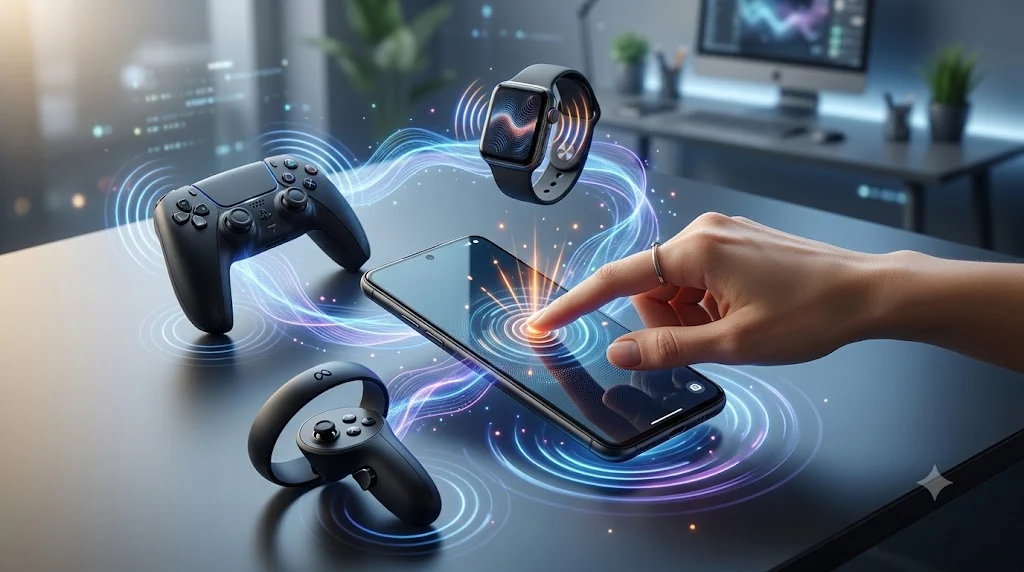
Your phone vibrates when you tap a button. Your game controller shakes when a car crashes. Your smartwatch gives a tiny tap when a notification arrives. These small sensations may feel ordinary, but they are examples of haptics.
So, what does haptics meaning actually describe? In simple terms, haptics is technology that lets a device communicate with you through the sense of touch. It can use vibrations, pressure, force, or other physical sensations to make digital interactions feel more real.
If you use smartphones, gaming consoles, smartwatches, VR headsets, or other modern devices, you have probably experienced haptics already. Understanding it helps you see how technology can communicate with more than just your eyes and ears.
What Does Haptics Mean
Haptics refers to technology that creates touch-based feedback during interaction with a digital device or system.
The word is connected to the Greek word “haptein,” associated with touching or coming into contact. In technology, haptics adds a physical sense to digital interaction.
The easiest example is your smartphone.
Imagine you tap a button and feel a small vibration under your finger. Your phone is giving you haptic feedback.
You might think:
“I tapped the button, and my phone vibrated.”
That vibration tells you:
“Your action was registered.”
Haptics can be very simple, such as a short vibration, or much more advanced. Some systems can create different sensations that represent pressure, movement, impact, resistance, or other physical experiences.
Simple Examples of Haptics
Here are some everyday examples:
- A phone vibrates when you type.
- A smartwatch taps your wrist for an alert.
- A gaming controller shakes when something happens in a game.
- A VR controller gives feedback when you touch a virtual object.
- A steering wheel becomes harder to turn during a racing game.
- A device provides a small vibration when you successfully complete an action.
So, when someone asks “What does haptics mean?”, the simplest answer is:
Haptics is technology that uses touch sensations to communicate information or respond to your actions.
What Is Haptic Feedback
Haptic feedback is the physical response you feel from a device after an action.
The word “haptic” describes the touch-based technology, while “haptic feedback” usually describes the sensation delivered to the user.
For example:
You: Tap a button.
Phone: Gives a tiny vibration.
Result: You feel that your action worked.
This makes the interface feel more responsive.
Haptic feedback can also be much stronger.
In a racing game:
You: Drive into a wall.
Controller: Vibrates or provides force feedback.
Result: You physically feel the impact.
That extra sensation can make digital experiences feel more connected to the real world. Haptic technology is used in smartphones, gaming, VR, training systems, healthcare, manufacturing, and other applications.
Haptics Meaning on a Phone
When you see “Haptics” in your phone settings, it usually relates to touch-based feedback.
For example, your phone may provide a small vibration when you:
- Type on the keyboard
- Press a button
- Toggle a setting
- Perform certain gestures
- Receive an alert
- Interact with an interface
The exact features depend on the phone and operating system.
The purpose is simple: your phone uses touch to confirm or communicate something.
Imagine typing a message.
Without haptics, you only see the letters appear on the screen.
With haptics, you may also feel a tiny response as you press each key.
That extra feedback can make the keyboard feel more physical even though the screen itself is flat.
Haptics Meaning in Gaming
Gaming is one of the clearest examples of haptic technology.
A controller can vibrate when your character is hit, a vehicle crashes, a weapon fires, or another important event happens.
For example:
Player: “My car just crashed.”
Controller: Rumbles strongly.
That vibration gives the player a physical clue about what is happening on screen.
Advanced gaming systems can go beyond simple vibration. Force feedback can create resistance or physical pressure. For example, a racing wheel may become harder to turn when the virtual car encounters resistance.
This makes the game feel more immersive because the player is not only seeing the event but also feeling a response.
Haptics Meaning in VR
Haptics are especially important in virtual reality.
VR creates a digital environment that looks and feels like another space. Haptic technology can add the sense of touch to that environment.
For example, imagine picking up a virtual object.
Without haptics:
You see the object move.
With haptics:
You see the object move and feel a physical response through a controller or wearable device.
Some advanced systems use gloves, controllers, or other wearable devices to provide tactile sensations. Haptic feedback can help make virtual objects and interactions feel more realistic.
This is why haptics is often discussed alongside VR, AR, gaming, and immersive technology.
How Does Haptic Technology Work
The basic idea is easier than it sounds.
A haptic system usually detects an action and then creates a physical response.
The process can look like this:
You perform an action → the system detects it → software processes it → a haptic device creates a sensation → you feel the response.
A smartphone, for example, may detect that you pressed a virtual button. The device then activates a small actuator that produces a vibration.
Different technologies can create different sensations.
Vibrotactile Feedback
This is the most familiar type.
It uses vibrations to communicate information. Smartphones, controllers, and wearable devices commonly use this approach.
Force Feedback
Force feedback creates a sense of resistance or physical force.
A gaming steering wheel is a good example. The wheel can resist your movement to simulate driving conditions.
Thermal Feedback
Some advanced systems can simulate sensations related to heat or cold.
Kinesthetic Feedback
This type focuses on sensations related to movement, force, size, or physical interaction.
Not every device uses all these forms. Most everyday users mainly experience simple vibration-based haptics.
Haptics vs. Vibration: Are They the Same
Not exactly.
Vibration is one form of haptic feedback, but haptics is a broader concept.
Think of it this way:
Haptics = the larger category
Vibration = one technique used within that category
For example, a phone’s small vibration is haptic feedback. But a sophisticated VR system that creates a sense of pressure or resistance can also use haptics without relying only on simple vibration.
So saying “haptics means vibration” is an easy shortcut, but it does not explain the whole concept.
Types of Haptic Technology
Haptic systems can appear in different forms.
Touchable Haptics
These are found in devices you physically touch, such as smartphones and other interactive screens.
A small vibration after tapping a button is a common example.
Wearable Haptics
Wearable devices can send touch signals through the body.
A smartwatch that gives a small tap on your wrist is a simple example.
More advanced wearable systems can use gloves, wrist devices, or specialized equipment.
Graspable Haptics
This involves devices that you hold.
Gaming controllers and joysticks are common examples.
Haptic Wearables in VR
VR gloves and other wearable systems can provide tactile feedback during virtual interactions.
These technologies can help users feel more connected to digital environments.
Why Is Haptics Important
Haptics matters because humans naturally use touch to understand the physical world.
A digital screen usually gives you visual information. Sound can provide another layer. Haptics adds physical feedback.
This can improve several areas.
Better User Experience
A small vibration can tell you that an action worked without requiring another visual message.
More Immersive Gaming
Haptic feedback can make game events feel more physical.
More Realistic VR
Touch sensations can make virtual interactions feel more believable.
Training and Simulation
Haptic systems can help people practice tasks in simulated environments. They are used in areas such as healthcare, manufacturing, aviation, and other training applications.
Accessibility
Haptic signals can also provide information through touch, which can be useful when visual or audio feedback is not enough. Haptic technology has applications that include accessibility and tactile communication.
Haptics in Everyday Life
You may use haptic technology more often than you realize.
Here are some familiar situations:
Your phone:
A small vibration confirms a touch or notification.
Your smartwatch:
A gentle tap alerts you without a loud sound.
Your game controller:
The controller shakes during important game events.
Your car:
Some modern systems can use tactile signals to alert drivers.
Your VR system:
Controllers can provide feedback when interacting with virtual objects.
This means haptics is not just futuristic technology. It is already part of everyday digital life.
Common Misconceptions About Haptics
Haptics Only Means Phone Vibration
This is the most common misunderstanding.
Phone vibration is an example of haptics, but haptic technology can also involve force, pressure, movement, and other tactile sensations.
Haptics Is Only for Gaming
Gaming uses haptics heavily, but it is not the only industry that uses it.
Haptic technology is also used in healthcare, training, manufacturing, aviation, VR, and other applications.
Haptics Means You Can Literally Feel a Virtual Object
Not always.
Haptic systems can simulate certain physical sensations, but they do not necessarily create a perfect physical copy of the object.
Haptics and Touchscreens Are the Same
They are related but different.
A touchscreen detects your touch. Haptics can provide feedback after or during that interaction.
Haptics in Professional and Medical Settings
Haptics has applications beyond consumer electronics.
In healthcare training, haptic systems can help trainees practice procedures in simulated environments. The technology can provide physical feedback while a person interacts with a virtual or simulated system.
This can be useful because some professional skills depend heavily on hand movement, pressure, and physical control.
Haptic systems are also used in areas such as manufacturing and aviation training. Instead of learning only from a screen or manual, users can interact with simulations that provide tactile responses.
The goal is not simply to make technology entertaining. It can also make digital training more interactive and realistic.
Advantages and Disadvantages of Haptics
Haptic technology offers several benefits, but it also has limitations.
| Advantages | Disadvantages |
|---|---|
| Makes interfaces feel more responsive | Can use additional battery power |
| Improves gaming immersion | Advanced systems can be expensive |
| Adds another form of feedback | Poorly designed feedback can become annoying |
| Can support accessibility | Hardware can be complex |
| Helps create realistic simulations | Some sensations are difficult to reproduce |
Advanced haptic systems can also face technical challenges involving hardware, connectivity, accuracy, and cost.
Is Haptics Good or Bad
Haptics itself is neither good nor bad. Its value depends on how it is designed and used.
A short vibration after pressing a button can be helpful because it confirms your action.
But constant or poorly timed vibrations can become distracting.
For example:
Helpful:
Tap → small vibration → action confirmed.
Annoying:
Every tiny interaction → strong vibration.
Good haptic design should provide useful information without overwhelming the user.
FAQs
What does haptics mean in simple words?
Haptics means using touch sensations to communicate information or respond to actions in a digital or electronic system.
What is an example of haptics?
A phone giving you a small vibration when you tap a button is a simple example of haptic feedback.
Does haptics mean vibration?
Vibration is one type of haptic feedback, but haptics is a broader term that can also include force and other tactile sensations.
What does haptics mean on a phone?
On a phone, haptics usually refers to touch-based feedback, such as small vibrations when typing, tapping buttons, or interacting with certain features.
What does haptics mean in gaming?
In gaming, haptics provides physical feedback through a controller or other device. It may simulate impacts, movement, or other events in the game.
What is haptic feedback in VR?
Haptic feedback in VR provides physical sensations that can make virtual interactions feel more realistic. Controllers and wearable devices are common ways to deliver it.
Is haptic technology only used for entertainment?
No. Haptics is also used in areas such as healthcare training, manufacturing, aviation, robotics, and other professional applications.
Conclusion
The haptics meaning is simple once you connect it to something you already know: touch-based feedback from technology. Every time your phone gives a tiny vibration, your smartwatch taps your wrist, or your gaming controller shakes during an action, you may be experiencing haptics.
Haptics can be as simple as a vibration or as advanced as force feedback and tactile sensations in VR. It helps digital systems communicate with users through touch instead of relying only on screens and sounds.
Today, haptic technology appears in smartphones, gaming devices, wearables, virtual reality systems, training simulations, and professional equipment. Its purpose is often to make technology feel more responsive, immersive, and natural.
So, the next time your device gives you a tiny tap or vibration, remember that it is more than just a random buzz. It is technology using touch to communicate with you.
Read More Related Articles:
IG Meaning in Text Messages | Definition, Uses, and Real …
What Is OML in Text | Meaning, Examples, Snapchat, TikTok …
What It Really Means in Messages and Online Chats